
Why Your Staircase Deserves a Seamless Transition
Baseboard stairs trim transition is the key to eliminating unsightly gaps where your staircase meets your wall trim. Here’s what you need to know:
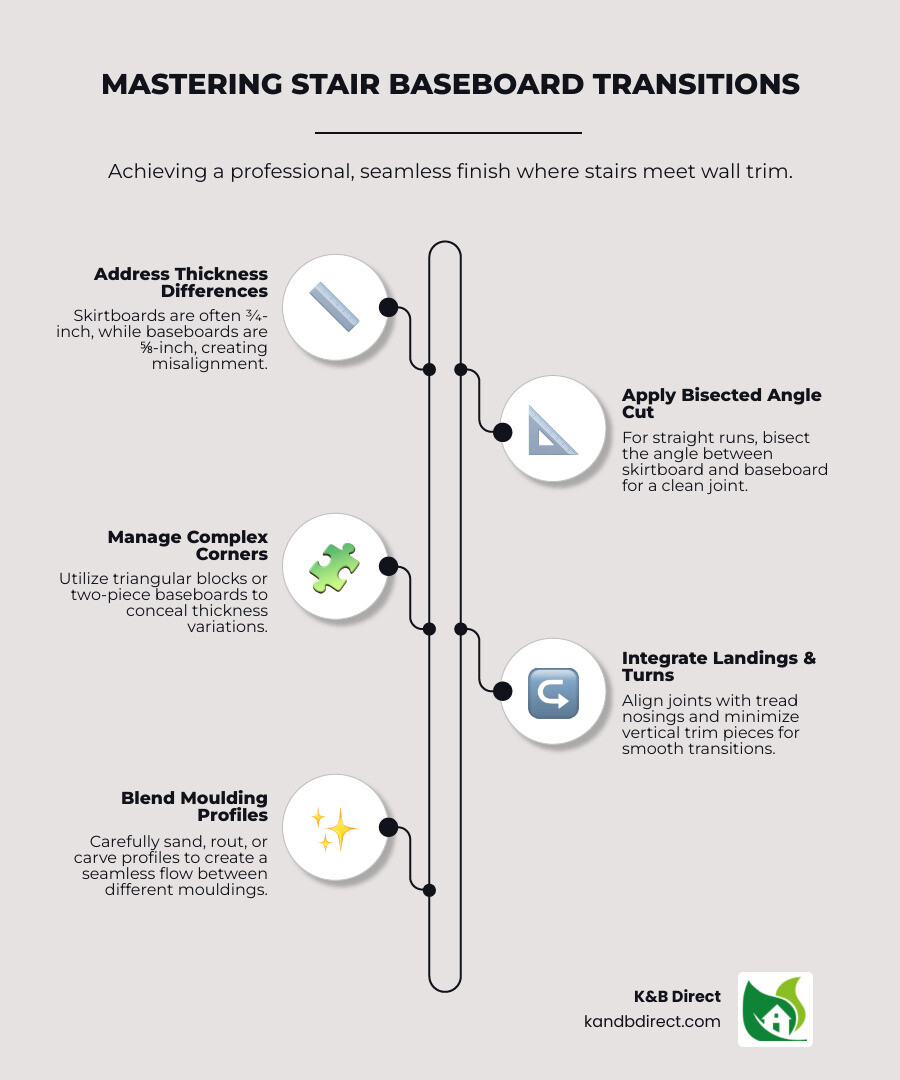
- The Challenge: Stair skirtboards are typically ¾-inch thick while baseboards are often ⅝-inch, creating awkward misalignments
- The Classic Solution: Bisect the angle between the skirtboard and baseboard for a structurally logical, visually pleasing joint
- For Complex Corners: Use triangular blocks or two-piece baseboards to hide thickness differences
- For Landings: Align joints with tread nosings and minimize vertical trim sections
- When Profiles Don’t Match: Sand, rout, or carve profiles to blend seamlessly rather than using bulky plinth blocks
If you’ve ever noticed an awkward gap or clunky joint where your stairs meet the wall, you’re not alone. As one carpenter recently asked a colleague: “What’s the best way to handle the transition from a finished stair stringer to the baseboard, especially when the skirtboard ends near a corner?” It’s a question that reveals one of the trickiest challenges in trim carpentry—creating a clean, professional transition between two different pieces of trim that meet at different angles and thicknesses.
The good news? There are proven techniques that professional carpenters use to make these transitions look intentional and beautiful. Whether you’re dealing with a simple staircase in a hallway or a highly visible entrance that guests see first, the right approach transforms what could be an eyesore into a polished detail that improves your home’s overall aesthetic.
I’m Eryk Piatkowski, Owner at K&B Direct, and over the past decade I’ve helped countless homeowners steer the complexities of baseboard stairs trim transition projects, ensuring they achieve professional results with quality materials. This guide will walk you through everything you need to know to get it right.
Understanding the Core Challenge: Why Transitions Get Tricky
When we talk about a baseboard stairs trim transition, we’re addressing a common pain point in finish carpentry. The main goal is to create a seamless visual flow where the baseboard running along a wall meets the skirtboard (also known as a stringer) of a staircase. This often presents several common challenges:
- Varying Thicknesses: Skirtboards and baseboards often come in different thicknesses, making a flush, clean joint difficult.
- Profile Mismatches: The decorative profiles on the top edges of skirtboards and baseboards may not align perfectly.
- Angles, Angles, Angles: Stairs are inherently angled, while baseboards are typically level, requiring precise angle cuts.
- Visibility: In high-visibility areas like a front entrance, any imperfection in the transition can stand out.
Imagine a beautiful new staircase in your home. You want the trim work to be just as stunning as the stairs themselves. But without careful planning and execution, that crucial meeting point can become an “awkward gap” rather than a polished detail.
The Impact of Material Thickness
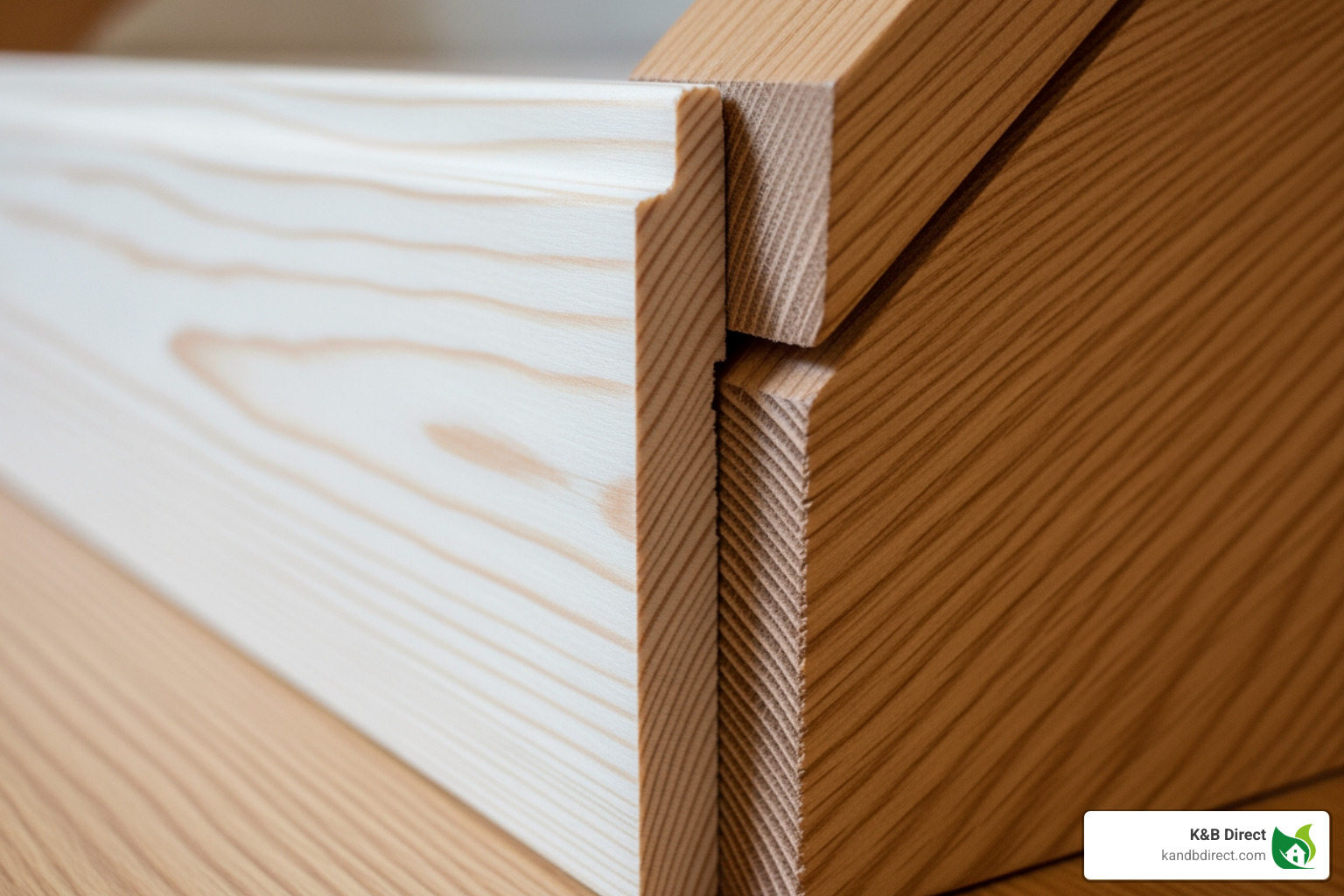
One of the most frequent dilemmas we encounter is the difference in material thickness. It’s quite common for a stair skirtboard to be 0-inch thick, while the accompanying baseboard might be a slightly thinner 5-inch. This seemingly small difference can create significant visual and structural challenges. If we simply butt the thinner baseboard against the thicker skirtboard, we’re left with an uneven surface, an unsightly ledge, and a joint that just doesn’t look “right.”
Achieving flush joints becomes a puzzle when thicknesses vary. Sometimes, a slight “reveal” (where one piece of trim slightly overlaps another) can be intentional and attractive, but it needs to be carefully planned. Without it, the difference in thickness can appear accidental and detract from the overall finish.
Matching and Blending Moulding Profiles
Beyond just thickness, the profiles the decorative shapes on the top edges of baseboards and skirtboards are critical. Often, the base cap molding that runs along the top of a baseboard needs to meet a similar cap under the skirtboard. If these profiles don’t align, or if the skirtboard’s raked (angled) profile doesn’t blend smoothly into the baseboard’s level profile, the transition looks disjointed.
For a truly professional finish, especially with intricate profiles, we might need to resort to some specialized techniques. This could involve carefully carving, routing, or sanding the profiles to ensure they flow seamlessly into each other, rather than just forcing them together. This meticulous work ensures that the aesthetic continuity is maintained, enhancing the beauty of your trim throughout your home.
The Carpenter’s Secret: Mastering Angles for a Flawless Baseboard Stairs Trim Transition
The cornerstone of a beautiful baseboard stairs trim transition lies in mastering the angles. It’s not just about cutting to fit; it’s about understanding the “structural logic” that makes a joint visually harmonious and pleasing to the eye. For us, this means precise measurements, thoughtful cuts, and a deep understanding of different pieces of trim interact.
The Classic Bisected Angle: The ‘Why’ and the Process
The traditional and often most aesthetically pleasing method for joining a stair skirtboard to a baseboard is to bisect the angle between them. This approach mirrors structural principles found in architecture, like diagonal members in a bridge efficiently transfer loads. This inherent structural logic lends a sense of stability and correctness to the joint.
When we bisect the angle, we’re essentially creating two equal angles that meet at the joint. This ensures that the visual flow is transferred smoothly and offers equal bearing surfaces, making the connection appear strong and intentional. Furthermore, this method, when combined with a 45-degree miter, ensures that the profiled top edges of both the baseboard and the skirtboard align effectively.
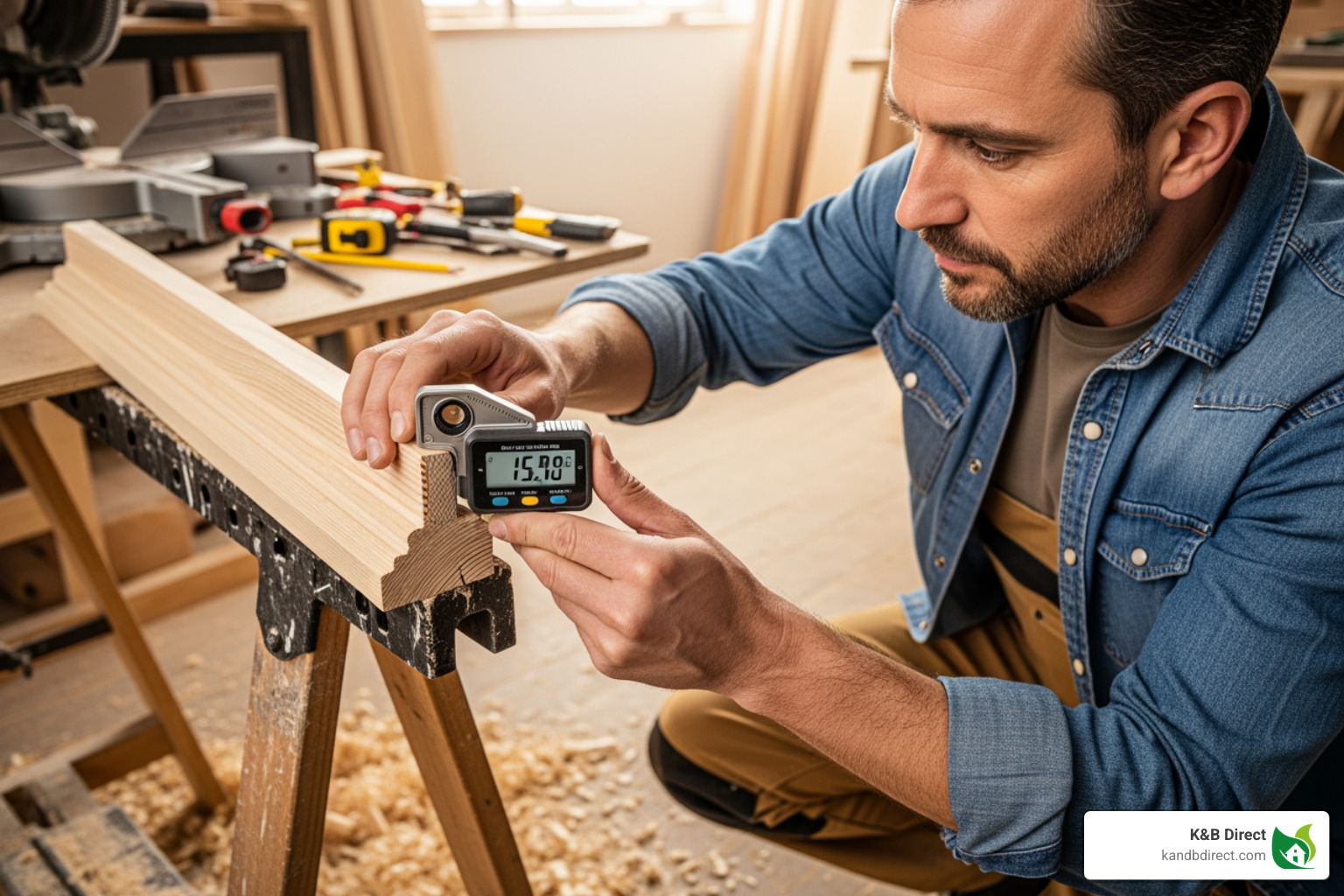
To calculate the miter angle, we first measure the total angle where the skirtboard meets the baseboard. If, for instance, we measure an angle of 127 degrees, bisecting it gives us 63.5 degrees. On a miter saw, the angle would be set to 90 degrees minus 63.5 degrees, resulting in a 26.5-degree setting. This precision is vital for that flawless fit. For additional insights on woodworking techniques, the Fine Homebuilding resource offers extensive guidance on trim carpentry.
Executing the Cut for a Precise Fit
Executing these cuts requires patience and accuracy. Here’s an effective approach:
- Marking the Boards: Carefully mark the exact point where the baseboard and skirtboard will meet, taking into account any reveals or profile matching.
- Setting the Miter Saw: Using the bisected angle calculation, set the miter saw to the precise angle needed.
- Test Fitting: Before making the final cut on the good material, perform a test fit with scrap pieces. This allows for any micro-adjustments to the angle or length.
- Making Adjustments: Even with careful measurement, walls can be out of square. A slight adjustment to the angle may be needed to accommodate these real-world imperfections.
- Securing the Joint: Once the fit is right, secure the joint using finish nails and a strong wood adhesive, ensuring a durable and seamless connection.
For more in-depth techniques on these transitions, many professionals refer to trusted trade resources that offer valuable insights into the intricacies of this craft.
Advanced Solutions for Complex Scenarios
Not all baseboard stairs trim transition points are straightforward. Sometimes, we encounter complex scenarios such as close corners, outside corners, inside corners, or unique stair landings. These situations demand more advanced techniques to maintain that seamless, professional finish.
Method 1: The Triangular Block
When you have a thicker skirtboard meeting a thinner baseboard, and you want to maintain the distinct base cap profiles, the triangular block method offers a neat solution. This approach allows the base cap under the skirtboard and the base cap of the baseboard to terminate independently, creating a visually clean stop.
Heres a typical implementation:
- Create the Block: Cut a small triangular block of wood, usually from the same stock as the skirtboard, and fit it flush against the bottom edge of the skirtboard. This block effectively extends the skirtboard’s thickness to accommodate the base cap.
- Terminate Base Cap: The base cap from the skirtboard then cleanly terminates into this triangular block.
- Install Baseboard: Install the baseboard behind the triangular block, allowing for a slight, intentional reveal. This creates a distinct, layered look that handles the thickness difference gracefully.
- Independent Termination: The base cap of the baseboard can then terminate into the wall or return on itself, without interfering with the skirtboard’s cap.
This method is particularly effective in situations where a 0-inch skirtboard transitions into a 5-inch one-piece baseboard, preventing the awkwardness of trying to force two different caps to meet imperfectly.
Method 2: The Two-Piece Baseboard
Another solution for managing thickness discrepancies, especially when dealing with a wider skirtboard, is to use a two-piece baseboard. This involves constructing a custom baseboard from thicker stock to match the skirtboard’s depth.
An effective approach is as follows:
- Match Thickness: Create a two-piece baseboard using 0-inch stock (or whatever matches the skirtboard) for the section adjacent to the stair. This ensures a flush connection with the skirtboard.
- Transition at an Inside Corner: Transition this custom, thicker baseboard to a standard, thinner baseboard (often referred to as “speed base”) at an inside corner. Inside corners are excellent for hiding transitions because the change in thickness is less noticeable. This allows you to maintain a consistent look around the stairs while seamlessly integrating with the standard baseboard profile elsewhere in the room.
This method is ideal when the transition point itself is highly visible, but you have an adjacent inside corner where the change in baseboard thickness can be discreetly introduced.
Handling a baseboard stairs trim transition at landings and corners
Stair landings, especially those that wrap around outside or inside corners, present their own unique challenges for baseboard stairs trim transition. The goal is to maintain continuity and a clean appearance, minimizing any vertical trim sections that can look out of place.
- Wrapping Outside Corners: For a landing that wraps an outside corner, ensure the trim levels off with the last tread above the landing. Turn the corner with a precise 45-degree bevel, extend it level, and then drop vertically to intersect the lower skirtboard. The angles where the trim meets the vertical drop are bisected for a clean joint.
- Navigating Inside Corners: For inside corners of a stair landing, the approach is similar but reversed. Align the trim joint with key stair elements, such as the tread nosing, to ensure visual consistency.
- Minimizing Vertical Trim: In all complex corner situations, aim to minimize the use of short vertical trim pieces. Instead, carefully measure and cut angles so that the trim flows smoothly, aligning joints with structural elements like the top tread nosing whenever possible. This results in a much more refined and intentional appearance.
Alternative Methods and Flooring Considerations
While precise angle cuts and custom trim pieces are often preferred methods for baseboard stairs trim transition, there are other solutions and considerations, especially when dealing with flooring transitions at the top or bottom of stairs.
When to Use a Plinth Block
A plinth block is a rectangular, often thicker, piece of trim typically used at the base of a door casing. While not specifically designed for stair transitions, it can sometimes be employed as a functional, albeit sometimes clunky, solution when baseboard and skirtboard profiles simply refuse to align, or when a carpenter is unsure of other methods.
It is generally best to use plinth blocks sparingly for stair transitions, as they can draw too much attention to the joint and look somewhat out of place unless they are supporting a vertical element, like a door frame. However, they can be a viable option if:
- Profiles Don’t Match: If the baseboard and skirtboard profiles are very different and blending them is not feasible.
- Supporting a Vertical Element: If the transition occurs at a point where a vertical element, like a newel post or a door jamb, naturally terminates, a plinth block can look more intentional.
Industry experts often note that plinth blocks can look clunky if theyre not supporting a vertical element, so the goal is always a solution that integrates seamlessly into the overall design.
Choosing the Right Flooring Transition Strip
Beyond the baseboard itself, the flooring at the top or bottom of your stairs also requires careful transition. Different types of transition strips are designed for specific scenarios, ensuring both a smooth flow and durability.
Here’s a quick guide to the most common types:
- T-Mold: Used when transitioning between two level, hard surfaces of the same height, such as hardwood to laminate, or tile to hardwood. The “T” shape bridges the gap neatly.
- Reducer: When transitioning between two hard surfaces that are uneven in height (e.g., thicker hardwood to thinner tile), a reducer provides a gentle slope, ensuring a safe and smooth transition.
- End Cap (Threshold/Baby Threshold/Square Nose): This strip is designed for transitions to carpet, exterior door thresholds (like a sliding glass door), or when a hard surface meets a vertical obstacle like a fireplace. It provides a clean, finished edge.
- Stair Nose (Stair Nosing/Bull Nose): Essential for the edge of steps, a stair nose conceals the exposed edge of the top step, improves safety, and gives a finished look to individual steps or an entire staircase. It’s shaped with a rounded or squared front edge.
To help you visualize, here’s a comparison:
| Transition Strip Type | When to Use It | Example |
|---|---|---|
| T-Mold | Two level, hard surfaces of equal height | Hardwood to Tile (same height) |
| Reducer | Two hard surfaces of uneven height | Hardwood (thicker) to Tile (thinner) |
| End Cap | Hard surface to carpet, exterior door, or vertical obstacle | Laminate to Carpet, Wood to Sliding Glass Door |
| Stair Nose | Edge of a step or an entire staircase | Top step of a staircase, individual stair treads |
Frequently Asked Questions about Stair Trim Transitions
Here are some of the most common questions about stair trim transitions:
What’s the best way to blend different baseboard and skirtboard profiles?
Blending different baseboard and skirtboard profiles is a hallmark of skilled trim carpentry. The best method is to carefully sand, rout, or carve the profile of the thicker piece to flow smoothly into the profile of the thinner piece, creating a custom, seamless transition. This requires a keen eye and steady hand but results in a far more integrated look than simply butting two mismatched profiles together. It’s about making the two pieces look like they were always meant to be one, rather than abruptly ending.
What is the ‘structural logic’ behind bisecting the angle?
The ‘structural logic’ behind bisecting the angle in baseboard stairs trim transition is rooted in our perception of stability and strength. When you bisect the angle between the angled skirtboard and the level baseboard, it creates a joint that appears strong and intentional, much like the way load-bearing components in bridge construction are angled. This approach provides equal bearing surfaces, ensuring that the visual line (and metaphorically, any “load”) is efficiently transferred. Our eyes instinctively find this balanced and symmetrical connection aesthetically pleasing, which is why it simply “looks right.”
What’s the solution when stairs end very close to a corner?
When stairs end very close to a corner, a standard mitered return might not be feasible or visually appealing due to the limited space. For these close corners, a common technique is to project a level line from the top tread onto the wall. Where this line intersects the skirtboard determines the point where the trim rises vertically to meet the baseboard. Then a short vertical piece of trim runs from this point up to the level baseboard. The angles between the angled skirtboard and this vertical piece, and between the vertical piece and the level baseboard, are bisected and mitered (often at 45 degrees to the level baseboard) to create a clean, tight turn. This approach minimizes any awkward gaps and maintains a polished look, even in tight spaces.
Achieve a Flawless Finish with Quality Mouldings
The journey to a perfect baseboard stairs trim transition is one of precision, patience, and choosing the right materials. We’ve explored various methods, from the classic bisected angle to advanced techniques like triangular blocks and two-piece baseboards, all designed to overcome the common challenges of varying thicknesses and profiles. We’ve also touched upon the essential flooring transition strips that complete the picture, ensuring every detail in your home, from the baseboard to the stair nose, is carefully finished.
A truly professional and aesthetically pleasing result hinges on the quality of the mouldings and trim you select. High-quality products that meet the highest standards of craftsmanship make it easier to achieve a cohesive and beautiful aesthetic throughout your home.
Don’t let awkward gaps detract from the beauty of your space. With the right techniques and well-made materials, your stair baseboard transitions can become a seamless, neat feature.
Explore a full collection of high-quality mouldings and millwork to find the perfect pieces for your next project.