
What Are Closet Door Parts Names? A Quick Reference Guide
Closet door parts names can be confusing — especially when you’re staring at a broken track or a wobbly door and have no idea what to call the piece you need.
Here are the core components you’ll find across the most common closet door systems:
| Part Name | Where It’s Found | What It Does |
|---|---|---|
| Top Track | Along the top of the door frame | Guides the door as it moves |
| Bottom Track / Sill Track | Along the floor | Keeps the door path stable |
| Rollers / Hangers | Attached to the top of the door | Allow the door to slide smoothly |
| Floor Guide | At the bottom center | Prevents side-to-side wobble |
| Top Pivot | Top corner of bi-fold door | Anchors and rotates the door |
| Bottom Pivot | Bottom corner of bi-fold door | Supports weight and rotation |
| Snugger | Inside bi-fold track | Holds the door tight when closed |
| Bumper | Edge of door or frame | Absorbs impact and reduces noise |
| Pull / Flush Pull | Door face | Used to open and close the door |
| Pivot Bracket | Track-mounted | Receives the pivot pin |
| Hinge | Between bi-fold door panels | Connects panels and allows folding |
Whether you’re replacing a single broken roller or rebuilding an entire bi-fold system, knowing these names is the first step.
Closet doors seem simple — until something goes wrong. A door that drags, wobbles, or refuses to close properly can turn a daily routine into a frustrating experience. The problem is that most homeowners don’t know the names of the individual parts, which makes troubleshooting and finding replacements much harder than it needs to be.
The good news? Closet door systems follow predictable patterns. Once you understand the anatomy — tracks, rollers, pivots, guides, and pulls — everything clicks into place. This guide walks you through every major component, organized by door type, so you can identify exactly what you’re looking at.
I’m Eryk Piatkowski, owner of K&B Direct, and with over a decade of hands-on experience helping homeowners and professionals select the right hardware and door systems, I’ve seen just about every closet door parts names question you can imagine. Understanding these components is the foundation for any successful renovation — and that’s exactly what we’ll cover here.
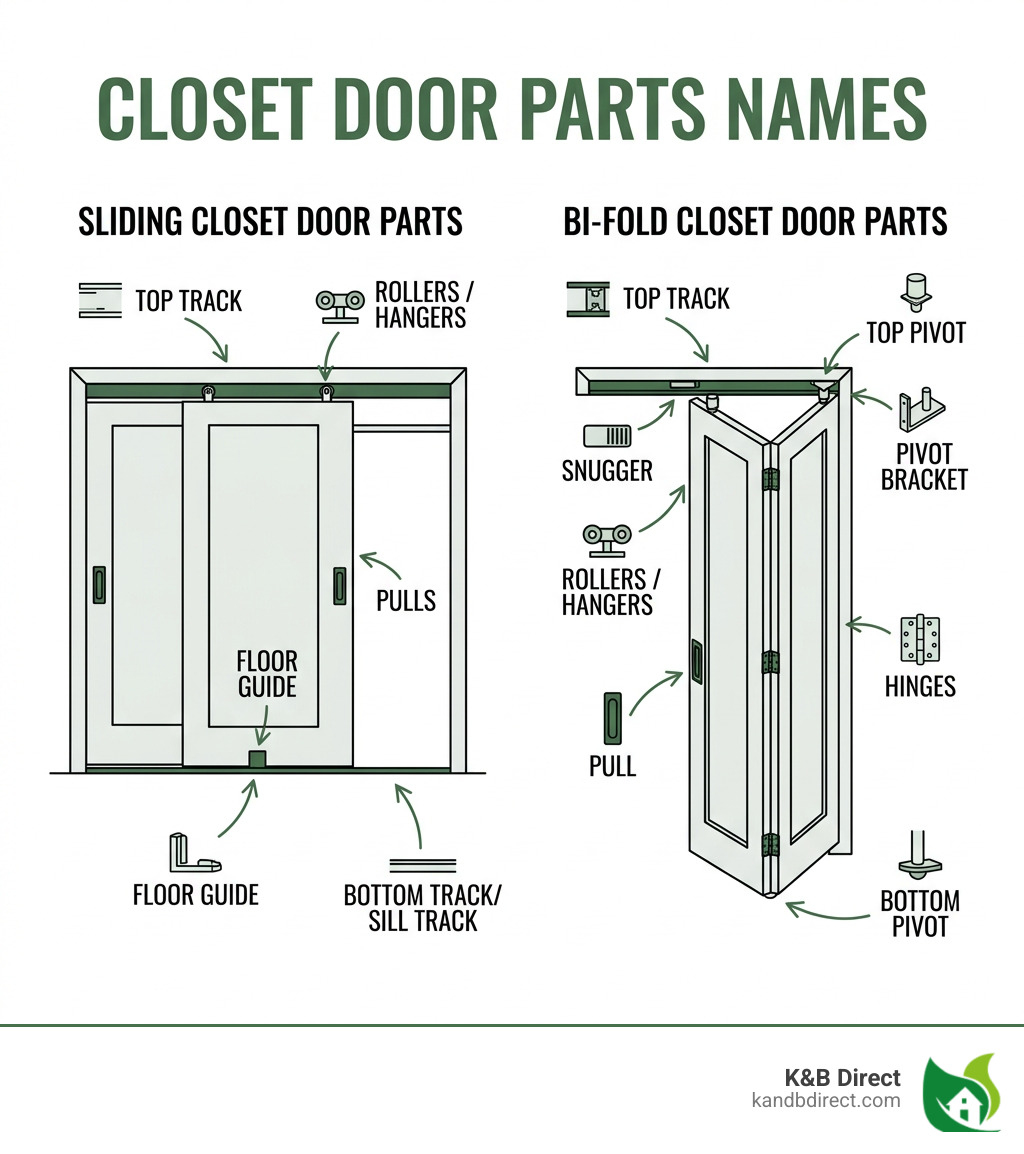
Know your closet door parts names terms:
Understanding the Main Types of Closet Door Systems
Before we dive into the specific closet door parts names, we need to look at the systems they belong to. In our experience serving the Chicago and Glen Ellyn areas, most homes utilize one of three primary configurations. Each system relies on a unique set of hardware to manage weight and movement.
Bi-Fold Doors
Bi-fold doors consist of two or more panels that fold in half as they slide along a track. These are incredibly popular in Illinois homes because they provide full access to the closet interior without requiring the wide swing radius of a traditional door. They rely heavily on pivot points and a top track. If you are looking for ways to maximize your floor plan, space-saving-closet-doors are often the best solution.
Bi-Pass (Sliding) Systems
Bi-pass doors feature two or more panels that slide parallel to each other. One door sits in front of the other, and they “pass” each other on separate tracks. This is a classic “wardrobe” style. While they don’t allow you to see the entire closet at once, they are excellent for tight hallways where a folding or swinging door would block traffic. For a deeper look at general door construction, you can explore this Door Parts Explained: Complete Guide to Door Anatomy.
Pocket Doors
A pocket door is a sliding door that disappears into a compartment in the adjacent wall when fully open. These are common in older Chicago bungalows and modern minimalist homes alike. Because the door is hidden, the hardware—specifically the track and hangers—is mounted inside the wall cavity.
Sliding Mechanisms and Pivot Points
The “magic” of any closet door lies in how it moves. Sliding mechanisms use rollers and tracks to distribute weight, while bi-fold systems use pivot points (stationary anchors) at the top and bottom corners of the door to allow for rotation and folding.
Essential Closet Door Parts Names for Sliding and Bypass Systems
Sliding and bypass systems are common in bedrooms across Lombard and Arlington Heights. Their operation is deceptively simple: wheels move inside a metal channel. However, when a door starts sticking, you need to know exactly which part has worn out.
The Top and Bottom Tracks
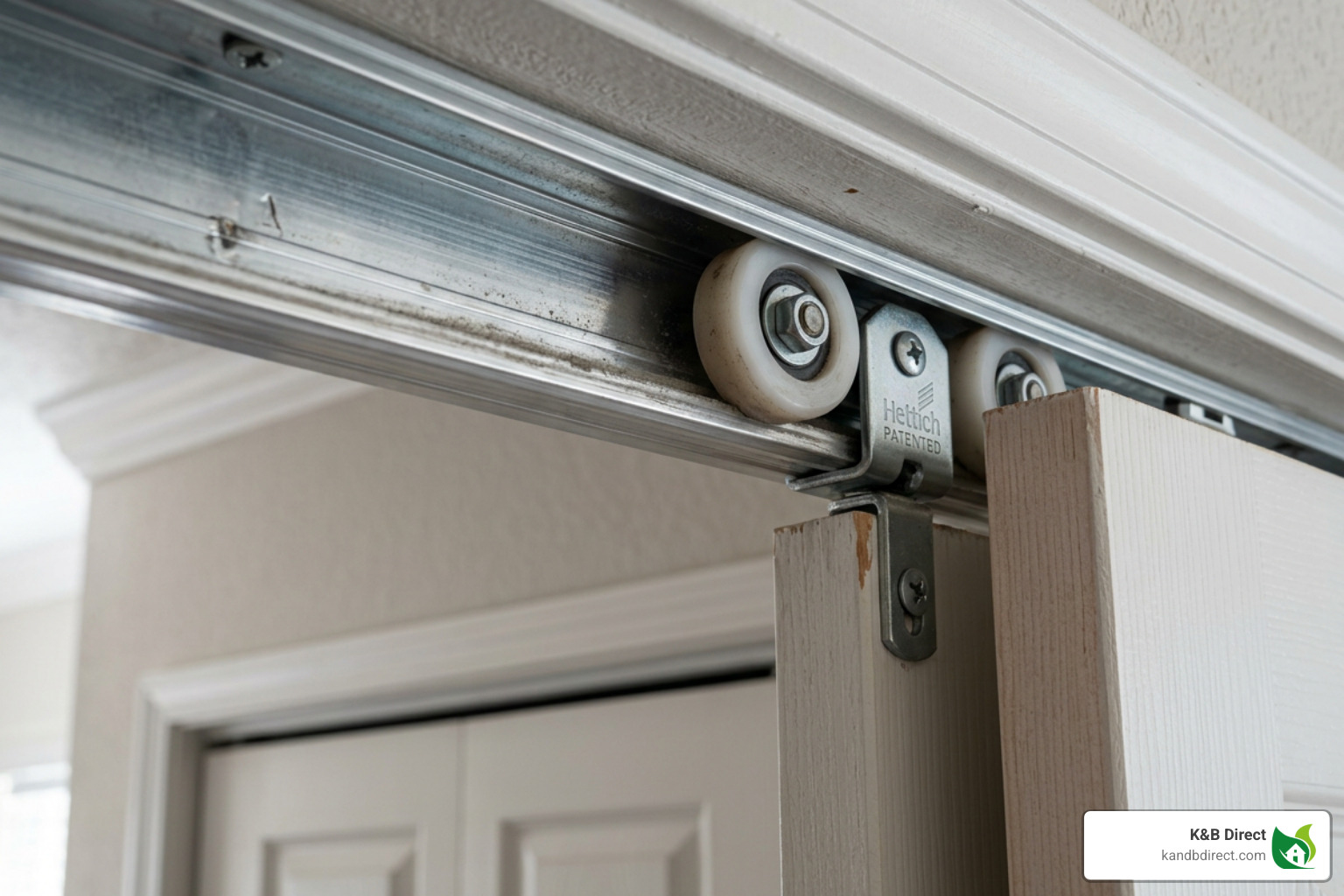
The top track is the most critical structural component. It is usually made of extruded aluminum or steel and is mounted to the header of the door frame. In many bypass systems, the top track has two separate “valleys” or channels, one for each door panel.
The bottom track, or sill track, is less common in modern interior setups but frequently found on mirrored sliding doors. It keeps the bottom of the panels aligned so they don’t swing inward or outward. If your doors are “swinging” toward the back of the closet, you might be missing a floor guide or a bottom track.
Hangers and Rollers
Hangers are the brackets that attach to the top of the door slab. They hold the rollers (the wheels) in place. Depending on the weight of the door, you might have single-wheel rollers or tandem rollers (two wheels on one bracket). For more on modern aesthetics, check out our modern-sliding-closet-doors-complete-guide.
Material Matters: Nylon vs. Steel
When selecting replacement rollers, the material of the wheel significantly impacts how the door feels and sounds.
| Feature | Nylon Rollers | Steel Rollers |
|---|---|---|
| Noise Level | Very Quiet | Can be noisy/metallic |
| Durability | Good for standard doors | Excellent for heavy/mirror doors |
| Smoothness | Smooth, soft feel | Precise, “industrial” feel |
| Maintenance | Low | High (may require lubrication) |
Identifying Sliding Closet Door Parts Names
To ensure your sliding system operates at its peak, we recommend familiarizing yourself with these specialized components:
- Nylon Rollers: These are the industry standard for lightweight wood doors. They are self-lubricating to an extent and provide a whisper-quiet glide.
- Steel Ball-Bearings: Found in high-end hangers, these provide the smoothest possible movement for heavy solid-core doors.
- Floor Guides: These small plastic or metal pieces are mounted to the floor in the center of the opening. They keep the bypass doors separated and prevent them from rubbing against each other.
- Anti-Lift Blocks: These are often overlooked safety features. They are small plastic clips installed in the top track that prevent the door from being accidentally lifted off the track—a common issue if a child or pet bumps into the door.
- Track Lubricants: We always suggest using a silicone-based spray. Avoid oil-based lubricants as they attract dust and grit, which eventually turns into a “grinding paste” that destroys your rollers.
Bi-Fold Hardware: Pivots, Snuggers, and Hinges
Bi-fold doors have more moving parts than almost any other interior door style. Because they must both slide and rotate, the hardware is more complex. If you’re looking at your doors in Barrington or Schaumburg and they’re hanging crooked, the issue is likely in the pivot assembly.
Pivot Brackets and Pins
The top pivot and bottom pivot are the anchors of the door.
- Pivot Brackets: These are the metal “sockets” that hold the pins. One is mounted in the top track, and the other is mounted to the floor or the side jamb.
- Adjustable Pins: Most modern bi-fold doors use threaded pins. By turning the nut on the pin, you can raise or lower the door to ensure it is level and doesn’t rub on the carpet.
Spring-Loaded Assemblies
In a standard bi-fold setup, the door panel furthest from the wall has a guide pin or guide wheel at the top. This pin is often spring-loaded, allowing you to “pop” the door out of the track easily for cleaning or access. You can find a wide variety of these bifold-closet-doors components at K&B Direct.
Common Bi-Fold Closet Door Parts Names
Beyond the main pivots, several smaller parts ensure the doors stay closed and aligned:
- Snuggers: A snugger is a small plastic sleeve with a spring inside that sits in the center of the top track. When you close the doors, the guide wheel hits the snugger, which provides just enough tension to keep the doors from “creeping” back open.
- Rubber Bumpers: These are usually placed on the door jamb or between panels to prevent a loud “bang” when the doors are closed quickly.
- Non-Mortise Hinges: Unlike standard door hinges that require a cutout (mortise) in the wood, bi-fold hinges often sit flat on the surface of the door edges.
- Alignment Plates: These are metal “teeth” mounted at the bottom of the doors where they meet in the middle. They ensure the two panels stay flush with each other when closed.
- Tinnerman Clips: These are specialized fasteners used to hold pivot pins in place within certain metal door frames.
When choosing hardware, we always look for standards set by the Builders Hardware Manufacturers Association. This ensures the parts have been tested for endurance and can handle thousands of “open-close” cycles.
Finishing Touches: Pulls, Knobs, and Decorative Hardware
The hardware that moves the door is the “engine,” but the hardware you touch is the “interior.” In the Chicago area, we see a huge trend toward updating handles to match modern home aesthetics.
Pulls and Knobs
For bi-fold doors, you’ll typically use bifold door handles. These are usually mounted in the center of the inner panels.
- Dummy Knobs: These are “fake” knobs that don’t turn. They are purely for pulling the door open.
- Flush Pulls: Common on sliding and pocket doors, these are recessed into the wood so the door can slide past the other panel without the handle getting in the way.
The Anatomy of the Handle
When you’re looking at closet door parts names for handles, you’ll encounter these terms:
- Backplate / Rosette: The decorative metal plate that sits against the door behind the knob.
- Spindle: The square metal bar that connects the knobs on either side (though rarely used on closets unless they are swinging doors).
- Finish Matching: It’s important to match your closet hardware to the rest of the room. Popular finishes in Illinois currently include Matte Black, Satin Nickel, and Champagne Bronze.
Frequently Asked Questions about Closet Door Parts Names
What are the most common closet door parts names for bi-fold systems?
The most common parts you will need to identify are the Top Pivot, Bottom Pivot, Guide Wheel, and Snugger. If your door is sagging, look at the bottom pivot bracket. If it won’t stay closed, the snugger spring in the track is likely the culprit. For help with sizing, refer to our bifold-door-sizes guide.
Which measurements are necessary for selecting tracks and rollers?
Precision is key. You need to measure:
- Track Length: The total width of the closet opening.
- Wheel Diameter: Usually 7/8″, 1″, or 1-1/4″. Even a 1/8″ difference can prevent the roller from fitting in the track.
- Door Thickness: Standard interior doors are 1-3/8″ or 1-3/4″.
- Housing Length: The size of the bracket that holds the wheel.
- Mounting Hole Spacing: The distance between the screws that attach the hanger to the door.
What is the difference between a snugger and a bumper?
While they both deal with the door closing, they serve different roles. A snugger uses a tension spring to hold the door in the “closed” position so it doesn’t drift open. A bumper is an impact absorber made of rubber or soft plastic designed for noise reduction and to prevent the door from hitting the frame too hard.
Conclusion
At K&B Direct, we believe that understanding the “bones” of your home is the best way to achieve the aesthetics you’ve always dreamed of. Whether you are in Des Plaines, Naperville, or downtown Chicago, knowing your closet door parts names empowers you to make better decisions for your home.
From the heavy-duty steel rollers that provide a silent glide to the adjustable pivots that keep your bi-fold doors perfectly level, every component plays a role in the harmony of your living space. We pride ourselves on offering professional-grade selection and high-quality hardware components at the lowest possible prices.
If you’re ready to upgrade your home’s interior, explore our full range of category/bifold-doors/ and sliding systems. Our team is here to help you find the perfect parts to keep your home running smoothly and looking beautiful.