
how to cut baseboard: 7 Powerful Steps for Flawless Results 2025
Mastering the Basics of Baseboard Cutting
Learning how to cut baseboard is like learning to ride a bike—it might seem tricky at first, but once you get the hang of it, you’ll wonder why you ever found it intimidating. Whether you’re freshening up your living room or completing a full-home renovation, mastering this skill will save you both money and those frustrated sighs that come with DIY projects gone wrong.
Think of baseboards as the final handshake between your walls and floors—they need to fit just right to make a good impression. When they’re installed properly, they add that polished, finished look that makes a room feel complete. When they’re not… well, those gaps and misalignments have a way of catching the eye (and not in a good way).
Here’s what you really need to know before making your first cut: always measure twice (adding that tiny 1/16″ for a snug fit), and mark clearly with a pencil and level. Your cuts will vary depending on what you’re working with—inside corners typically need a coped or 45° mitered cut, while outside corners require matching 45° miters on both pieces. For straight runs, you’ll use either clean 90° butt cuts or 45° scarf joints for a more seamless look.
Your tool choice matters too. Working with baseboards that are already installed? Reach for an oscillating multi-tool for precision cuts without removal. For new installations, a miter saw gives you clean, accurate cuts, while a coping saw helps you steer those tricky inside corners with finesse.

I’ve helped countless homeowners through their baseboard projects here at K&B Direct, and I’ve noticed that finishing touches make all the difference. After cutting, take a moment to sand those edges smooth and seal with caulk where the baseboard meets the wall. These small steps lift your work from “DIY” to “professionally done.”
The techniques differ slightly between new installations and modifications to existing trim. New baseboards give you more flexibility and forgiveness, while working with installed pieces requires a steadier hand and more precise measurements. But don’t worry—both are absolutely achievable for the average homeowner with a little patience.
The perfect baseboard installation isn’t just about aesthetics—it’s about creating that seamless transition that makes a house feel like a well-crafted home. And with the right approach, it’s a skill you’ll use again and again in your home improvement journey.
Tool & Safety Prep: How to Cut Baseboard the Right Way
Before diving into your baseboard project, gathering the right tools and understanding proper safety precautions is essential. As a Chicago Local 1 Finish Carpenter once told me, “The quality of your tools determines the quality of your cuts—and your safety gear determines whether you’ll be around to enjoy the finished product.”
Essential Tool Checklist
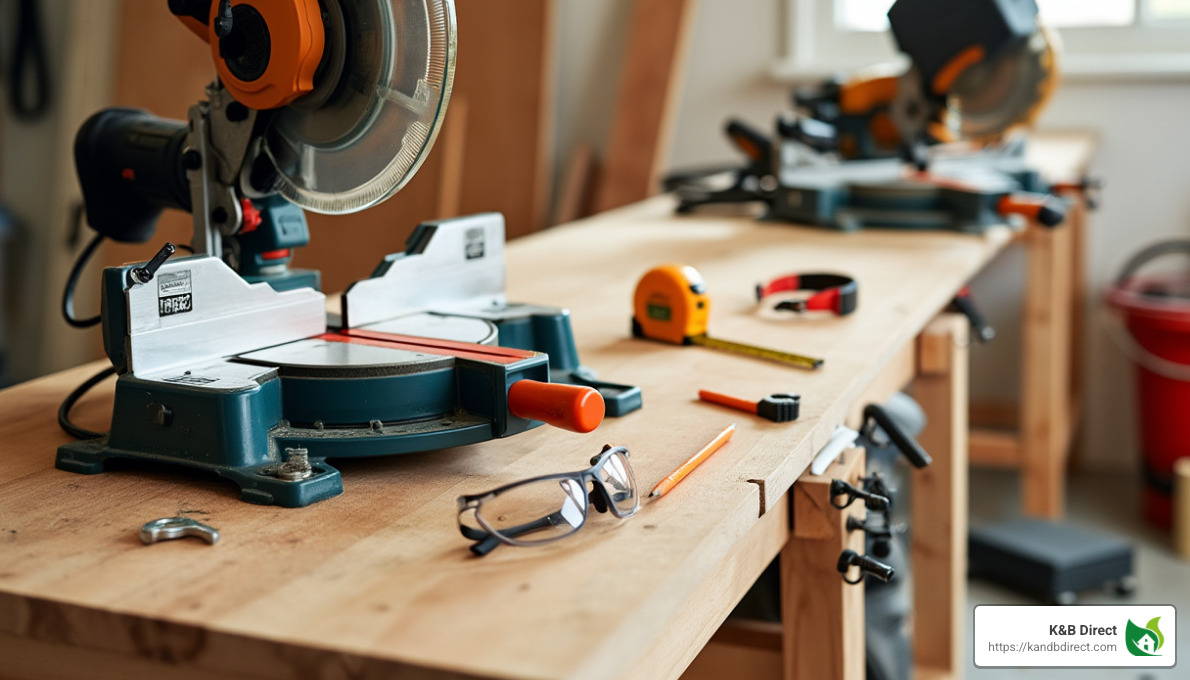
When it comes to how to cut baseboard properly, your tool selection makes all the difference. You don’t need to break the bank, but having the right equipment will save you hours of frustration.
For most homeowners, an oscillating multi-tool is worth its weight in gold, especially when modifying existing baseboards. These versatile tools can make plunge cuts right against the wall with remarkable precision. According to research from Popular Mechanics, modern oscillating tools have come a long way in battery life and cutting power.
A quality miter saw becomes your best friend for new installations, creating those perfect 45-degree angles for outside corners. Don’t overlook the humble coping saw either—this inexpensive hand tool is the secret weapon for creating tight inside corners that won’t gap over time.
For securing your baseboards, an 18-gauge brad nailer strikes the perfect balance between holding power and minimal wood splitting. The thin nails leave tiny holes that are easy to fill later.
| Task | Manual Option | Power Option | Best For |
|---|---|---|---|
| Straight Cuts | Miter box & handsaw | Miter saw | Miter saw: Speed & precision |
| Inside Corners | Coping saw | Jigsaw with coping foot | Coping saw: Beginners learning technique |
| Outside Corners | Miter box & handsaw | Miter saw | Miter saw: Clean, precise angles |
| Cutting Installed Baseboard | Utility knife & chisel | Oscillating multi-tool | Oscillating tool: Clean cuts with minimal effort |
| Scribing to Floors | Block plane | Belt sander | Block plane: Precise control |
Your measuring arsenal is just as important as your cutting tools. A reliable tape measure, carpenter’s pencil, and a good level form the foundation of accurate work. For those tricky angles that aren’t quite 90 degrees (and trust me, few walls in older homes are perfectly square), a Starrett angle finder or sliding T-bevel will become indispensable.
As Gary M. Katz, a veteran carpenter, wisely notes: “Coped corners are faster and more accurate than miters.” This insight highlights why having both a good coping saw and a quality miter saw makes such a difference in your results.
Safety First Before You Cut
Let’s be honest—nothing ruins a DIY project faster than a trip to the emergency room. Working with sharp blades and power tools demands respect and proper protection.
Your eyes are irreplaceable, so quality safety goggles are non-negotiable. A good dust mask protects your lungs, especially when cutting MDF baseboards which contain adhesives you definitely don’t want in your respiratory system. Your future self will thank you for wearing ear plugs when using power tools, as hearing damage is cumulative and permanent.
Work area preparation makes a huge difference in both safety and results. Clear away all debris from your cutting space and ensure you have plenty of light—shadows and cutting tools are a dangerous combination. Set up a stable work surface at a comfortable height to prevent back strain and awkward cutting angles.
Managing your extension cords properly prevents tripping hazards and potential electrical issues. Never use frayed cords, and make sure they’re rated for your tools’ power requirements. Keep cords away from your cutting path—nothing throws off your concentration like accidentally cutting through a live electrical cord.
Blade guards on power tools exist for a reason—never disable or modify them. Take the extra few seconds to let blades come to a complete stop before setting tools down. These small habits can prevent major accidents.
As one homeowner noted in our research, “I fixed a botched baseboard job by rubbing off as much as possible followed by cleaning up whatever was left with mineral spirits and light 000 steel wool buffing.” This reminds us that safety extends to chemical use as well—always work in well-ventilated areas when using solvents and finishes.
With the right tools in hand and safety precautions in place, you’re ready to tackle the measuring and marking phase of your baseboard project—where precision pays off in professional-looking results.
Measuring & Marking for Flawless Fits
The old carpenter’s adage “measure twice, cut once” is especially true for baseboard work. Proper measuring and marking are the foundation of professional-looking results.
How to Cut Baseboard Already Installed
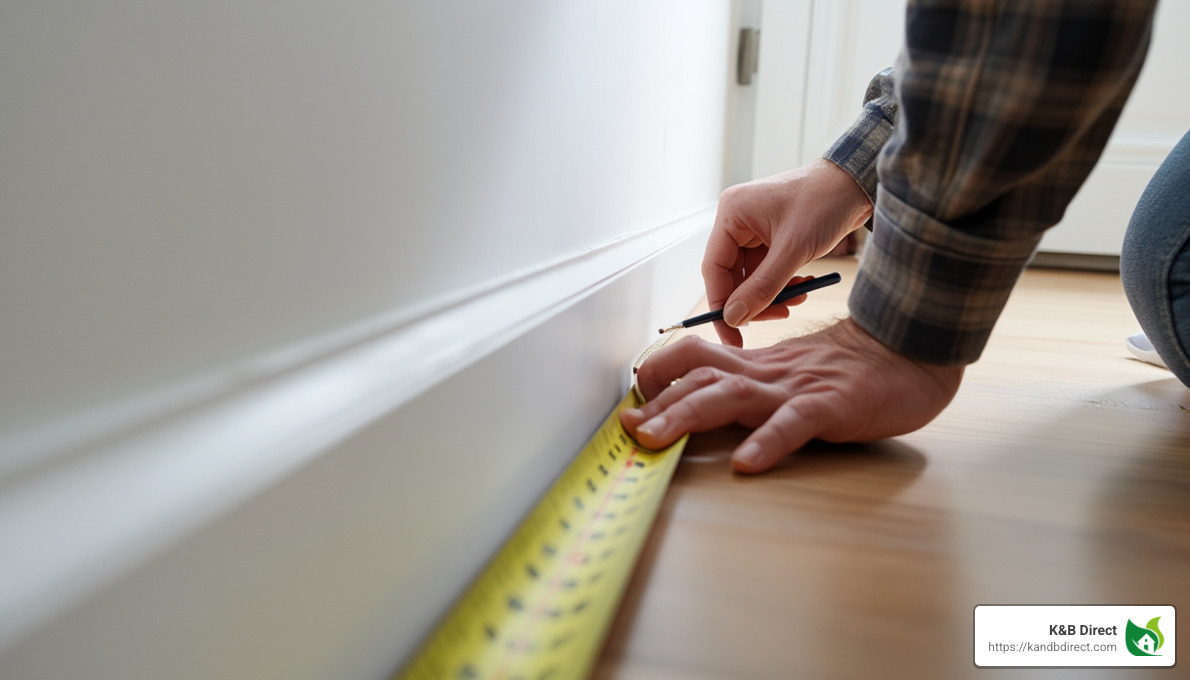
I once watched a professional trim carpenter tackle an existing baseboard with such confidence that I had to learn his secrets. Sometimes you need to cut baseboard that’s already on the wall—perhaps to make room for that gorgeous built-in bookcase or replace a section damaged by your enthusiastic puppy. This requires some special techniques that aren’t as scary as they seem.
Creating a clean cut starts with a good guide. Try using a scrap piece of trim as a spacer—hold it exactly where you need to make your cut and mark lines on either side. This creates a perfect template for your oscillating tool to follow. Always use a level to ensure these lines run straight and perpendicular to the floor. As my neighbor Tom likes to say, “A crooked line looks crooked forever, no matter how clean the cut.”
When it comes to controlling your cut depth, patience wins the race. Set your oscillating multi-tool with a wood-cutting blade and begin with light pressure along your marked line. You’ll feel a subtle change when the blade breaks through the baseboard—that’s your cue to stop before you nick the drywall behind it. One DIYer shared with me: “Cut only until you feel the blade break through the wood—stop before nicking the drywall.” Sage advice that’s saved many a wall repair.
After making your vertical cuts, score along the top edge with a utility knife where the baseboard meets the wall. This breaks the paint seal and prevents wall damage. Slide a thin pry tool or putty knife between the wall and baseboard, and gently wiggle the cut section free. The separation should feel smooth, not forced.
As one blogger enthusiastically shared: “This was SUPER easy. I’m excited to have a tool that will work for this job; removing baseboard is a stressful and time-consuming part of putting in built-ins.” With the right approach, what once seemed daunting becomes surprisingly manageable.
Accurate Layout on New Boards
Fresh baseboard installation gives you a clean slate, but demands precision from the very start. I’ve learned that creating a detailed cut list saves headaches later. Measure each wall section moving counterclockwise around your room (this helps track inside versus outside corners more intuitively).
For runs over 6 feet, add about 1/16″ to your measurements—this creates what carpenters call a “spring fit” that ensures tight seams. For tiny pieces under 6 inches, you might want to subtract a hair to prevent buckling. Always note the type of joint needed at each end (cope, miter, or butt) right on your cut list. And remember to add about 10% extra material for those inevitable mistakes we all make. Trust me, that extra trip to the store costs more in time than the spare material costs in dollars.
When marking your boards, use a sharp 2.5mm pencil for thin, accurate lines. For those tricky inside corners, a pro tip is to measure to a small block, then add the block’s length—this prevents your tape measure from bending at the corner and giving false readings. Outside corners rarely form perfect 90° angles in older homes, so verify with a Starrett angle finder or sliding T-bevel for precision.
A veteran carpenter once showed me to mark stud locations on the wall with blue painter’s tape. This simple trick makes nailing much easier and prevents the frustration of hunting for studs with baseboard in hand.
“Use a small block of baseboard as a measuring jig to take repeatable measurements,” a professional trim carpenter told me while working on my home. This 4-inch block becomes your secret weapon for consistency throughout the project.
Working with dark or textured baseboards from K&B Direct’s moulding collection? Apply masking tape before marking your cut lines—this clever trade secret keeps pencil lines visible on even the most challenging surfaces.
For the cleanest results, try drawing your cut lines on the back of the baseboard when possible. This keeps the front face pristine and is especially important when working with pre-finished materials like the beautiful General Purpose Base Shoe 1/2 x 3/4 PFJP that many of our customers love.
With careful measuring and marking, you’ve built the foundation for baseboard cuts that will fit like they grew there naturally.
Cutting Techniques: Straight Runs, Corners, and Joints
Now we’ll dive into the specific cutting techniques for different baseboard scenarios. The method you choose depends on the type of joint you’re creating.
Mitering vs. Coping Inside Corners
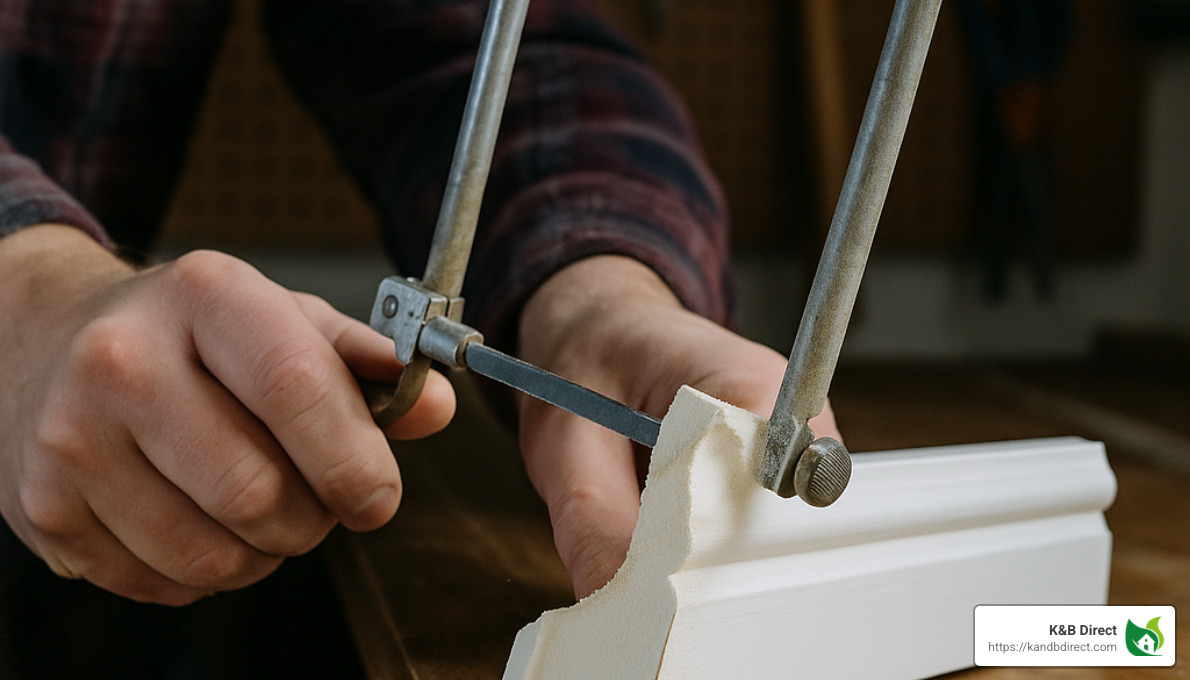
Inside corners can be handled in two ways: mitering or coping. While mitering might seem simpler at first glance, there’s a reason most professionals reach for their coping saw instead.
When you cope an inside corner, you’re essentially creating a custom fit that hugs the profile of the adjoining piece. This technique is more forgiving when corners aren’t perfect 90° angles (and trust me, in most homes, they rarely are!). As one Chicago Local 1 Finish Carpenter explained to me: “You cope because it adds not only strength but as you show in the video over time with wood movement coped inside corners won’t open up like you demonstrate on your 45-degree cut inside corner.”
To create a coped joint, first install one piece with a square 90° cut tight against the corner. For the joining piece, cut a 45° miter, which beautifully exposes the profile of your baseboard. Then, using a coping saw, carefully follow that profile line, keeping your blade at a slight back angle. This creates a piece that will nestle perfectly against the first board.
For tight curves, making small relief cuts prevents breaking and allows the wood to flex slightly. After coping, test the fit and sand as needed for that perfect, seamless match.
If traditional coping feels challenging, don’t worry! A jigsaw with a coping foot attachment offers a modern alternative that many pros have acceptd. I’ve found this especially helpful when working with thicker baseboards from our selection at K&B Direct.
Mitering vs. Coping Inside Corners
For outside corners, mitering is your best friend. Cut each piece at a 45° angle after carefully measuring both sides of the corner. With outside corners, the short point is always against the wall and the fence. I usually cut these slightly long (about 1/16″) and trim back as needed for that perfect fit.
Here’s a pro tip I learned the hard way: Use CA (super) glue and activator for outside miters. It creates an incredibly strong, invisible joint that won’t separate over time. Just be careful – as one veteran carpenter warned me: “You have about 5 seconds of working time once you spray CA activator—work fast or your fingers become part of the joint.” I can personally attest to the truth of this statement!
For long walls that exceed your baseboard length, create scarf joints by cutting opposing 45° angles where boards meet. This creates a larger glue surface and minimizes visible seams. Whenever possible, use 16-foot stock to reduce the number of joints needed. When installing, glue the joint and nail through the overlap into wall studs for maximum strength.
How to Cut Baseboard Around Obstacles
We’ve all been there – trying to fit baseboard around built-ins, cabinets, or unusual obstacles. These situations call for special techniques and a bit of patience.
The oscillating multi-tool is your secret weapon here. Mark your cut lines precisely using a level and pencil, then set up your multi-tool with a flush-cut wood blade. Cut with light pressure, letting the tool do the work rather than forcing it. For plunge cuts, start slowly and control your depth carefully to avoid damaging the wall behind. This technique is perfect when you need to modify baseboards that are already installed.
For irregular shapes like stone fireplaces or uneven floors, scribing is the technique to master. Hold your baseboard in position, set a compass to the widest gap, then run the compass along the irregular surface while marking the baseboard. Cut along this scribed line with a coping saw or jigsaw, test fit, and adjust as needed. This creates a custom-fit piece that follows the contours perfectly.
When dealing with protrusions like pipes or outlets, careful measuring and notching is key. Measure the width, height, and depth of the obstacle, transfer these measurements to your baseboard, and make relief cuts with a jigsaw. Finish the corners with a coping saw or chisel for clean, precise notches.
I recently helped a customer who told me: “I need to cut part of my baseboard so I can push the wardrobe all the way against the wall.” With proper marking and careful cutting using an oscillating tool, we created a perfect notch that allowed the furniture to sit flush while maintaining a clean look.
When cutting baseboard around obstacles, patience pays off. Take your time with measurements and cuts, and you’ll achieve results that look like they were done by a professional carpenter – even if it’s your first DIY baseboard project!
Advanced Skills: Uneven Walls, Odd Angles & Long Rooms
Even the newest homes rarely have perfectly square corners or completely flat walls. These real-world challenges are where your how to cut baseboard skills truly get tested. Don’t worry—with the right techniques, you can achieve professional results even in the trickiest situations.
Handling Wavy Walls
I once helped a friend install baseboards in a 1920s Chicago bungalow where not a single wall was straight. We laughed about needing a snake rather than a board! Here’s what works when your walls have more waves than Lake Michigan:
When you’re dealing with walls that bow in or out, the key is working with—not against—these imperfections. Hold your baseboard against the wall’s high points and take note of the gaps. A compass is your best friend here—set it to the largest gap size, then run it along the wall to transfer that wavy contour directly onto your baseboard.
After marking, cut along your scribed line with a jigsaw or belt sander. Pro tip: create what carpenters call an “underbevel” by tilting your tool slightly. This ensures the top edge fits tight against the wall while allowing the bottom to flex as needed.
Material choice makes a huge difference with wavy walls. MDF and urethane baseboards have more flex than solid wood options. For severely wavy sections, consider using thinner material—9/16″ rather than 3/4″—which will conform more easily. Construction adhesive along the back helps enormously, as do strategically angled nails that pull the baseboard tight to the wall.
For paint-grade trim, small gaps can disappear with a thin bead of caulk. With stain-grade trim, you’ll want to avoid visible caulk lines, so mechanical fit becomes more critical. As one of our regular customers at K&B Direct noted, “Paint-grade moldings saved my sanity in my old house—any gaps just disappeared with a little caulk and paint.”
Pro-Level Finish Tricks
The difference between amateur and professional baseboard installation often comes down to these finishing touches. These are the tricks that make your neighbors ask, “Did you hire someone?”
Outside corner miters benefit tremendously from a dab of CA glue (superglue). Cut your miters slightly long for a tight fit, apply a small amount of glue to one face, spray activator on the other, and press together for about five seconds. The bond becomes strong enough that sometimes you don’t even need nails! As one carpenter told me, “You have about five seconds of working time once you spray CA activator—work fast or your fingers become part of the joint.” (Speaking from experience, he wasn’t joking.)
For small gaps in outside miters, try this carpenter’s secret: use “something smooth, hard, and round” like a screwdriver shaft to gently roll the edge. This technique, which works especially well on MDF baseboards, can magically close small gaps by compressing the material slightly.
When filling nail holes, match your approach to your material. For paint-grade trim, standard spackle or wood filler works perfectly. With stain-grade trim, wax filler sticks in your wood tone create nearly invisible repairs. My favorite DIY trick: mix sawdust collected from your baseboard cuts with white glue for a perfectly matched wood putty.
Long boards benefit from what professionals call “spring-fitting.” For runs over 6 feet, cut the board about 1/8″ longer than measured. Install one end first, then bow the board slightly and press the other end into place. This creates tension that ensures a tight fit along the entire length—particularly effective when working with our General Purpose Base Shoe 1/2 x 3/4 PFJP for ensuring tight floor contact.
When dealing with non-standard angles (which are surprisingly common), a sliding T-bevel becomes invaluable. This simple tool captures the exact angle of your corner, which you can then transfer directly to your miter saw. For those tricky angles, always cut a test piece first—a minute spent testing can save wasting an entire length of baseboard.
As you tackle these advanced techniques, even professional carpenters weren’t born knowing how to cut baseboard perfectly. Each challenging situation teaches you something new, building skills that will serve you through countless home improvement projects.
Installation & Finishing Touches
Once your baseboards are cut, proper installation and finishing will ensure your hard work pays off with beautiful results.
Reinstalling Cut Sections
The moment of truth arrives when you’re ready to put those carefully cut pieces back in place. If you’ve removed sections of existing baseboard, reinstalling them properly is an art that combines precision and patience.
Begin by thoroughly cleaning the wall area where the baseboard will sit. Any old adhesive, paint chips, or debris can prevent a flush fit, so take your time here. A putty knife works wonders for scraping away stubborn residue. Next, do a quick test fit of your cut section, holding it in position to ensure it aligns perfectly with adjacent baseboards. This dry run can save you headaches later.
When you’re confident in the fit, apply a small bead of construction adhesive to the back of the baseboard. Don’t overdo it – a thin, zigzag pattern provides plenty of grip without messy squeeze-out. Press the section firmly into place, making sure it sits flush against both the wall and floor.
To prevent splitting these precision-cut pieces, pre-drill small holes before nailing. An 18-gauge brad nailer is perfect for most baseboard installations, providing enough holding power without leaving large holes to fill. Aim your nails at a slight downward angle for better grip, and focus on the thickest parts of the profile where nails will be less visible.
“I always keep my cut-offs organized by room,” shared one contractor I spoke with. “That way, if I need to make a repair years later, I have a perfect match for both the profile and the aged finish.”
Painting or Staining for a Seamless Look
The finishing touches truly make or break your baseboard project. Whether you’re painting or staining, the right approach ensures your hard work shines through in the final result.
Many professionals recommend pre-finishing your baseboards before installation. This approach gives you better access to all surfaces and eliminates the tedious task of carefully cutting in along floors and carpets. Sand all baseboards progressively with 120-grit, then 150-grit sandpaper until smooth to the touch. Apply primer and paint (or stain and sealer) to all surfaces, leaving only minor touch-ups for after installation.
“The best trim paint is Benjamin Moore Advance,” one painter told me. “It levels out beautifully, giving you that sprayed-on look with just a brush.” For stain-grade baseboards, apply a pre-stain conditioner to ensure even absorption, particularly important with pine and other soft woods.
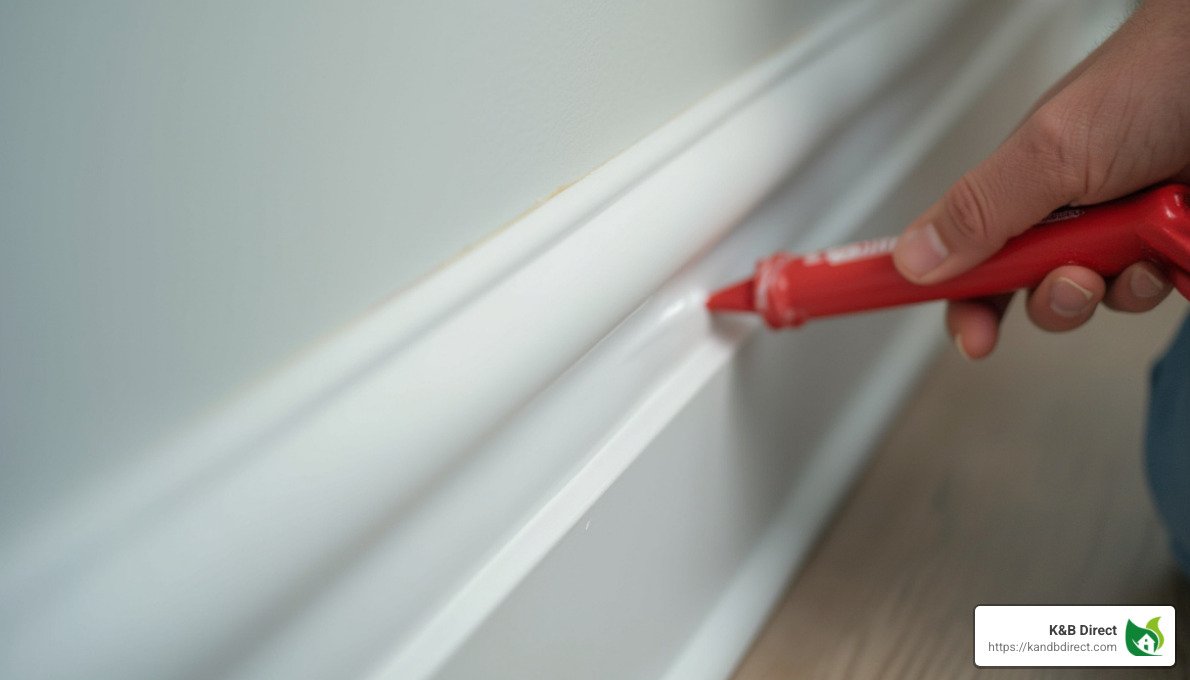
Once your baseboards are installed, the caulking step creates that seamless transition between wall and trim. Apply a thin bead of paintable caulk along the top edge where the baseboard meets the wall. Dampen your finger slightly and run it along the bead to create a smooth, concave profile. Wipe away any excess with a damp cloth and allow it to dry completely before applying final paint.
For those inevitable nail holes, wood filler or spackle works perfectly on painted trim. After it dries, a light sanding and touch-up with paint makes them virtually disappear. If you’re working with stained baseboards, colored wax sticks applied after finishing provide a perfect match without affecting the surrounding finish.
“I keep a set of artist brushes just for touch-ups,” one homeowner shared. “The tiny tip gives me perfect control for hiding those nail holes without leaving obvious paint marks.”
Proper lighting is crucial during this final stage. What looks perfect in dim light might reveal flaws in bright daylight, so check your work from different angles and lighting conditions. Taking this extra time ensures your baseboard cutting project concludes with truly professional results that will look fantastic for years to come.
For the highest quality baseboards to complete your project, browse K&B Direct’s selection of profiles that combine style, durability, and value.
Frequently Asked Questions about How to Cut Baseboard
What’s the best saw for beginners?
When you’re just starting out with baseboard projects, simplicity is your best friend. I always tell new DIYers that a basic miter box and handsaw combo is the perfect entry point. For less than $20, you’ll get a tool that makes clean 45° and 90° cuts—exactly what you need for most baseboard work.
As one weekend warrior told me after his first project: “The miter box and handsaw were perfect for my small bathroom. I was intimidated by power tools, but this gave me the confidence to tackle the job.” These manual tools also give you time to think through each cut without the intimidation factor of spinning blades.
Ready to level up? A 10-inch compound miter saw transforms baseboard cutting from a workout to a breeze. Look for models with laser guides—they’re like training wheels for precise cuts. While more expensive (typically $150-300), they quickly pay for themselves if you’re doing more than one room.
How do I measure odd interior angles?
Let’s face it—perfect 90° corners are as rare as unicorns in most homes. Those tricky odd angles can make or break your baseboard project, but measuring them doesn’t have to be complicated.
A sliding T-bevel is your secret weapon here. This simple tool captures the exact angle of your corner, which you can then transfer directly to your miter saw. For even greater precision, the Starrett miter angle tool is worth its weight in gold. It gives you a digital readout of the exact angle, taking the guesswork out of those frustrating corners.
Here’s a pro tip that saved my sanity on countless projects: for inside corners, learning to cope can eliminate the need for perfect angle measurements altogether. As one master carpenter shared with me, “Once I mastered coping, I stopped worrying about whether corners were 87° or 93°—the coped joint always fits perfectly.”
Can I cut baseboard without removing it from the wall?
Absolutely! The oscillating multi-tool is a game-changer for cutting baseboard that’s already installed. This versatile tool lets you make precise cuts without the hassle of removing and reinstalling entire sections.
To cut baseboard in place, clearly mark your cut lines with a pencil, attach a wood-cutting blade to your oscillating tool, and cut with light, controlled pressure. The key is feeling when you’ve cut through the baseboard but stopping before you damage the wall beneath. Think of it like cutting through a cake without slicing the plate.
One budget-conscious homeowner shared this gem: “I bought an oscillating tool for $20, used it for my project, then resold it for $15. Best $5 I ever spent on a tool rental!” For occasional DIYers, this approach makes perfect sense.
Working with a limited tool collection? A sharp utility knife and chisel can also do the job. Score your cut line deeply with repeated passes of the utility knife, then use a chisel to gradually remove material. It requires patience and a steady hand, but it works beautifully for smaller cuts.
As one resourceful DIYer told me after completing his built-in bookcase project: “The utility knife and chisel method took longer, but gave me incredible control for cutting around the exact shape of my bookcase.” Sometimes the old-school methods still shine!
Conclusion
Changing an ordinary room into one with professional-looking trim is all about mastering how to cut baseboard correctly. Throughout this guide, we’ve walked through the journey from measuring and marking to making that final perfect cut—all skills that can make your DIY project look like it was done by a pro.
The beauty of baseboard installation lies in the details. That extra 1/16″ you add for a snug fit, the choice to cope an inside corner rather than miter it, or the careful way you ease an outside corner with a screwdriver shaft—these little touches make all the difference in your finished project.
Remember what that Chicago carpenter shared with us: “The quality of your cuts determines the quality of your finish.” This couldn’t be more true. Taking your time with each measurement and cut pays dividends when you step back and admire your work.
For beginners, don’t be intimidated by the process. Start with simpler tools like a miter box if needed, and work your way up to power tools as your confidence grows. Even seasoned DIYers began somewhere, usually with a basic project and a willingness to learn.
The most important takeaways from our guide are worth highlighting:
First, measure twice (or even three times!) before cutting, adding that critical 1/16″ for a tight fit on longer pieces.
Second, choose the right tool for each situation—a miter saw gives clean cuts for new installations, while an oscillating tool is invaluable for modifying baseboards already on the wall.
Third, cope your inside corners whenever possible. This technique might take a little practice, but the joints won’t open up over time like mitered corners often do.
Fourth, don’t skip the finishing touches. Use CA glue for tight outside miters, take time with your caulking, and carefully fill and touch up nail holes for that seamless look.
Whether you’re refreshing a single room or tackling a whole-house project, the techniques we’ve shared will help you achieve results you can be proud of. Baseboards might seem like a small detail in your home, but they frame your rooms and create that finished, polished look that truly makes a space feel complete.
When you’re ready to start your next project, we’d love to help you find the perfect baseboards at K&B Direct. Our selection of mouldings and millwork offers options for every style and budget, with locations in Schiller Park and Chicago to serve you.
With patience, the right tools, and these professional techniques in your toolkit, you’ll be cutting baseboard like a pro in no time. Happy cutting, and enjoy your beautifully finished space!