
pvc floor molding: 5 Powerful Reasons for a Stunning 2025 Upgrade
The Complete Guide to PVC Floor Molding
Walking into a beautifully finished room, you might not immediately notice the trim along the floor – but you’d certainly notice its absence! PVC floor molding has revolutionized how we finish our spaces, offering that perfect blend of practicality and polish that today’s homeowners crave.
Unlike traditional wood that can swell, shrink or even rot when exposed to moisture, PVC floor molding stands firm against bathroom splashes and kitchen spills. This moisture-proof warrior quietly protects your walls while adding that finished look every designer aims for.
Let me break down how these modern marvels compare to the classics:
| Feature | PVC Floor Molding | Wood Molding | MDF Molding |
|---|---|---|---|
| Moisture Resistance | Excellent (100% waterproof) | Poor to Fair | Poor |
| Durability | High impact resistance | Moderate | Low to Moderate |
| Cost | $2-5 per linear foot | $2-7 per linear foot | $1-2 per linear foot |
| Paintability | Yes (requires proper primer) | Yes | Yes |
| Best For | Bathrooms, kitchens, basements | Living rooms, bedrooms | Dry areas, budget projects |
What really makes PVC floor molding shine is its versatility. With over 50 color options available, you’re no longer stuck with “white or whiter” for your trim. The material’s uniform composition means those inevitable bumps from vacuum cleaners or kids’ toys won’t leave visible battle scars like they would on traditional wood.
I’ve seen countless homeowners light up when they realize they can have the neat look of classic trim without the maintenance headaches. And here’s a little-known fact that might surprise you: according to Forbes, more than 30% of waste in landfills comes from home renovations. By choosing durable PVC molding that won’t need replacing every few years, you’re making an environmentally conscious choice too.
Since 2011, I’ve helped families at K&B Direct find the perfect PVC floor molding for their spaces. Whether you’re renovating a bathroom that constantly battles humidity or putting the finishing touches on a basement playroom, we’ve got options that deliver both beauty and brawn.
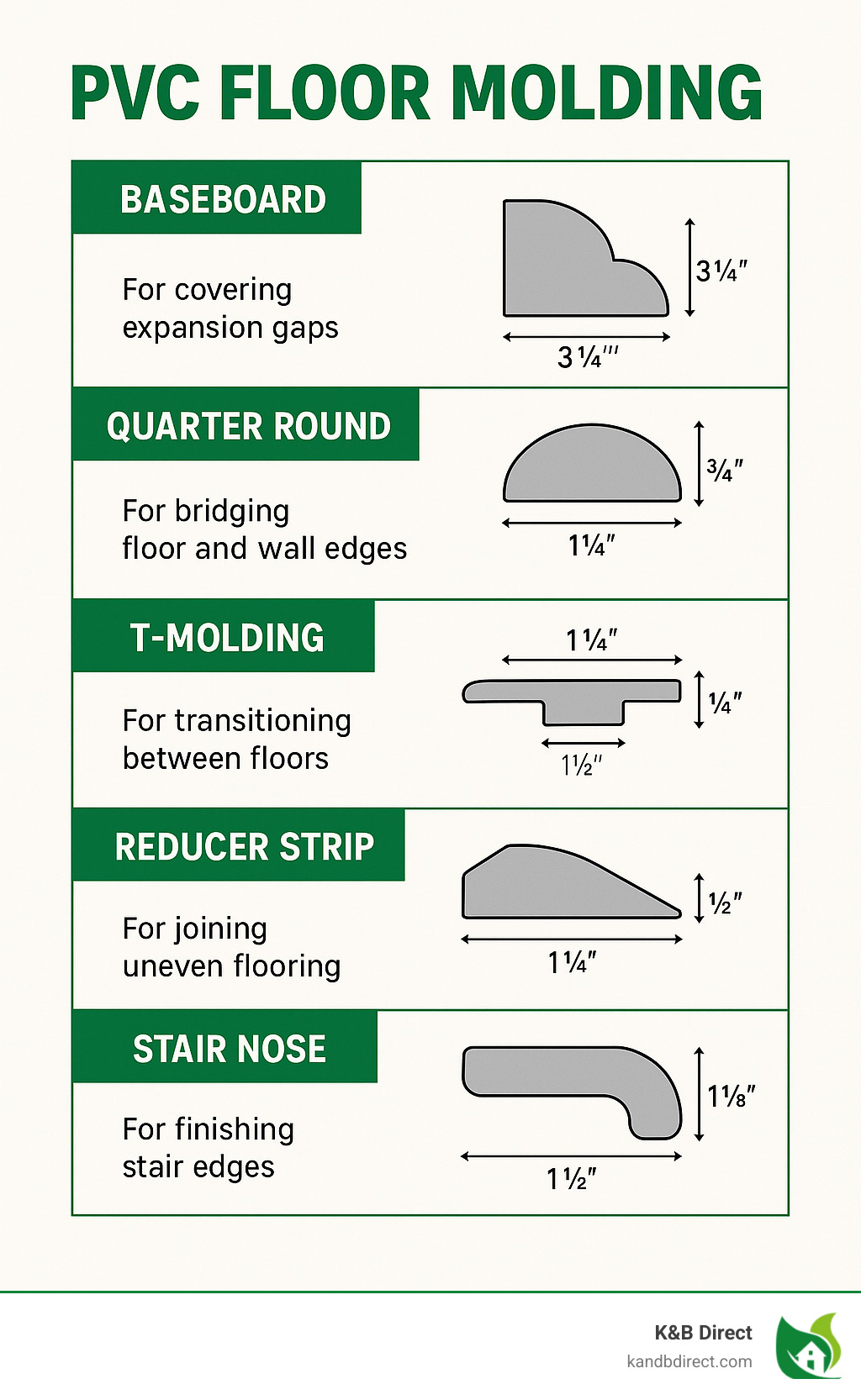
Wondering about installation? Many homeowners find our resources on how to cut baseboard and how to cut baseboard corners incredibly helpful when tackling their trim projects. With the right tools and a little patience, even DIY beginners can achieve professional-looking results with PVC floor molding.
PVC Floor Molding Baseboards: The Everyday Defense
When it comes to protecting your walls from everyday wear and tear, PVC floor molding baseboards are your home’s first line of defense. These versatile trim pieces cover the gap between your wall and flooring while adding a finished look to any room.
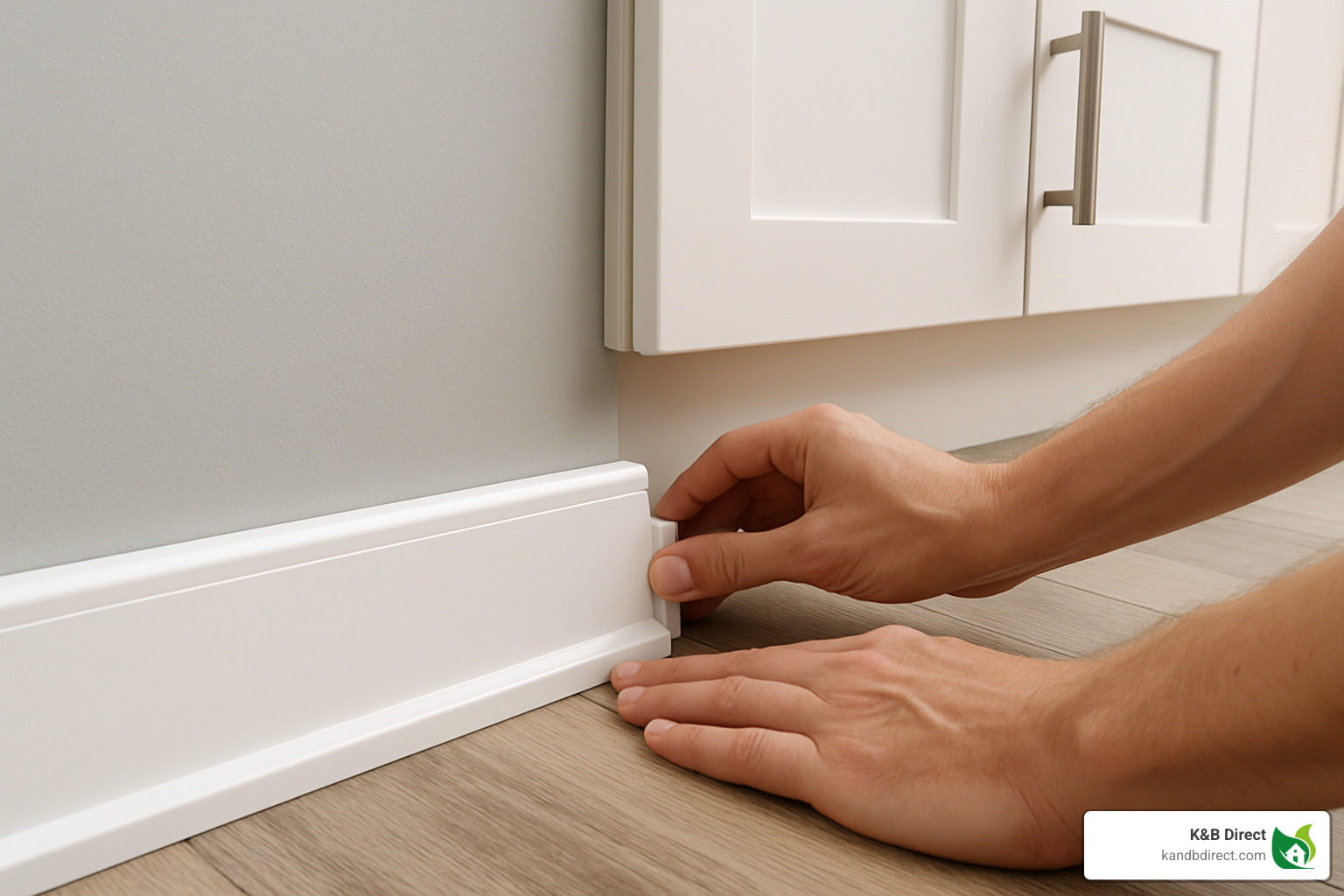
Unlike traditional wood baseboards that can absorb moisture and eventually warp, rot, or develop mold, PVC baseboards are 100% waterproof. This makes them particularly valuable in areas like bathrooms, kitchens, and basements where moisture exposure is inevitable.
One of our Chicago customers shared a story that might sound familiar: “After replacing water-damaged wood baseboards in my bathroom three times, I switched to PVC. Five years later, they still look brand new despite daily showers and occasional floor cleaning spills.”
At just $2-5 per linear foot, PVC floor molding baseboards offer remarkable value when you consider their durability. Primed MDF baseboards might save you a dollar per foot upfront, but they simply can’t match PVC’s moisture resistance and longevity. And while they’re comparable in price to mid-range wood options, they’ll outlast them by years in challenging environments.
One small quirk worth mentioning – PVC does tend to develop static electricity, which can attract dust. But don’t worry! A quick wipe-down with a damp cloth solves this minor inconvenience in seconds.
Why Choose PVC Floor Molding Here?
The durability of PVC floor molding really shines in wet environments. I’ve seen decades-old PVC baseboards in bathrooms that haven’t discolored at all, especially when finished with oil-based paint. This remarkable resistance to moisture makes PVC the smart choice for any area where water exposure is a concern.
Another advantage I love pointing out to customers is how PVC handles wear and tear. Because the material is uniform throughout (unlike wood with its varying grain patterns), scratches and dings are far less noticeable. If a scratch does occur, it won’t reveal a different color underneath as would happen with painted wood – a huge benefit in high-traffic areas.
It’s worth noting that PVC does tend to shrink and expand more than wood with temperature changes. Don’t worry though – this characteristic is easy to account for with the right installation techniques, which I’ll cover next.
Cutting & Installation Hacks
Installing PVC floor molding is definitely within reach of most DIY enthusiasts. After helping hundreds of customers through their installations, I’ve collected some professional tips that will make your project go much smoother.
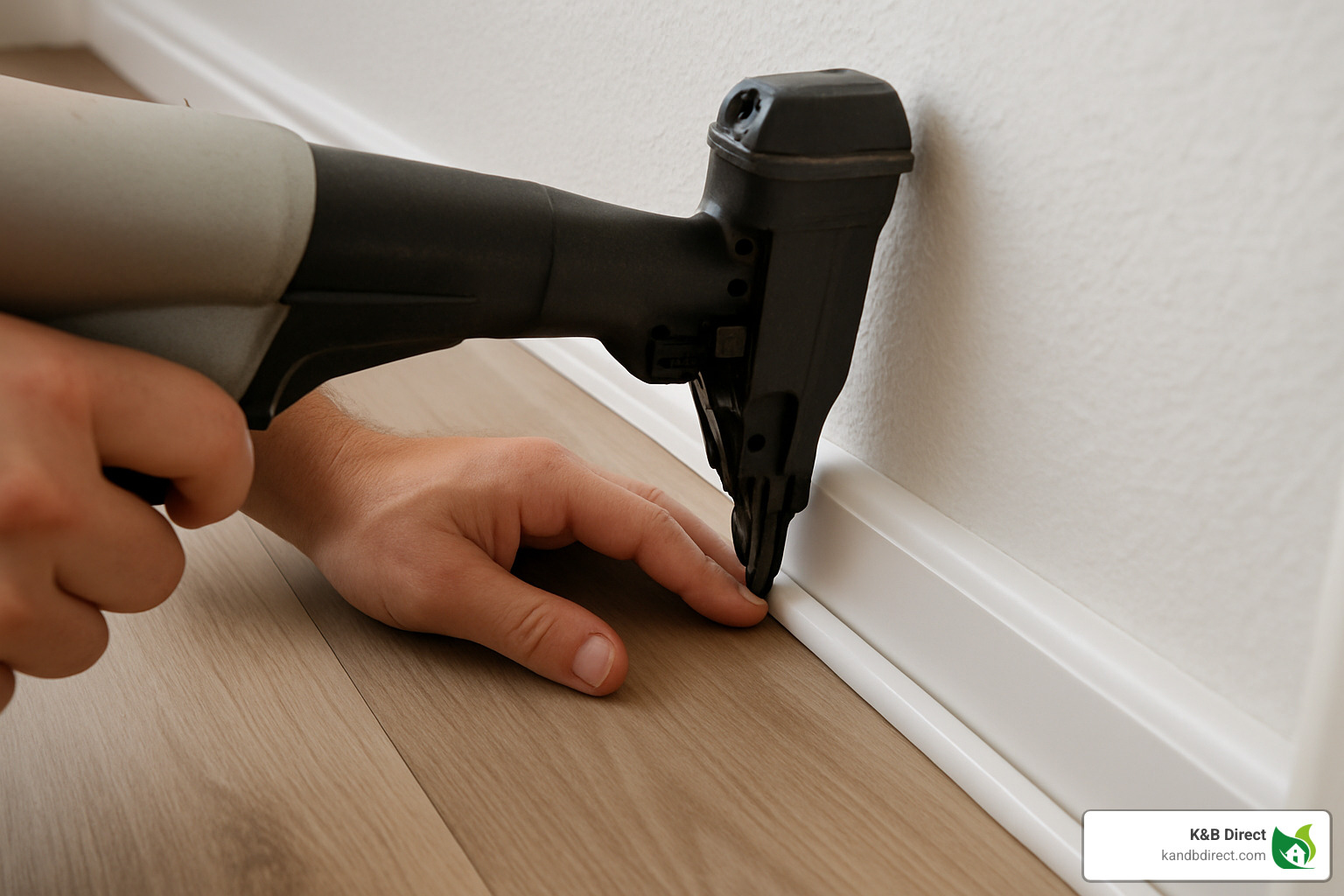
First, use the right blade – a carbide-tipped blade with at least 80 teeth on your miter saw will give you clean cuts without melting the PVC. This small investment makes a world of difference in your final results.
For those tricky mitered corners, here’s a pro secret: clear plumber’s PVC glue is fantastic for joining cut corners before nailing to walls. This creates a strong bond that prevents separation over time, even with the natural expansion and contraction of the material.
Nail placement matters more than you might think. Place finish nails about 16 inches apart and at least 3/4 inch from the edges to prevent splitting. Then, apply a thin bead of latex caulk along the top edge where the baseboard meets the wall to create a seamless look and prevent dust collection.
One of our professional installers from our Schiller Park location shared this gem: “Cover nail holes with a matching white wax stick rather than wood filler for a perfect match on white PVC moldings.” These little details make all the difference in a professional-looking installation.
Remember to let your PVC floor molding acclimate to room temperature for 24 hours before installation. This simple step minimizes expansion and contraction issues down the road.
One final safety note – cutting PVC creates fine dust that contains microplastics, so always wear appropriate dust protection and, if possible, cut outdoors or use dust collection systems. Your lungs will thank you!
Quarter Round & Shoe: Small Curve, Big Finish
Sometimes the smallest details make the biggest difference in a finished look. Quarter round and shoe moldings are perfect examples of how PVC floor molding can lift your space with minimal effort.
Quarter round molding features a 90-degree angle with a rounded face that creates a gentle curve where your baseboard meets the floor. Its cousin, base shoe molding, offers a slightly flatter profile that many homeowners prefer for a more subtle, refined appearance.
These tiny trim heroes do far more than just look pretty. They cover that necessary expansion gap between your flooring and walls—absolutely essential if you’ve installed floating floors like laminate or luxury vinyl. They also act as bodyguards for your baseboards, taking the hits from vacuum cleaners and mops so your main trim doesn’t have to. And let’s be honest, they just make everything look more finished and professional by hiding those sometimes uneven edges where flooring meets walls.
The good news? PVC floor molding in quarter round and shoe profiles comes in dozens of color options to either match or complement your existing trim. Whether you prefer a matte, satin, or semi-gloss finish, there’s an option that will coordinate beautifully with your overall design vision.
Matching PVC Floor Molding to Existing Trim
“But what if I already have wood trim?” This is a question we hear almost daily at K&B Direct, and I’m happy to say there are several ways to create a cohesive look.
If you have painted trim, PVC floor molding accepts paint beautifully—with the right prep. Start with an oil-based alkyd primer (this step is crucial!), then apply your chosen paint color. One of our Chicago customers put it perfectly: “After priming with oil-based primer, my painted PVC quarter round is indistinguishable from the painted wood baseboards I already had.”
For homes with stained wood trim, you have options too. Some manufacturers offer stainable vinyl moldings that take gel stains well, allowing you to mimic existing wood tones. Alternatively, many designers actually recommend choosing a complementary solid color that coordinates with your wood trim rather than attempting an exact match.
It’s worth knowing the difference between solid-core and wrapped PVC moldings. Solid-core options have the same color throughout the material, meaning scratches are far less noticeable since the color runs all the way through. Wrapped PVC has a vinyl covering over a different core material, which can show damage more readily if the surface is compromised.
Maintenance Made Easy
One of the joys of choosing PVC floor molding is how little maintenance it requires. While wood trim often needs regular refinishing or touch-up painting, PVC maintains its good looks with minimal effort on your part.
Keeping your PVC trim looking fresh is simple: sweep or vacuum dust using a brush attachment to prevent scratches, then wipe with a damp cloth using mild soap for any stubborn spots. Just avoid harsh chemical solvents that could damage the finish—they’re simply not necessary for cleaning PVC.
Those “vacuum bumps” that plague wood trim owners? Not an issue with PVC. As one of our long-time customers shared, “After years of accidentally hitting wood trim with my vacuum cleaner and causing chips and dents, I switched to PVC quarter round. Three years later, it still looks perfect despite daily vacuuming.”
The combination of easy maintenance and impressive durability makes PVC floor molding in quarter round and shoe profiles an increasingly popular choice for busy households—especially in high-traffic areas where cleaning happens frequently and bumps are inevitable.
T-Molding Transitions for Open-Plan Floors
In today’s open-concept homes, floor transitions between different rooms or flooring types require special attention. This is where T-molding, a versatile PVC floor molding profile, becomes essential.
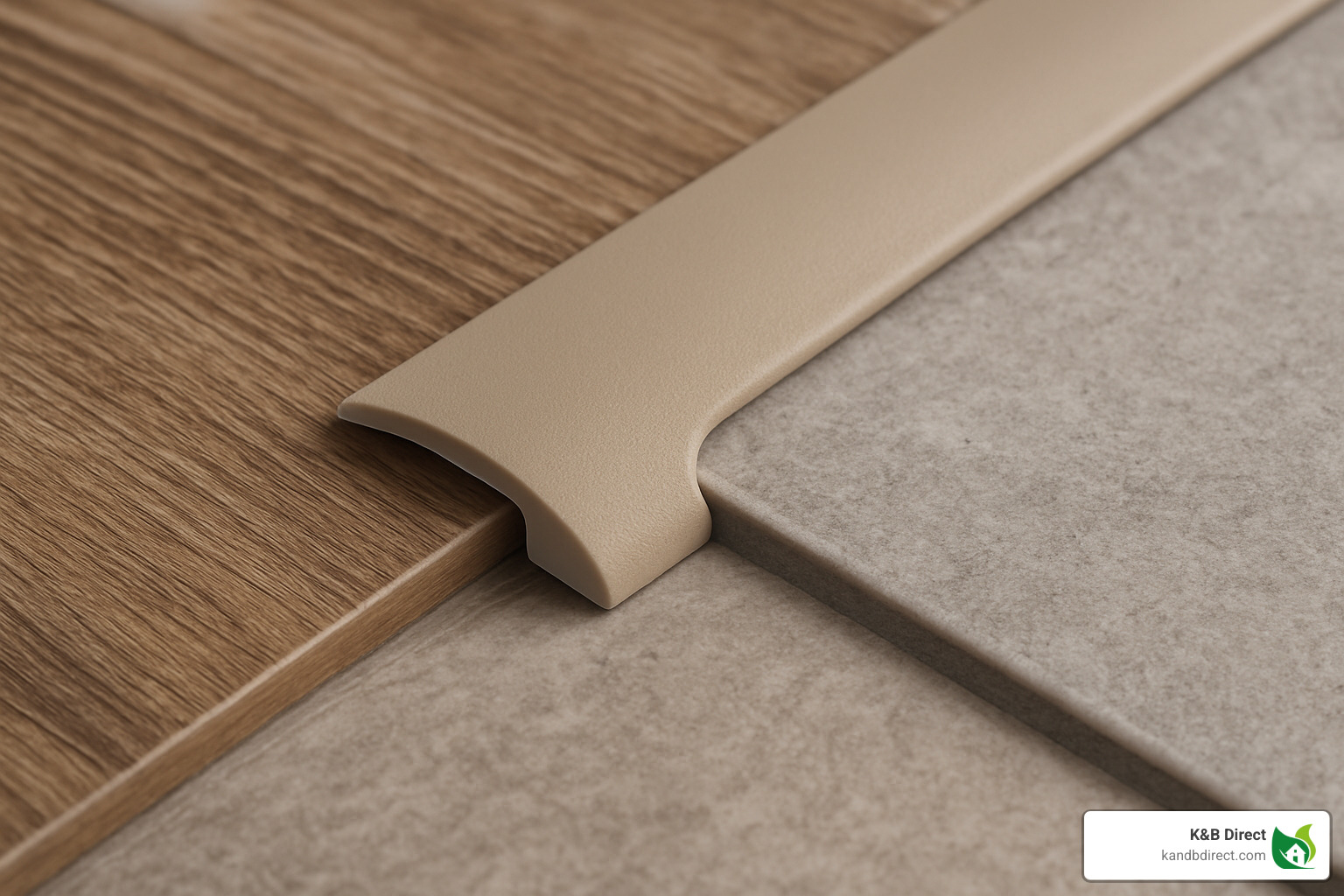
T-molding gets its friendly name from its T-shaped profile, which acts like a bridge connecting two floors of equal height while covering that all-important expansion gap between them. If you’ve installed floating floors like luxury vinyl plank or laminate, you already know these materials need breathing room to expand and contract as temperatures and humidity levels dance around throughout the year.
What makes PVC T-molding stand out is its impressive hardness rating – typically between 90-95 on the durometer scale. Think of it as the Goldilocks of floor transitions: not too rigid, not too flexible, but just right for withstanding daily foot traffic while keeping its shape year after year.
“I used to replace my wood transition strips every few years due to warping,” shared one homeowner at our Chicago showroom. “The PVC T-molding I installed five years ago still looks brand new, even with three kids and a dog running across it daily.”
You’ll find these transitions available in standard 94-inch lengths for most home projects, though commercial spaces can often source longer coils up to 500 linear feet – perfect for those sprawling open floor plans with minimal seams. Need a specific length for your project? Check out options like Vinyl T-Molding 94″ for standard residential applications.
Installing PVC Floor Molding Between Rooms
Installing T-molding might seem intimidating at first, but it’s actually quite straightforward once you understand the track system approach.
The key to success lies in proper preparation. Start by measuring your doorway or transition area carefully, then cut the plastic track to fit snugly. Instead of placing this track on top of your flooring, secure it directly to the subfloor using pressure-sensitive adhesive for concrete subfloors or screws for wood subfloors.
Remember the golden rule: always leave approximately a ¾-inch gap between flooring sections. This isn’t just a suggestion – it’s essential for allowing proper expansion of your floating floors. Once the track is secure and your gap is perfect, simply snap the T-molding into place with gentle pressure or a few taps from a rubber mallet.
As Mike, one of our installation pros at K&B Direct, often tells customers: “Think of T-molding as the referee between two competing floors – it needs to stand firm on neutral ground (the subfloor) while giving both sides room to move.”
Moisture & Movement Performance
When it comes to handling both moisture and movement, PVC floor molding truly shines in transition areas. Industry guidelines typically suggest installing transition strips every 80 feet for rigid vinyl plank flooring, while other materials might need them every 35 feet to prevent buckling or separation.
This remarkable flexibility makes PVC T-molding the perfect choice for bathroom thresholds, where moisture resistance isn’t just nice – it’s necessary. Unlike wood transitions that can swell, warp or even rot with repeated exposure to water, PVC remains steadfast and unchanged.
“The shower threshold in my master bath used to be a constant headache,” shared a customer from our Schiller Park location. “Since switching to PVC transition molding, I haven’t worried once about water damage, even with daily showers and occasional splashes.”
What’s equally impressive is how well PVC handles subtle variations in your subfloor. Its natural flex rating allows it to adapt to minor imperfections without cracking or separating – a common frustration with more rigid wood or composite transitions that can snap when forced to bend even slightly.
For homeowners creating accessible spaces, PVC T-molding also offers smoother transitions for wheelchairs or walkers, with less risk of creating trip hazards over time as the material maintains its original shape rather than warping or lifting at the edges.
Specialty PVC Profiles: End Caps, Reducers & Stair Nose
Beyond the basics of baseboards and T-moldings, PVC floor molding offers specialized profiles designed to address specific transition challenges in your home.
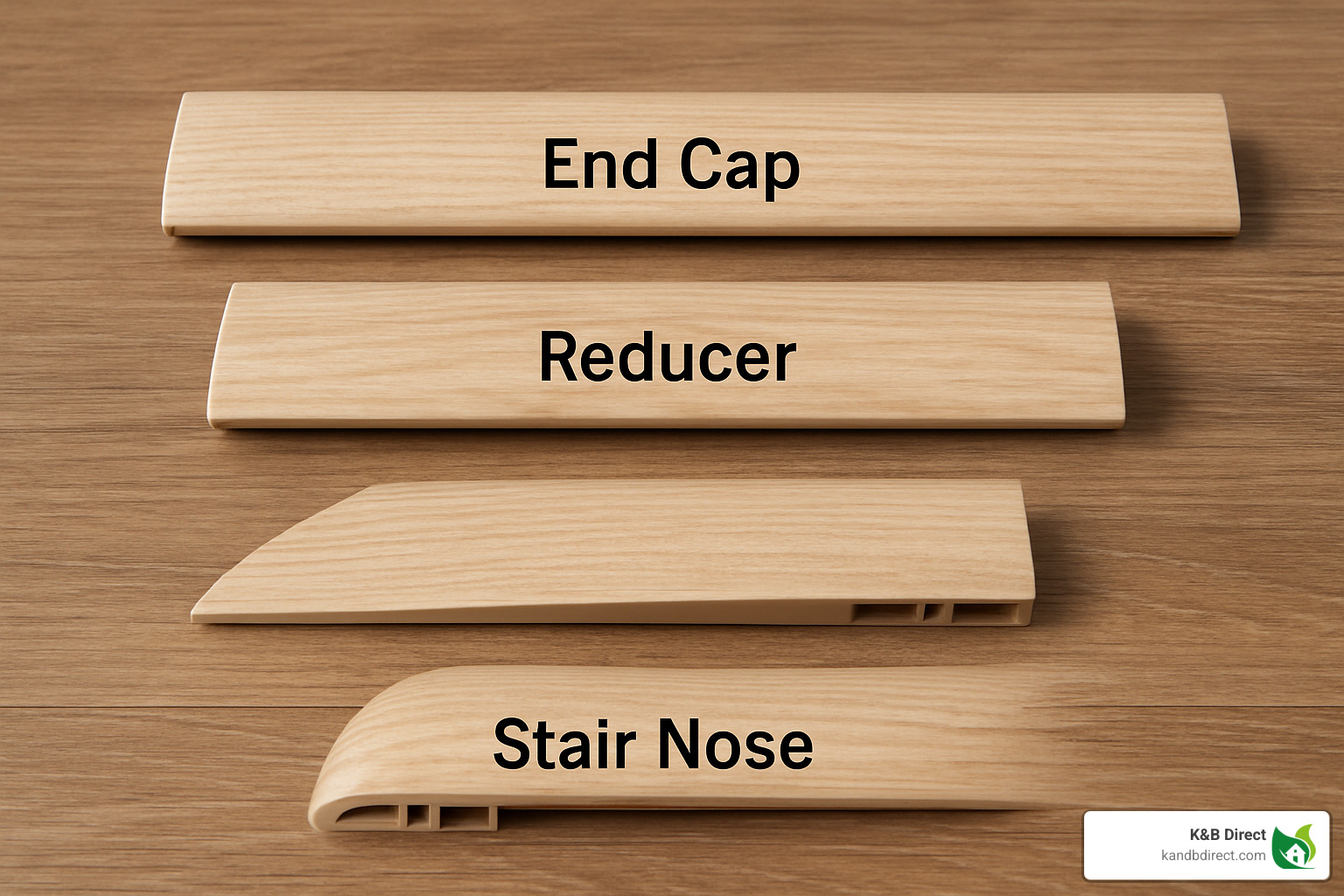
Walking through a beautifully finished home, you might not notice the subtle trim pieces that tie everything together—but you’d certainly notice their absence! End molding (or end caps) creates that finished edge where your flooring meets exterior doors, sliding door tracks, or fireplaces. These small but mighty pieces protect vulnerable flooring edges while giving your space that polished, “everything in its place” feeling.
When your kitchen’s luxury vinyl needs to transition to the dining room’s ceramic tile, reducer strips come to the rescue. With their gentle slope, these clever profiles eliminate trip hazards while smoothly bridging the height difference between different flooring types. As one of our customers put it, “My mother-in-law hasn’t stumbled once since we installed that reducer—worth every penny for family peace alone!”
If you’ve ever stubbed your toe on a stair edge, you’ll appreciate stair nose molding. These rounded-edge profiles not only create a finished look on each step but also make stairs safer by increasing visibility and protecting the flooring edge from the constant impact of footsteps. For homes with children or elderly residents, this safety feature is particularly valuable.
For our commercial clients handling large-scale projects, many of these specialty profiles come in coils up to 500 linear feet long, perfect for apartment complexes, hotels, or office buildings where consistency matters across multiple spaces.
Cost & Value Snapshot
When weighing your PVC floor molding options, it’s tempting to focus solely on the price tag, but the long-term value tells a more complete story.
Basic PVC baseboards typically cost between $2-5 per linear foot, while specialty profiles like stair nose molding might run $6-10 per linear foot. T-moldings and reducers generally fall somewhere in the middle at $4-8 per linear foot.
Yes, these prices edge slightly higher than primed MDF (around $1 per foot), but as Tom from Evanston told us after his basement renovation: “I initially balked at the price difference between PVC and MDF trim, but after replacing water-damaged MDF twice in my basement, the PVC has already paid for itself.” That’s the kind of math that makes sense in real homes!
If you’re handy, DIY installation can significantly reduce your project costs. Professional installation typically adds $2-4 per linear foot, depending on your location and project complexity. Many of our customers at K&B Direct find that a mix works well—installing simple baseboards themselves but calling in pros for trickier stair nose applications.
Unlike wood or MDF alternatives that often come with limited or no warranties, quality PVC moldings typically include warranties ranging from 10-25 years. That’s peace of mind you can literally walk on every day.
Health & Eco Considerations
Let’s talk about the elephant in the room—PVC floor molding is plastic, and that raises legitimate questions about health and environmental impact.
Modern PVC moldings have come a long way in addressing off-gassing concerns. Today’s quality products are typically formulated to minimize volatile organic compounds (VOCs). At K&B Direct, we prioritize offering low-VOC or zero-VOC certified products because we believe healthy homes start with healthy materials.
Parents and pet owners will be relieved to know that quality PVC moldings are manufactured without lead stabilizers. Always verify that products meet current safety standards—something we’re happy to help with when you visit our showroom.
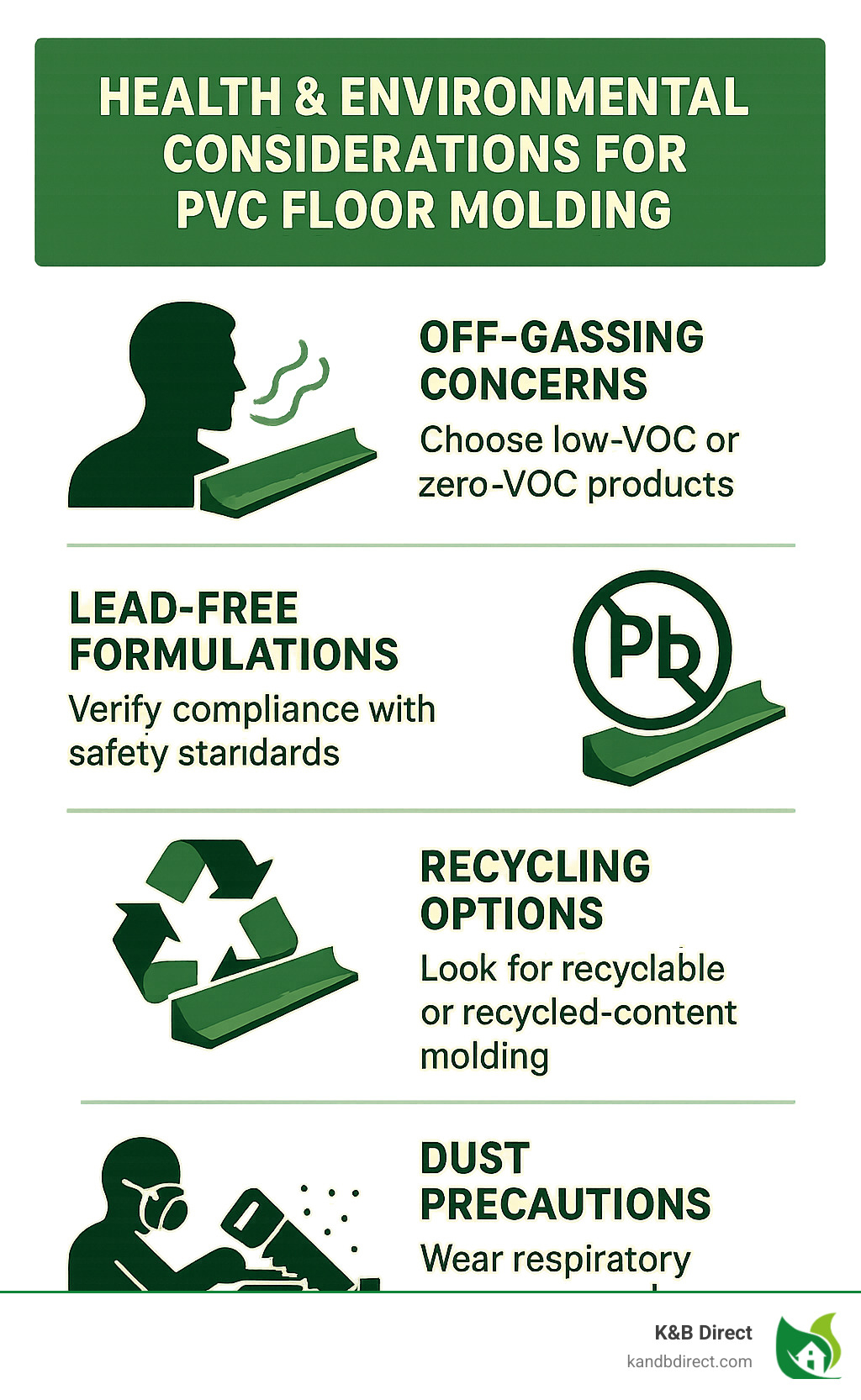
While PVC isn’t biodegradable, it is recyclable, and many manufacturers now incorporate recycled content in their moldings. As Maria, one of our environmentally-conscious customers shared, “I was concerned about using plastic in my home, but knowing my PVC trim contains 90% recycled materials made me feel better about the choice.”
If you’re doing your own installation, take proper precautions when cutting PVC. The resulting dust contains microplastics, so wear appropriate respiratory protection, work in well-ventilated areas, and clean up thoroughly afterward. As one of our installer friends quipped, “PVC cutting smells like burning hair—another good reason to use dust collection and ventilation!” A little humor helps, but safety matters.
Conclusion
Selecting the right PVC floor molding profiles for your home should feel exciting, not overwhelming. After all, these finishing touches are what transform a construction project into a home you’ll love for years to come.
When making your decision, keep a few key factors in mind. First, consider what each room needs. In spaces like bathrooms, kitchens, and basements where moisture is a constant companion, PVC floor molding shines brightest. Its waterproof nature simply outperforms wood or MDF alternatives that will eventually succumb to warping or mold.
Think about what each profile does for your space. Baseboards protect your walls and cover gaps, quarter round creates seamless floor-to-wall transitions, T-molding bridges same-height floors, reducers smooth the path between different floor heights, and stair nose adds both safety and style to your steps.
Size matters too! Your baseboards should generally match your ceiling height – taller ceilings call for more substantial baseboards. Most homes look balanced with baseboards between 3.25″ and 5.25″ in height, but trust your eye on what feels right in your space.
“I always tell my customers to bring a photo of their room when selecting molding,” says one of our Schiller Park associates. “It helps them visualize the finished product much better than just looking at samples in the store.”
While PVC floor molding comes in countless colors and finishes, classic white remains our bestseller because of its clean look and paintability. For homes with wood-look floors, matching or complementary vinyl finishes create that cohesive appearance that makes a house feel thoughtfully designed.
At K&B Direct, we take pride in offering a comprehensive selection of PVC floor molding options that won’t break your budget. Our team at both our Schiller Park and Chicago locations genuinely enjoys helping customers find the perfect profiles for their specific projects – whether you’re refreshing a single bathroom or changing an entire home.
We understand that these finishing touches aren’t just functional – they’re what lift your space from “done” to “stunning.” That’s why we focus on providing quality products with friendly service that ensures your vision becomes reality.
For more information about our complete selection of mouldings and millwork options, visit our mouldings & millwork section or stop by one of our showrooms. There’s nothing like seeing and feeling these products in person to appreciate the difference quality makes.
The right molding doesn’t just finish a floor—it completes your entire space, creating that polished, professional look that makes coming home a pleasure. With PVC options, you’ll enjoy that beautiful finish with minimal upkeep for years to come. And isn’t that what home improvements should be about? Beauty that lasts, not beauty that creates more work.