
Choose Cabinet Door Wood for Lasting Performance
For the best wood for cabinet doors, choose hard maple for daily wear, white oak for humid spaces and visible grain, or poplar for a smooth painted finish. Use straight, kiln-dried lumber at 6-8% moisture content, and favor quarter-sawn boards when stability matters most.
Hardwood doors resist dents and hold joinery better than pine. For wide doors, use frame-and-panel construction so the center panel can move with seasonal humidity. Plywood can make a lighter, stable slab door, while MDF is best kept away from moisture because it can swell permanently.
The right species is only part of the decision. Grain direction, door weight, hinge capacity, finish, and your home’s climate all affect whether a door stays flat and swings true for years.
I’m Eryk Piatkowski, Owner at K&B Direct, where we have helped homeowners and professionals create kitchens and baths since 2011. In this guide, I’ll help you compare the best wood for cabinet doors so you can match durability, style, and long-term performance to your space.
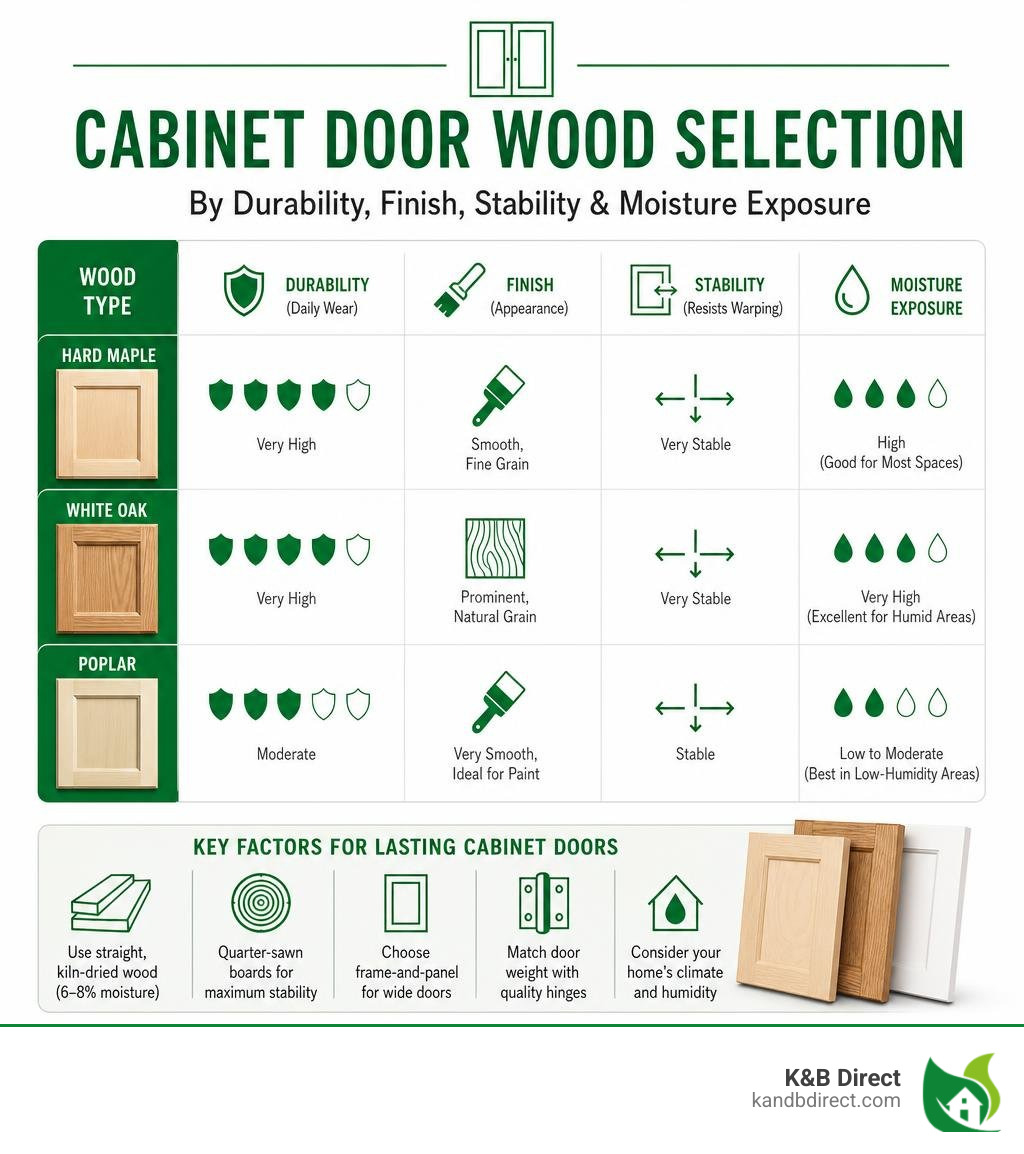
Best wood for cabinet doors definitions:
Evaluating the Best Wood for Cabinet Doors: Hardness, Stability, and Grain
Selecting lumber for doors requires balancing physical density, structural movement, and visual character. When building or updating front-facing panels, the species must resist daily mechanical impacts without transferring excessive weight to the frames.
Physical hardness is evaluated using the Janka scale, which measures the force required to embed a 0.444-inch steel sphere halfway into the wood sample. For residential cabinetry facing constant daily use, materials with ratings above 900 lbf deliver the resilience required to prevent dents from utensils, cookware, and repeated handling. You can discover more regarding material characteristics in our review of Choosing Wood for Durable Cabinet Doors (Wood Selection).
| Wood Species / Material | Janka Hardness (lbf) | Density (pcf) | Radial Shrinkage (%) | Tangential Shrinkage (%) | Primary Recommended Application |
|---|---|---|---|---|---|
| Hard Maple | 1,450 | 45 | 4.8% | 9.9% | High-traffic clear finishes, painted shaker stiles |
| White Oak | 1,360 | 47 | 5.6% | 10.5% | Stained rift/quarter-sawn luxury cabinets |
| Red Oak | 1,290 | 44 | 4.0% | 8.6% | Traditional open-grain stained assemblies |
| Yellow Birch | 1,260 | 43 | 7.3% | 9.5% | Cabinet carcasses, secondary frame components |
| Black Walnut | 1,010 | 38 | 5.5% | 7.8% | High-end natural clear-coat architectural fronts |
| Black Cherry | 950 | 35 | 3.7% | 7.1% | Traditional stained shaker panels, low-weight doors |
| Yellow Poplar | 540 | 28 | 4.6% | 8.2% | Paint-grade interior face frames and stiles |
| Baltic Birch Plywood | N/A (Multi-ply) | 40 | < 0.5% | < 0.5% | Stable slab cores, engineered floating panels |
Selecting the Best Wood for Cabinet Doors by Traffic and Durability
High-activity residential zones demand dense hardwoods that resist gouging. Hard sugar maple (Acer saccharum) stands out with a 1,450 lbf Janka rating, delivering three times the dent resistance of common softwoods. In field evaluations of busy residential kitchens, hard maple doors maintained with 6-8% moisture content show under 1% degradation over a decade of operation.

White oak (Quercus alba) offers an exceptional alternative at 1,360 lbf. Its closed cellular structure contains tyloses, which plug the vascular vessels and make it naturally resistant to water absorption. This quality makes it a superior option when building a custom wood cabinet for damp environments like master bathrooms, laundry spaces, or prep stations.
Grain Orientation and Dimensional Stability
Lumber moves unevenly across its anatomical axes. Tangential expansion (plain-sawn) creates almost twice the movement of radial expansion (quarter-sawn). Plain-sawn lumber can expand up to 8% across its width during seasonal shifts, whereas quarter-sawn boards expand only about 2.5%, making them over 50% less prone to cupping or twisting.
To ensure long-term stability:
- Orient vertical grain on stiles to keep door edges straight and prevent rubbing against adjacent openings.
- Use quarter-sawn or rift-sawn cuts for rail and stile joinery to minimize expansion across the joint lines.
- Groove solid center panels into the perimeter frame with 1/16-inch perimeter clearance, allowing the wood to float freely through seasonal humidity cycles.
Material Comparison: Hardwood, Softwood, and Engineered Panels
Achieving exceptional joinery requires balancing solid timber with engineered sheet goods. Solid lumber provides unmatched edge-shaping possibilities, while composite panels deliver uniform dimensional stability across wide surfaces. For a deeper perspective on construction techniques, review The Art of Material Selection for Cabinet Doors (Wood Finishing Secrets).
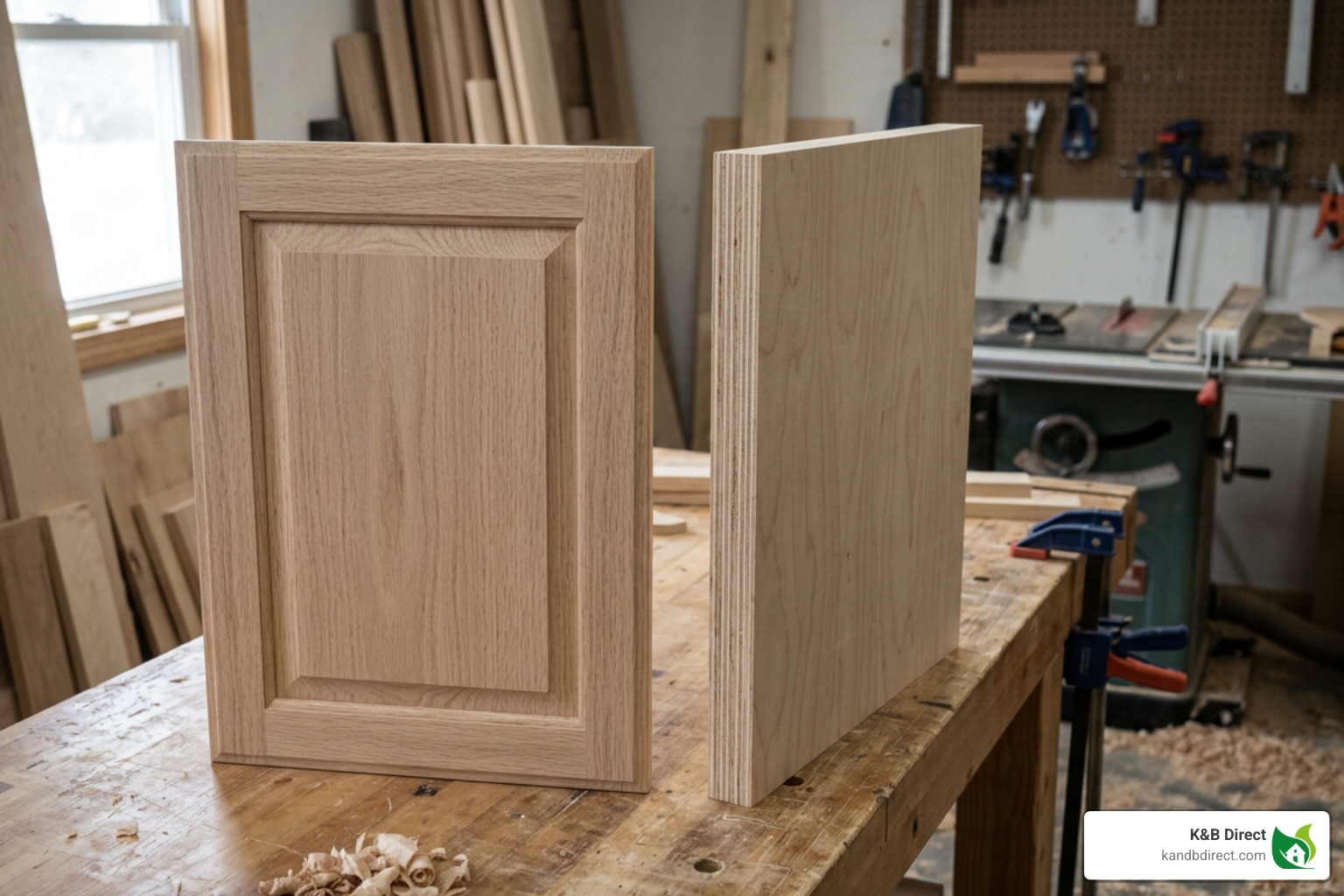
Solid Hardwoods vs. Softwoods
Fine hardwoods such as black cherry and American walnut provide rich, natural color and steady dimensional performance. Cherry has a modest density of 35 pcf, which keeps overall weight low while maintaining structural strength.
In contrast, softwoods like Eastern white pine feature low hardness ratings between 380 and 510 lbf. Fast-growing conifers contain soft earlywood rings that compress under light impacts. While softwoods can be used for rustic accents, they require careful sealing and support. When renovating heritage millwork or executing arched kitchen cabinet doors upgrade convert or replace projects, fine hardwoods ensure the arched profiles hold crisp detail without chipping over time.
Engineered Options: Baltic Birch Plywood and MDF
Engineered sheet goods solve the movement challenges common in wide slab designs. Premium Baltic birch plywood features 13 void-free plies of cross-banded birch veneer in a 3/4-inch thickness, creating exceptional screw-holding power and five times the structural stability of standard fiberboards.
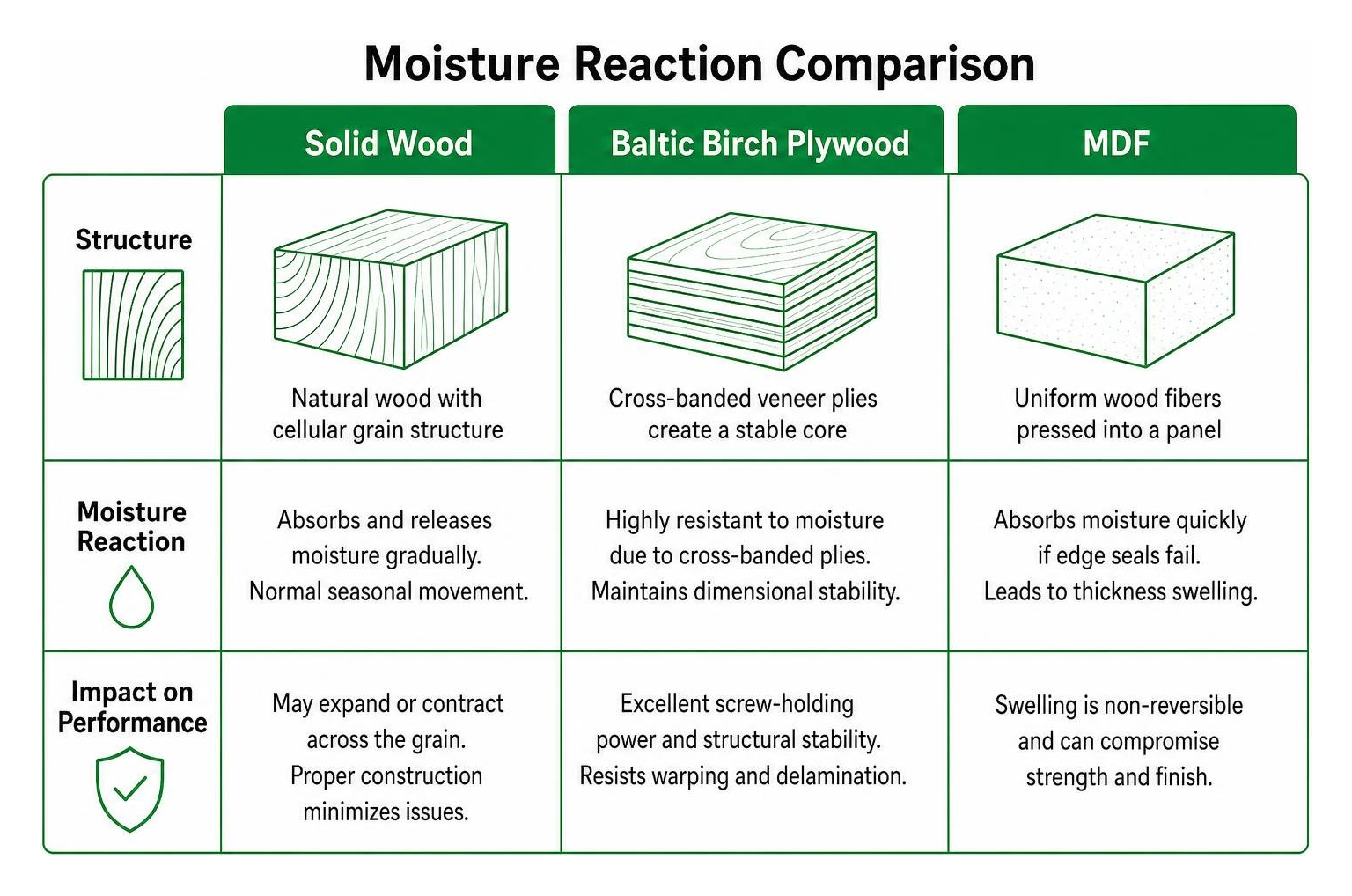
Medium-density fiberboard (MDF) provides a smooth, uniform surface without grain patterns, making it popular for painted center panels. However, standard MDF absorbs moisture quickly if edge seals fail, leading to non-reversible thickness swelling.
For reliable results, many professional cabinetmakers use a balanced approach:
- Structural carcasses and shelving built with multi-ply veneer cores for rigid support.
- Front frames and door perimeters crafted from solid maple or oak for impact resistance.
- Floating interior door panels made from moisture-sealed MDF or veneered cores to prevent seasonal seam separation.
This method ensures durable cabinet boxes that stay true through seasonal shifts.
Finish Matching: Paint-Grade vs. Stain-Grade Selections
The choice between a painted or natural finish directly impacts lumber selection. Applying pigmented finishes over open-pored or knot-rich woods can reveal grain lines and telegraph seams over time. More practical advice on material characteristics is available in Birch vs Maple Plywood for Cabinets: Which to Choose.
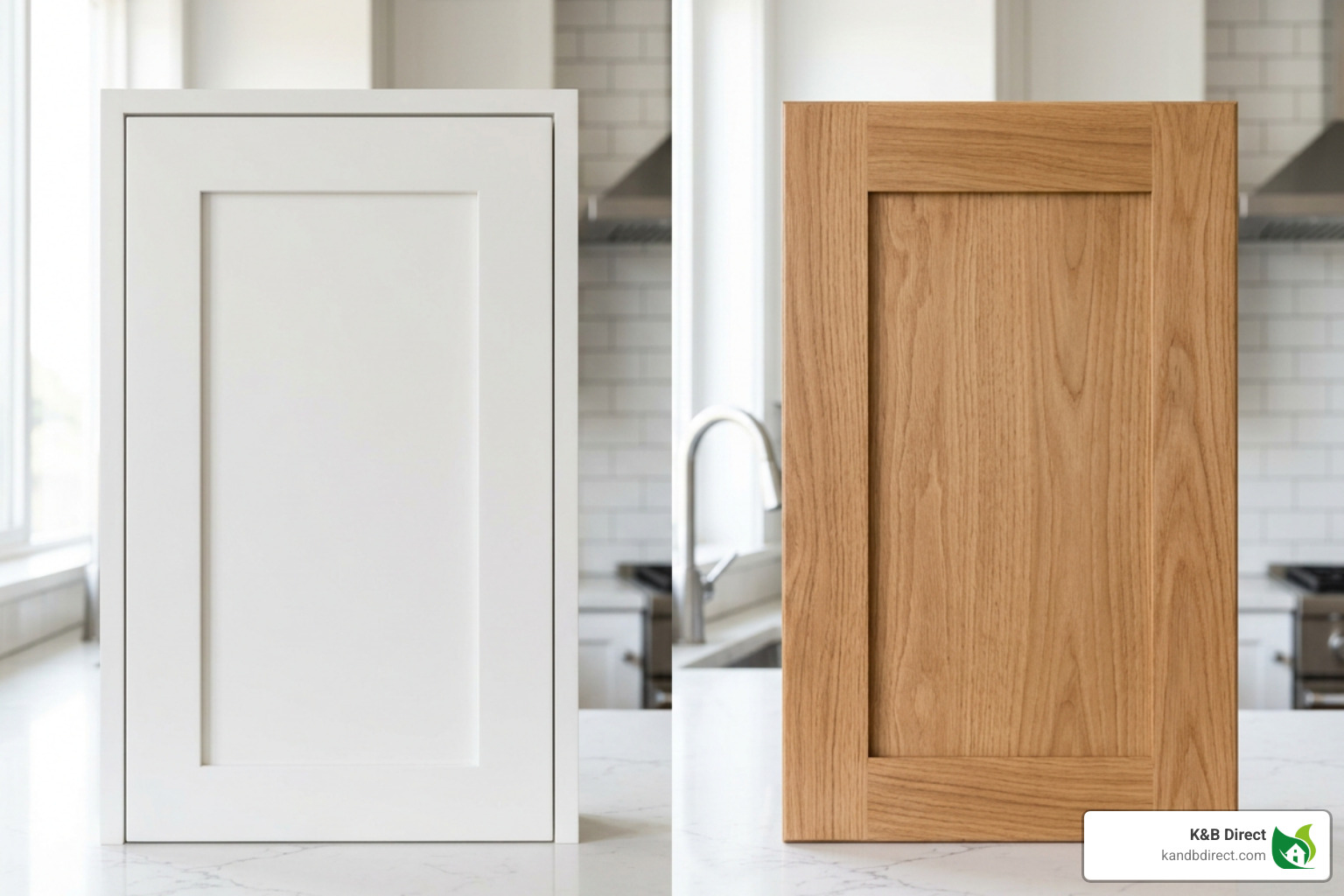
Finding the Best Wood for Cabinet Doors for Stained vs. Painted Finishes
For painted cabinetry, tight closed-grain hardwoods are ideal. Yellow poplar machines cleanly, holds sharp profiles, and offers a uniform surface for primers. Because poplar’s natural color ranges from pale cream to olive green, it is best suited for opaque coatings. When creating the ultimate guide to modern white shaker cabinets, hard maple stiles paired with premium MDF center panels provide a smooth, durable finish.
Stained finishes look best on distinct grain patterns like oak, cherry, and walnut. However, diffuse-porous species like birch and maple can absorb liquid pigment unevenly, leading to dark blotches. To achieve an even stained finish on these species:
- Sand surfaces evenly up to 180-grit using sequential abrasive steps.
- Apply a high-grade solvent or pre-stain conditioner to balance surface absorption.
- Use pigmented gel stains or spray-applied dye stains rather than standard penetrating oil stains.
- Topcoat with non-yellowing water-borne acrylic or conversion varnish to preserve natural wood tones.
Architectural Cohesion with Casings and Mouldings
Doors should complement the broader architectural details of the room. Aligning wood species and profile lines creates a unified look from baseboards to ceiling transitions.
Pairing perimeter doors with matching cabinet trim creates a cohesive look. When framing built-in units, choosing complementary cabinet casing ties the millwork seamlessly into existing wall casings and base mouldings.
Engineering Considerations: Weight, Density, and Moisture Content
Cabinet doors act as horizontal cantilevers supported by vertical hinges. Exceeding recommended weight thresholds or using unseasoned timber can lead to sagging, misaligned reveals, and hardware binding. For detailed engineering calculations, refer to Weight Considerations for Cabinet Door Materials (Engineering Choices).
Strength-to-Weight Ratios and Hinge Sag Prevention
A door’s weight directly affects hardware lifespan. A 24-inch by 30-inch solid red oak door (3/4-inch thickness) weighs approximately 14 lbs, while an identical door made from poplar weighs roughly 6 lbs. Engineered plywood cores reduce door weight by 20% to 30% compared to heavy hardwoods, reducing continuous stress on mounting plates.
When engineering heavy door installations:
- Calculate total panel mass before selecting hardware.
- Use concealed European-style hinges with 35mm cup pockets, rated for 1.5 times the calculated door mass.
- Install three hinges on panels exceeding 36 inches in height or 12 lbs in mass, adding a fourth hinge for doors taller than 60 inches.
- Ensure hinge screws penetrate at least 5/8-inch into solid hardwood mounting plates to prevent thread pullout.
For homeowners reviewing options at the best place to buy cabinet doors for home kitchen renovations, checking door weight against hinge ratings prevents long-term sagging.
Moisture Content Matching and Climate Control
Moisture balance is essential for long-term cabinet performance. Wood is hygroscopic, expanding as it absorbs humidity and shrinking as it dries. Indoor cabinetry performs best when seasoned to 6-8% moisture content (MC). Bringing lumber with a 12% MC into a heated home can result in up to 1/8-inch of shrinkage across a 12-inch panel, causing joint separations and finish cracks.
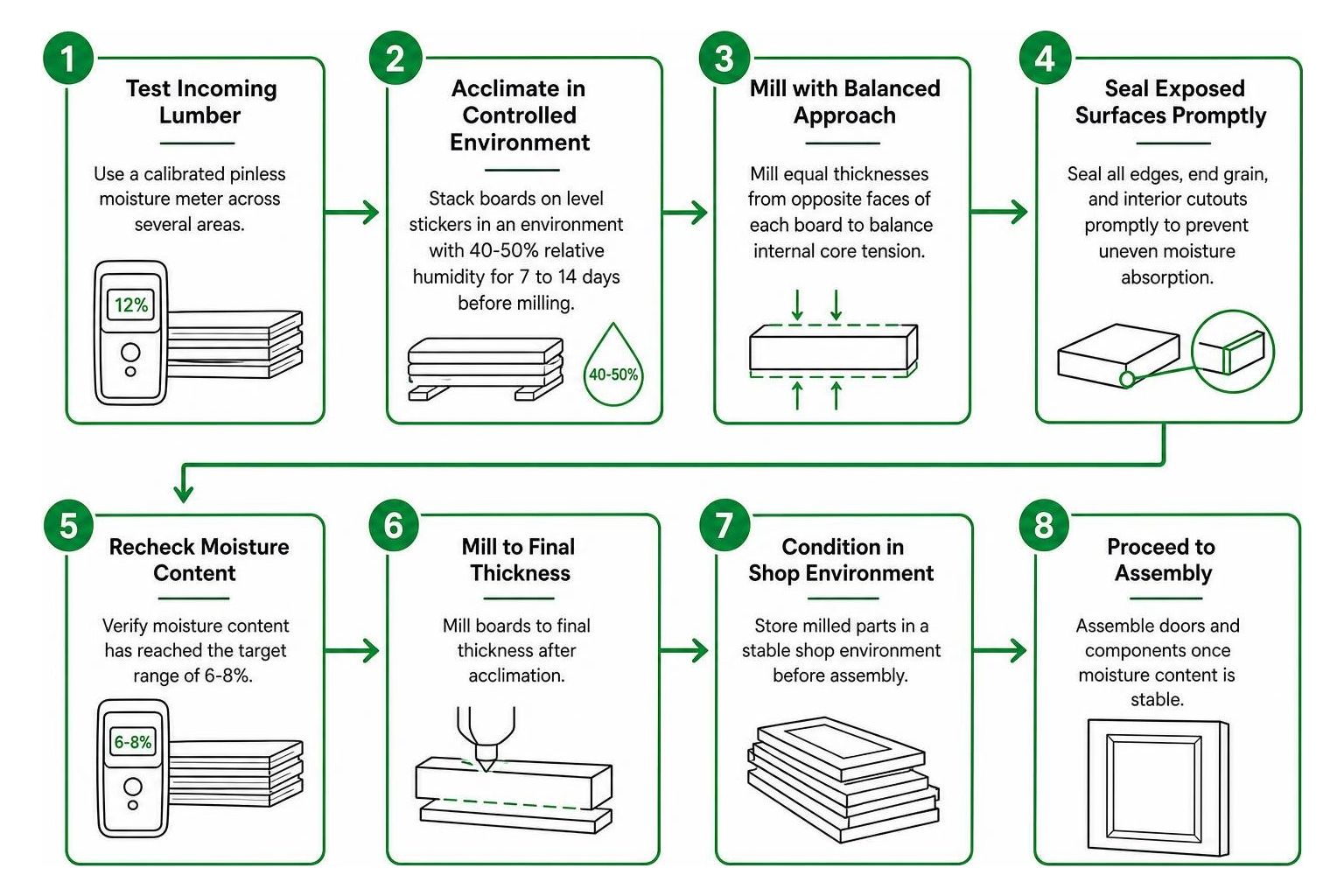
To prevent moisture-related defects:
- Test incoming lumber with a calibrated pinless moisture meter across several areas.
- Stack boards on level stickers in an environment with 40-50% relative humidity for 7 to 14 days before milling.
- Mill equal thicknesses from opposite faces of each board to balance internal core tension.
- Seal all edges, end grain, and interior cutouts promptly to prevent uneven moisture absorption.
Frequently Asked Questions About Cabinet Door Lumber
Can MDF be used for bathroom and kitchen cabinet doors?
MDF performs reliably for interior floating panels in climate-controlled spaces when fully encased in paint. However, unsealed raw MDF absorbs airborne humidity quickly. In high-moisture bathroom environments or near kitchen sinks, moisture can enter unsealed micro-gaps, causing edges to swell permanently. For moisture-prone areas, solid white oak, hard maple, or marine-grade plywood panels offer superior long-term performance.
Why is hard maple preferred over soft maple for cabinet doors?
Hard sugar maple (Acer saccharum) features a Janka hardness of 1,450 lbf, making it approximately 50% more dent-resistant than red or silver soft maple species (Acer rubrum / saccharinum, rated at 700-950 lbf). While soft maple machines easily, hard maple provides the long-term impact resistance needed for busy kitchens.
What is the professional standard for combining materials in cabinetry?
Professional custom shops often combine materials for optimal performance. The cabinet box carcass is typically built from 3/4-inch pre-finished birch or maple veneer-core plywood for structural alignment and weight savings. Face frames and door stiles are made from solid hard maple or white oak for durability and secure hinge mounting, while center panels use veneered stable cores or moisture-sealed MDF to eliminate movement cracks.
Conclusion
Building beautiful, durable doors comes down to understanding wood species, grain alignment, internal moisture, and hardware capacities. Selecting quarter-sawn hard maple or white oak at 6-8% moisture content and maintaining balanced joinery helps prevent warping, sagging, and finish cracking over years of use.
At K&B Direct, we help homeowners and builders bring their design visions to life across the greater Chicago area, including Schiller Park, Rosemont, Park Ridge, Des Plaines, Schaumburg, and surrounding communities. Discover our collection of premium kitchen cabinets to find durable, finely crafted designs tailored to your home.