
The Case for 4-Inch Flat Baseboards in Today’s Homes
4 flat stock baseboard is one of the most practical and versatile trim choices available for modern renovations. It’s clean, simple, and works in almost any room — yet it rarely gets the attention it deserves.
Here’s a quick comparison to help you decide if it’s right for your project:
| Feature | 4″ Flat Stock Baseboard | Profiled Baseboard |
|---|---|---|
| Style | Modern, minimalist, Craftsman | Traditional, ornate |
| Material | MDF or finger-jointed pine | Wood, MDF |
| Surface | Smooth, knot-free, paint-ready | Varies |
| Installation | Butt joints or mitered joints | Requires precise mitering |
| Common thickness | 1/2″ to 5/8″ | Varies |
| Best for | Contemporary and Craftsman homes | Classic or Victorian homes |
Flat stock baseboards skip the decorative curves and grooves. Instead, they use a straight, clean profile that blends seamlessly into modern interiors. They’re primed, paint-ready, and much easier to install than traditional mouldings — making them a smart choice for renovators who want a polished result without the complexity.
I’m Eryk Piatkowski, owner of K&B Direct, and with over a decade of experience helping homeowners select quality millwork — including 4 flat stock baseboard — I’ve seen how the right trim choice transforms a space. Let’s break down everything you need to know.
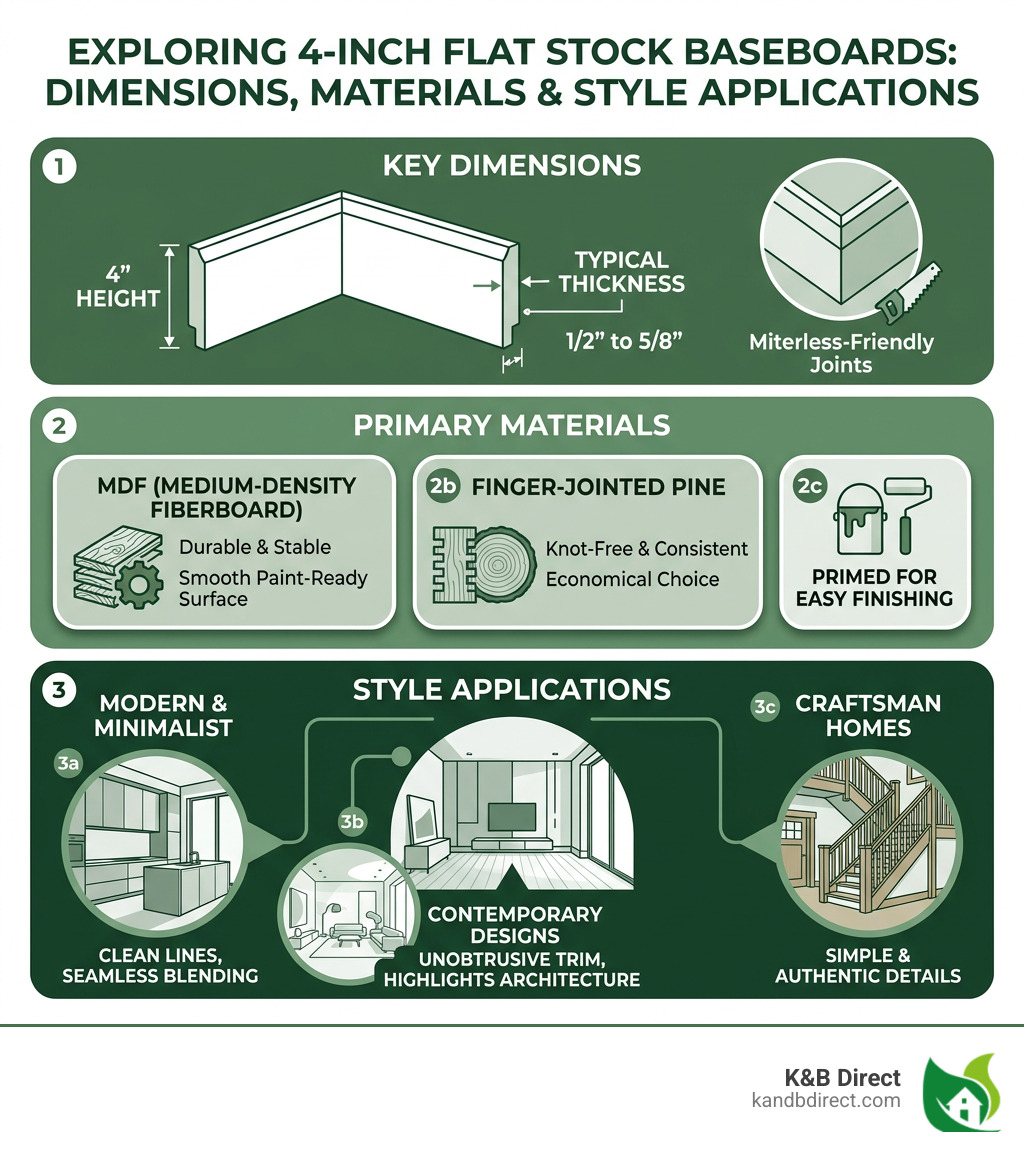
Discover more about 4 flat stock baseboard:
Defining the Modern Aesthetic
When we talk about modern design in the Chicago area, we often emphasize clean lines and the absence of unnecessary clutter. This is where the 4 flat stock baseboard truly shines. Unlike traditional profiles like Colonial or Ogee, which feature multiple “steps” or curves, flat stock provides a singular, bold vertical plane. This simplicity creates a crisp transition between the wall and the floor, allowing other architectural elements—like a statement furniture piece or a bold paint color—to take center stage.
This style is a hallmark of the Craftsman movement, which values honesty in materials and structural clarity. In a Craftsman-style home, you’ll often see these baseboards paired with matching 3-1/2″ window and door casings to create a cohesive, framed look throughout the room. If you are aiming for a truly contemporary feel, you might explore modern base moulding options that utilize these straight edges to emphasize the height of a room. For more information on how profiles affect the look of your home, check out our baseboard moulding guide.
One of the subtle details that sets high-quality flat stock apart is the “eased edge.” While the board looks crisp and angular, the very top corner is slightly rounded off. This prevents the wood from splintering and makes the edge much more resistant to impact from vacuum cleaners or wandering toys.
Material Options for 4 Flat Stock Baseboard
Choosing the right material for your 4 flat stock baseboard depends on your priorities for durability and finish. We primarily see two heavy hitters in the Illinois market: Primed MDF and Primed Finger-Jointed (FJ) Pine.
Primed MDF (Medium Density Fiberboard)
MDF is the go-to for many of our customers in Barrington and Arlington Heights because of its incredible smoothness. Because it is an engineered product, it has no knots, grain patterns, or sap streaks that might bleed through your paint. It is also highly stable, meaning it won’t expand and contract as much as solid wood during our humid Chicago summers and dry winters. For those concerned about safety and composition, you can review the MDF Material Safety Data Sheet for technical details.
Primed Finger-Jointed Pine and Poplar
If you prefer the feel of real wood, finger-jointed pine is a fantastic alternative. Small pieces of clear wood are joined together to create long, straight lengths. This process removes the natural tension in the wood, making the boards less likely to warp or “cup” over time. For a premium finish, American Poplar is often used. It is a hardwood that provides a denser, more dent-resistant surface while remaining paint-ready.

Installation and Finishing Techniques
The beauty of a 4 flat stock baseboard is that it doesn’t require a master carpenter’s touch to look professional. However, understanding the dimensions is key to a successful project. While we call it “4-inch,” the actual height is often 3-1/2 inches (if using standard 1×4 stock) or a true 4-1/4 inches for specialized moulding profiles.
| Height | Common Thickness | Style Match |
|---|---|---|
| 4″ to 4-1/4″ | 1/2″ or 9/16″ | Standard ceilings (8ft), Modern/Craftsman |
| 5-1/4″ | 5/8″ | Higher ceilings (9ft), Transitional |
| 7-1/4″ | 5/8″ | Grand rooms (10ft+), Bold Minimalist |
Many high-quality flat stock boards feature a “relief cut” on the back. This is a shallow groove or concave sweep that allows the board to sit flatter against a wall that might not be perfectly plumb. It also helps prevent the board from cupping as it ages. You can learn more about picking the right size in our baseboard trim selection guide.
Installation Tips for 4 Flat Stock Baseboard
One of the biggest advantages of this style is the ability to use miterless joints. In traditional moulding, corners must be cut at precise 45-degree angles (mitering) or “coped” to fit together. With flat stock, you can use simple “butt joints” where one board ends squarely against the face of another. This is especially effective if you use a slightly thicker casing for your doors, allowing the baseboard to terminate cleanly against the side of the door trim.
For the best results:
- Brad Nails: Use a 16-gauge or 18-gauge nailer to secure the boards to the wall studs.
- Adhesive: In addition to nails, a bead of construction adhesive on the back of the board ensures a permanent bond, especially on long runs.
- Corners: If you prefer a traditional look, you can still miter the corners. Check out our guide on baseboard corner cutting methods for a step-by-step walkthrough.
- Customization: If you want a slightly more detailed look, you can add a base cap moulding to the top of the flat stock.
Choosing the Right 4 Flat Stock Baseboard for Your Home
When ordering, consider the length of your walls to minimize joints. Standard lengths typically include:
- 8-length: Great for small bathrooms or closets; easy to transport in a standard vehicle.
- 12-length: The “sweet spot” for most residential rooms.
- 16-length: Ideal for long hallways or open-concept living areas to create a seamless look.
Investing in 4 flat stock baseboard is also a smart move for your home’s valuation. It provides a finished, high-end look that appeals to modern buyers without the heavy expense of ornate hardwoods. You can browse our full range of options in our baseboard category overview.
Performance and Durability Standards
At K&B Direct, we prioritize products that stand the test of time. A quality 4 flat stock baseboard should offer excellent resistance to the daily wear and tear of a busy household. Because our products come pre-primed, they are ready for a final coat of high-quality latex paint immediately after installation.
Durability isn’t just about dents; it’s about safety too. When working with any wood product, it is important to be aware of the California Proposition 65 wood dust warning, which notes that wood dust can be harmful if inhaled. Always cut your trim in a well-ventilated area and wear a mask.
The eased edges we mentioned earlier are crucial for splinter prevention. By removing the sharp 90-degree corner at the top of the board, the paint adheres better and the wood is less likely to chip if bumped. This results in a smooth, paint-ready surface that maintains its “just installed” look for years.
Frequently Asked Questions
Can flat stock be used for door casings?
Absolutely! In fact, we highly recommend it for a cohesive room design. Using the same 4 flat stock baseboard material for your door and window casings creates a strong architectural consistency. If you want a bit of hierarchy, you might use a 3-1/2″ width for the doors and the 4-1/4″ height for the baseboards. To add a touch of flair to these flat surfaces, you can explore different base cap profiles.
What paint works best on primed MDF?
MDF is incredibly thirsty, but since our stock comes pre-primed, the hard work is done for you. We recommend using a high-quality semi-gloss or satin latex-based paint. These finishes are durable and easy to wipe clean. Because the surface is knot-void, the paint will lay down perfectly smooth, giving you a professional “sprayed” look even if you use a brush or roller.
Does this style work on uneven floors?
This is a common concern in older homes throughout Chicago and the surrounding suburbs. While flat stock is rigid, boards with relief cuts or back-side grooves are more forgiving. If you have significant gaps between the bottom of the baseboard and an uneven floor, you can use a two-piece base molding solution. This involves adding a small piece of “shoe moulding” or “quarter round” to the bottom of the flat stock. The shoe moulding is flexible and can follow the contours of the floor while the baseboard remains perfectly level.
Conclusion
The 4 flat stock baseboard is proof that you don’t need complex patterns to make a bold statement. Whether you are updating a bungalow in Glen Ellyn or finishing a new build in South Barrington, this trim style offers the perfect blend of modern aesthetics and practical durability.
At K&B Direct, we are dedicated to helping you achieve your dream home aesthetics. We provide top-quality millwork and mouldings with strong overall value, ensuring you don’t have to compromise on quality to stay within your project’s needs. From Chicago to Lake Zurich, we are here to serve our local communities with friendly service and expert advice.
Ready to transform your space? Shop all baseboard mouldings at K&B Direct today!