Why Your Garage Walls Need a Garage Vinyl Baseboard
Garage vinyl baseboard is one of the smartest, most overlooked upgrades you can make to protect your garage walls — and choosing the right one makes a real difference.
Quick answer: What is a garage vinyl baseboard and why does it matter?
- It is a flexible strip of vinyl (also called cove base) installed where your wall meets the floor
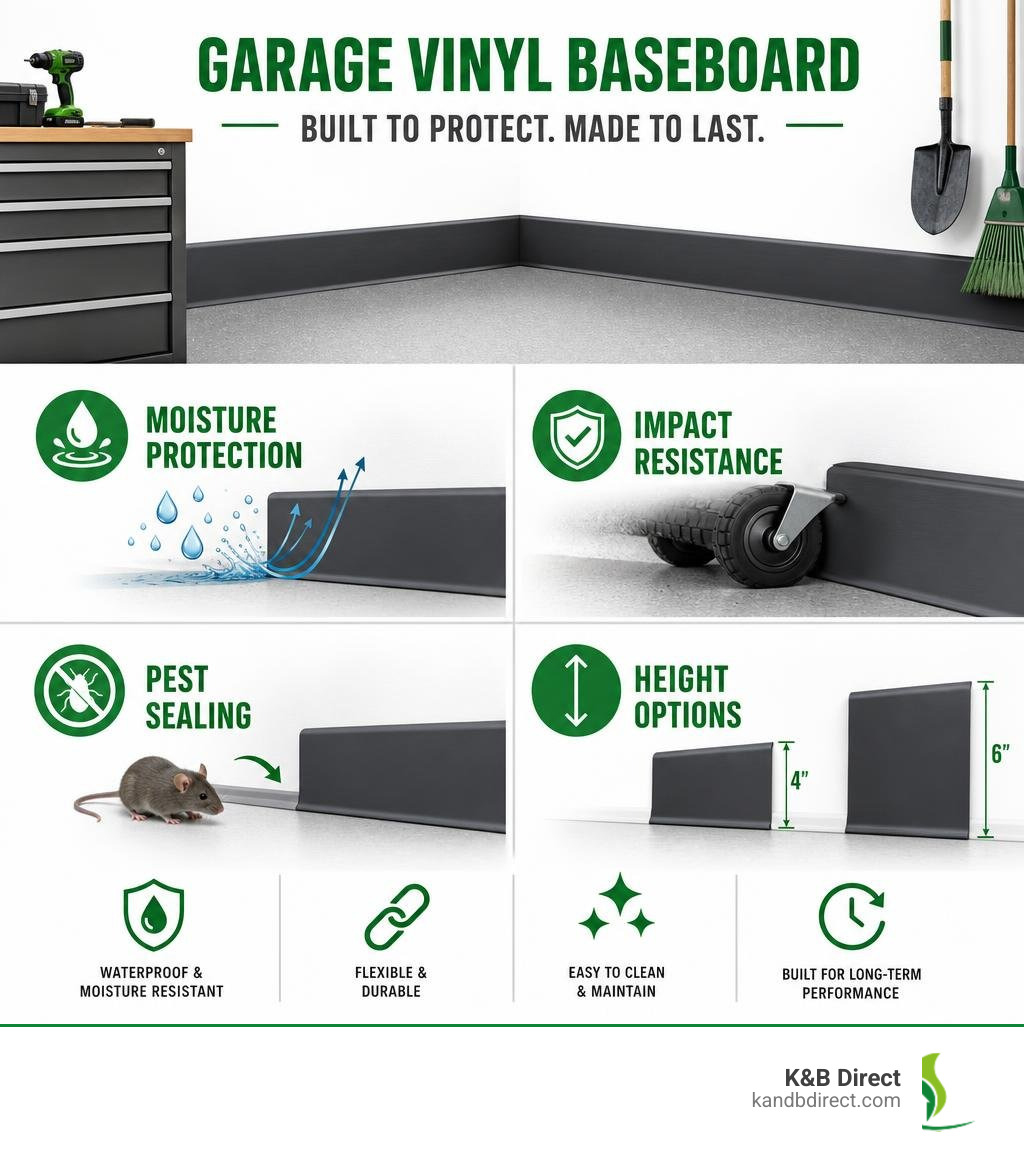
- It seals the gap between the wall and concrete, blocking moisture, pests, and dirt
- It protects drywall from scuffs caused by tools, equipment, and vehicles
- Standard heights are 4 inches and 6 inches — 6-inch offers better coverage in hard-working spaces
- It comes in self-adhesive (peel-and-stick) or glue-down (dry-back) formats
- Top materials include thermoplastic vinyl (TV), thermoplastic rubber (TR), and thermosetting rubber (TS)
Garages are tough on walls. Snow melt, road salt, and splashed water pool along the floor line. Lawnmowers, rolling toolboxes, and car doors leave marks. Standard wood or MDF trim absorbs moisture and falls apart fast. Vinyl baseboard is built for exactly these conditions — waterproof, flexible, and durable enough to handle years of daily punishment.
One forum member on an online garage forum put it simply: they installed vinyl baseboard in their one-car garage five years ago, and it still looks great.
I’m Eryk Piatkowski, owner of K&B Direct, and after more than a decade helping homeowners and renovators choose the right trim and moulding solutions — including garage vinyl baseboard — I know what holds up and what doesn’t. In the sections below, I’ll walk you through everything you need to choose the right product for your space.
Basic garage vinyl baseboard vocab:
Choosing the Best Garage Vinyl Baseboard for Your Garage
Selecting the right trim for a utility environment or vehicle storage area requires a shift in mindset compared to choosing trim for your living room. In a residential garage, the floor level is exposed to vehicle-tracked moisture, dirt, and heavy impacts.

When we look at material selection, several options exist on the market. Traditional wood or Medium-Density Fiberboard (MDF) trim absorbs water like a sponge, leading to swelling, mold, and rot. This is why we highly recommend waterproof materials. You can read more about these options in our guide on Vinyl Trim That Wins the Floor War.
Thickness and height are critical dimensions to evaluate. The standard commercial thickness is 1/8 inch (0.125 inches), which provides a robust barrier against impact from lawnmowers, heavy boots, and rolling equipment. For lighter-duty applications, a 0.080-inch thickness is also available.
Height selection typically comes down to 4-inch or 6-inch options. While 4-inch trim is a common standard, opting for a 6-inch height provides significantly better protection against water splashes, mud, and chemical spills. It also hides any rough drywall cuts or uneven concrete transitions more effectively.
Benefits of Garage Vinyl Baseboard Over Other Materials
Why choose a garage vinyl baseboard over wood, metal, or pure rubber? The primary reasons are moisture protection, impact resistance, and long-term durability in unconditioned spaces.
- Moisture Resistance: Unlike wood or MDF, vinyl is completely waterproof. It will not rot, warp, or split when exposed to standing water, melting snow, or road salt tracked in by your tires. For spaces where water exposure is a constant concern, exploring Waterproof Baseboard Options is essential.
- Impact Resistance: Thermoplastic vinyl (TV) is highly durable, possessing a high density and tensile strength. It absorbs impacts from tools and sports equipment without denting or cracking.
- Flexibility: Unlike rigid wood or metal, flexible vinyl easily conforms to slightly curved walls or uneven concrete floors, creating a tighter seal.
- Maintenance: Vinyl requires no painting, staining, or sealing. A simple wipe-down with a damp cloth or mild detergent is all it takes to keep it clean.
When compared to rubber options, thermoplastic vinyl is highly economical while still providing exceptional durability. While thermosetting rubber (TS) offers ultimate resistance to extreme temperature changes without shrinking, premium thermoplastic vinyl remains the go-to solution for most residential utility spaces due to its balance of performance and straightforward installation.
Key Features of Premium Garage Vinyl Baseboard
When browsing for high-quality garage vinyl baseboard, look for specific design features that enhance both performance and aesthetics:
- Cove Profile with a Toe: A “cove” base features a flared bottom edge (the toe) that curves outward. This toe bridges the gap between the wall and the concrete floor, sealing out dust, water, and insects. It also makes sweeping and mopping much easier.
- Substantial Height: Going with a taller profile makes a massive difference in utility spaces. Learn more about the advantages of Going Big with 6 Inch Vinyl Baseboards to maximize your wall protection.
- Color Versatility: While white and gray are popular, black is a classic choice for garages. It excels at hiding scuffs, tire marks, and grease stains. Discover Why Black Vinyl Baseboard Trim is Always in Style to see its ability to elevate your garage design.
Comparing Self-Adhesive and Glue-Down Wall Base
When preparing for your installation, you must choose between self-adhesive (peel-and-stick) and traditional dry-back (glue-down) options. Each has its advantages depending on your garage environment and local climate conditions in the Chicago area.
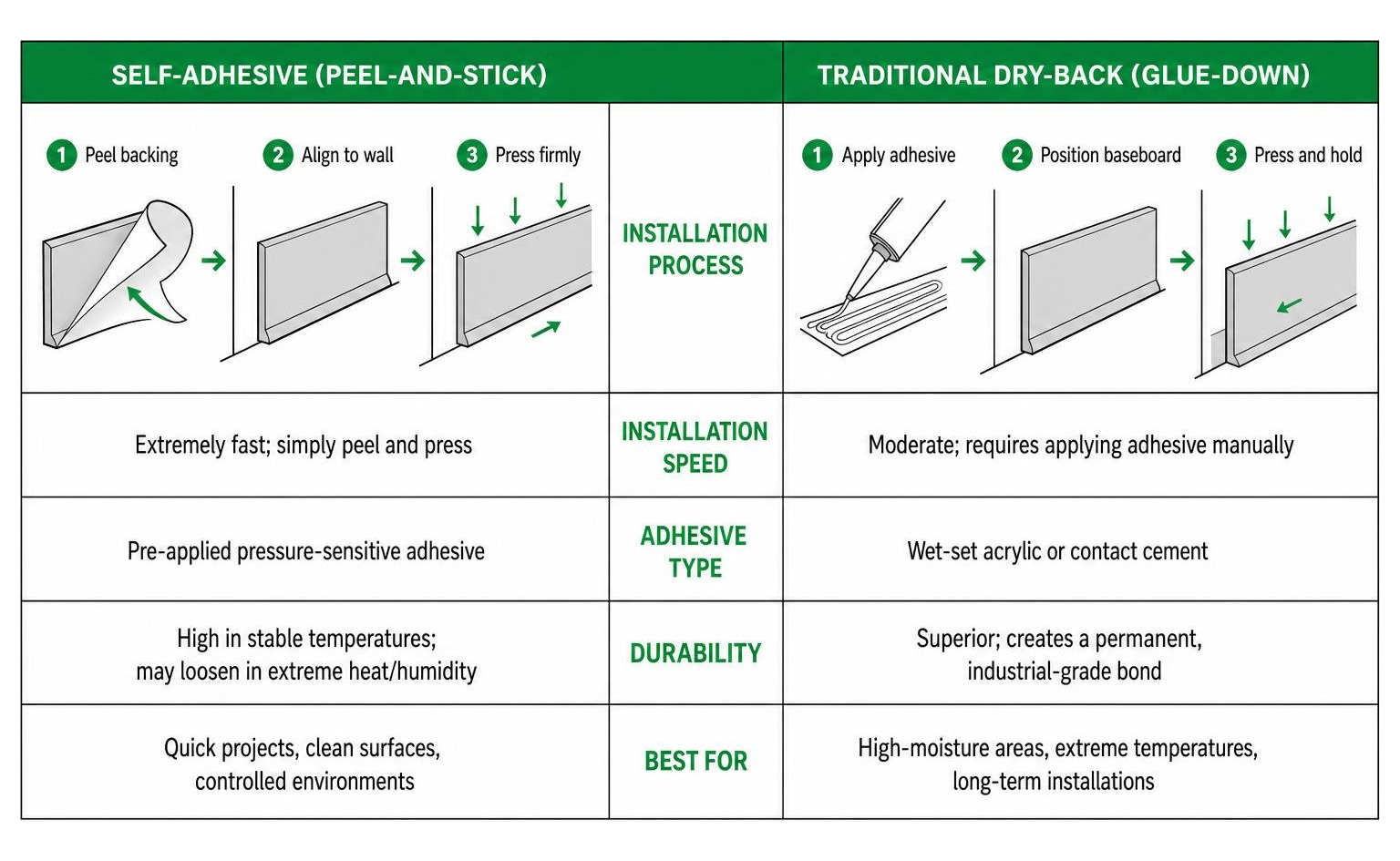
| Feature | Self-Adhesive (Peel-and-Stick) | Traditional Dry-Back (Glue-Down) |
|---|---|---|
| Installation Speed | Extremely fast; simply peel and press | Moderate; requires applying adhesive manually |
| Adhesive Type | Pre-applied pressure-sensitive adhesive | Wet-set acrylic or contact cement |
| Durability | High in stable temperatures; may loosen in extreme heat/humidity | Superior; creates a permanent, industrial-grade bond |
| Required Tools | Utility knife, tape measure, hand roller | Utility knife, tape measure, adhesive trowel, cartridge gun |
| Best For | Quick updates, climate-controlled garages | Unconditioned spaces, high-moisture areas |
Self-adhesive vinyl baseboards are incredibly popular for straightforward, quick updates. However, in unconditioned spaces subject to the extreme seasonal temperature swings of northern Illinois—from freezing winters in Schaumburg and Des Plaines to humid summers in Oak Brook and Elmhurst—adhesive performance is critical.
Traditional dry-back vinyl baseboards, applied with a heavy-duty, moisture-resistant wet-set adhesive, offer the strongest long-term bond. The ribbed backing on dry-back trim is specifically engineered to grip the adhesive and lock onto the wall. For a deeper look into the way real-world homeowners evaluate these options, check out the Vinyl Baseboard Discussion on an online garage forum.
Professional Installation and Wall Preparation Guide
Achieving a clean, long-lasting installation starts with meticulous preparation. If the surface is dusty, greasy, or damp, no adhesive—whether self-stick or heavy-duty glue—will bond properly.
Follow this step-by-step process to prepare your garage walls:
- Remove Old Trim: Never install new vinyl baseboard over old, rotting wood or peeling plastic. Strip the old trim away entirely.
- Clean the Surface: Scrape away old glue, loose paint, and drywall dust. Wipe the lower wall and floor transition with a degreaser or isopropyl alcohol to remove oil, grease, and dirt.
- Dry Completely: Ensure the wall and floor are completely dry before proceeding. Moisture trapped behind the vinyl can lead to adhesive failure and mold growth.
- Acclimate the Material: Unroll your vinyl baseboard and let it lay flat in the garage for at least 24 hours. This allows the material to relax, flatten, and acclimate to the local temperature, preventing shrinkage later.
- Mark a Guide Line: Draw a faint pencil line along the wall at the exact height of your trim (e.g., 4 or 6 inches) to ensure a perfectly straight installation.
For more detailed strategies on handling trim projects, refer to this guide on Installation Guide for Baseboards and Trim.
Handling Inside and Outside Corners
Corners are where many trim projects go wrong. Because vinyl baseboards are flexible, you have a few options for creating clean transitions:
- Wrapping Outside Corners: Instead of cutting the vinyl at an outside corner, you can wrap it. Score the back of the vinyl baseboard slightly with a utility knife along the corner line (do not cut all the way through). Use a hair dryer to gently warm the vinyl, making it highly pliable, then wrap it tightly around the corner and hold it in place until it cools and sets.
- Mitering Inside Corners: For inside corners, a 45-degree miter cut on overlapping pieces creates a tight, professional joint.
- Using Corner Connectors: If you want to avoid complex cuts, you can purchase pre-fabricated, color-matched corner connectors. These connectors adhere directly to the corner, and the straight runs of your vinyl baseboard simply butt up against them for a seamless look.
Managing Uneven Floors and Wall Gaps
Concrete floors in residential garages are rarely perfectly flat. They often slope toward a drain or have slight dips. Here is the method to handle these imperfections:
- Scribing: If the concrete floor has significant waves, hold the vinyl baseboard against the wall, use a compass or contour gauge to trace the floor’s profile onto the bottom of the vinyl, and trim it carefully with utility shears.
- Using Base Shoe Moulding: If you prefer not to cut the main baseboard, install the vinyl trim level, then apply a highly flexible PVC Floor Molding or base shoe along the bottom to mask any remaining gaps.
- Silicone Sealant: Apply a high-quality, flexible silicone caulk along the top edge of the baseboard and where the toe meets the concrete floor. This seals out water completely and hides minor gaps.
Frequently Asked Questions about Garage Wall Base
Can vinyl wall base handle extreme temperature swings?
Yes, premium thermoplastic vinyl is engineered to withstand substantial temperature fluctuations. In the Chicago area, unconditioned garages can experience temperature swings from sub-zero winter days to over 100 degrees Fahrenheit in the summer.
While vinyl does expand and contract slightly, using a high-quality, flexible adhesive ensures the bond remains secure. If you are installing self-adhesive trim in temperatures below 68 degrees Fahrenheit, we recommend using a hair dryer to warm and activate the adhesive backing during installation to guarantee a strong bond.
Should old trim be removed before installing new vinyl base?
Absolutely. Installing new vinyl baseboard directly over old, damaged wood or peeling trim is a recipe for failure. Removing the old material allows you to inspect the drywall or concrete for moisture issues, clean the surface thoroughly, and achieve a flat, secure bond. For advice on choosing rot-free materials, take a look at our guide on No More Rot: Choosing and Buying PVC Baseboard Trim.
What is the purpose of a cove base with a toe?
The flared toe at the bottom of a cove base serves both practical and sanitary purposes. It curves outward to cover the expansion gap between the drywall and the concrete floor. This curve creates a tight seal that prevents water, dirt, sawdust, and pests from slip-streaming under your walls. It also eliminates sharp, 90-degree corners where dirt and debris love to accumulate, making cleanup a breeze.
Conclusion
Upgrading your garage with a durable garage vinyl baseboard is a highly effective way to protect your walls, keep out pests, and create a clean, professional look. Whether you choose a classic 4-inch profile or opt for the enhanced protection of a 6-inch black vinyl trim, this simple addition will keep your hard-working space looking great for years to come.
At K&B Direct, we are dedicated to helping homeowners across the Chicago area—from Schiller Park and Park Ridge to Schaumburg and Elmhurst—find the highest quality mouldings and trim at the absolute lowest possible rates.
Ready to transform your garage? Explore our extensive selection of Baseboard Trim and browse our full catalog of Molding and Baseboards to find the perfect fit for your next project.