
Why Alder Trim Boards Belong in Your Next Renovation
Alder trim boards are one of the most versatile and underrated finishing materials available for residential renovations today. Whether you’re updating a kitchen, bathroom, or living space, alder delivers a warm, natural look that works across a wide range of design styles — from rustic cabin to modern contemporary.
Quick answer: What makes alder trim boards a strong choice?
- Natural warmth — Alder has a light reddish-brown tone that deepens beautifully over time
- Easy to work with — It machines, sands, and finishes smoothly with standard woodworking tools
- Two distinct looks — Choose clear/superior grade for a clean finish, or knotty alder for rustic character
- Wide profile selection — Dozens of standard moulding profiles available, plus custom milling options
- Stain and paint friendly — Takes both stains and paints well, giving you full design flexibility
- Broad applications — Used for baseboards, casings, crown moulding, door jambs, and more
Alder is a hardwood that punches above its weight class. It’s often compared to cherry and walnut for its grain pattern, yet it typically comes in at a more accessible value — making it a smart pick for homeowners who want a premium look without compromising on budget.
No room really feels finished without the right trim. The details — the baseboards, the casings around doors and windows — are what pull a space together and give it a polished, intentional feel. Alder does that job exceptionally well.
I’m Eryk Piatkowski, owner of K&B Direct, and over more than a decade of helping homeowners renovate kitchens and bathrooms, I’ve seen alder trim boards consistently deliver on both aesthetics and performance. In this guide, I’ll walk you through everything you need to choose, install, and finish alder trim with confidence.
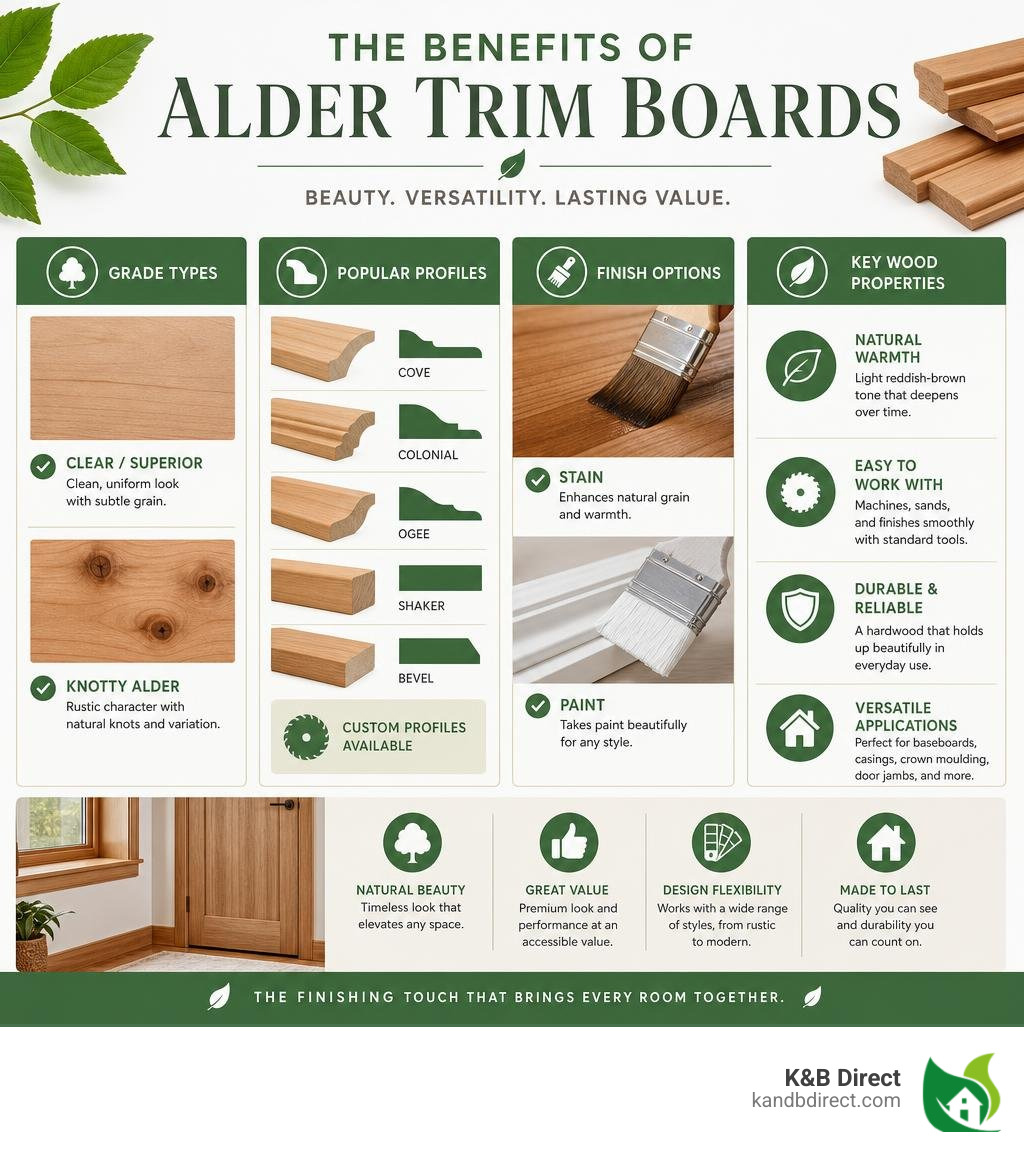
Alder trim boards terms explained:
Understanding the Grades of Alder Trim Boards
When selecting alder trim boards for your home in the Chicago area — whether you are updating a classic bungalow in Oak Park, a historic home in Park Ridge, or a modern space in Schaumburg — your first major decision involves choosing the right wood grade. Alder is unique because its grades offer completely different visual personalities, making it suitable for both clean, contemporary aesthetics and rugged, rustic designs.

Clear and Superior Grade Alder
Clear or superior grade alder is selected for its uniform appearance. This grade is virtually free of knots, checks, and major color variations.
- Aesthetic Appeal: It features a straight, subtle grain pattern with a fine, uniform texture.
- Best Applications: Excellent for formal dining rooms, upscale modern living spaces, and clean architectural designs. If you intend to apply a light stain or want a smooth, paint-ready surface without grain telegraphing, superior grade is your ideal choice.
- Workability: Because there are no hard knots to navigate, cutting, routing, and shaping clear alder is exceptionally smooth, preserving the life of your cutting blades.
To explore the differences in how these grades fit into your design scheme, check out this helper resource on More info about wood trim options.
Knotty Alder
Knotty alder embraces the natural, organic imperfections of the tree. This wood features sound knots, small open checks, and rich color variations that range from light honey to deep reddish-brown.
- Aesthetic Appeal: It delivers a highly textured, rustic look that brings immediate character and warmth to a room.
- Best Applications: Perfect for cozy family rooms, traditional dens, cabins, and farmhouse-style kitchens. It is also highly favored for accent walls, ceiling beams, and rustic barn doors.
- Sourcing and Selection: Standard packages, such as the 4/4 Alder Knotty Lumber Pack – Select Count & Size , allow woodworkers to select boards that showcase these beautiful, natural features.
Both grades find extensive utility in residential and commercial projects across our Illinois service areas, allowing you to match the wood’s natural personality to your home’s unique architectural style.
Profiles, Dimensions, and Custom Milling Options
The beauty of choosing alder trim boards is the vast array of shapes and structures available to frame your rooms. From the baseboards running along your floors to the crown moulding bridging your walls and ceilings, there is a profile designed for every transition.
To see the full spectrum of what is possible, you can view our Alder Wood Moulding Profiles page.
Standard Dimensions for Alder Trim Boards
Understanding the difference between nominal sizes and actual dimensions is crucial when planning your layout. In North America, wood sizes are expressed in nominal terms (the size of the rough lumber before it is dried and planed), which differ from the actual finished dimensions.
Here is a quick reference guide for standard flat stock alder boards:
- 1×2 Boards: Nominal 1″ x 2″ translates to an actual thickness of 3/4″ and a width of 1-1/2″ (some specialized profiles, like the Alder Trim KA 1×2 – BZB Cabins , measure 1/2″ x 1-5/8″).
- 1×4 Boards: Nominal 1″ x 4″ translates to an actual size of 3/4″ x 3-1/2″.
- 1×5 Boards: Nominal 1″ x 5″ translates to an actual size of 3/4″ x 4-1/2″.
- 1×6 Boards: Nominal 1″ x 6″ translates to an actual size of 3/4″ x 5-1/2″.
For detailed information on choosing the right thickness for your project, refer to our Decorative Wood Trim Sizes: Your Essential Guide to 1 Inch, 1 2 Inch, and 3/4 Inch Options.
Standard stock lengths generally run from 7 units up to 16 units, allowing you to minimize joints on long wall spans. For those looking for versatile online options, you can browse Alder – Wood Boards – The Home Depot to see standard retail availability.
Custom Milling and Unique Profiles
If standard flat stock does not match the historical details of your home in Niles or Elmhurst, custom milling provides the ultimate solution. Builders and designers often require specialized shapes to match existing trim or to create a unique architectural statement.
- Eased Edges (S4S): Surfaced Four Sides with slightly softened corners to prevent splintering and paint chipping.
- Stepped and Curved Profiles: Special profiles like the SI (stepped) or cove mouldings create smooth, curved transitions between adjoining surfaces.
- Volume Options: Many suppliers offer extensive customization. For instance, Alder – Distinctive Wood Designs Inc. offers 91 different moulding profiles, while other regional catalogs provide dozens of options for casings, crowns, and jambs.
You can learn more about tailoring these shapes to your project by visiting our Custom Alder Moulding Options.
Comparing Alder to Other Wood Species
To appreciate why alder trim boards are so highly regarded, it helps to see how they perform against other common trim materials. Below is a comparison detailing the physical attributes, workability, and finishing characteristics of alder, poplar, oak, and pine.
| Wood Species | Workability | Grain Pattern | Hardness (Janka) | Paintability | Stain Readiness |
|---|---|---|---|---|---|
| Alder | Excellent; cuts and sands like butter | Fine, straight, uniform | Moderately Soft | Good (requires sealer) | Excellent; mimics cherry/walnut |
| Poplar | Very Good; easy to machine | Fine, but has green streaks | Medium-Soft | Excellent; the paint standard | Poor; stains can look blotchy |
| Oak | Harder to cut; prone to splintering | Prominent, open grain | Very Hard | Poor; grain texture shows | Excellent; classic stained look |
| Pine | Easy; but knots can bleed sap | Proninent, wild grain | Soft | Moderate; knots require sealing | Moderate; prone to uneven absorption |
For a broader look at how these materials compare across different home styles, explore our guide on the Information on types of moulding.
Alder stands out because it offers the uniform grain structure of a premium hardwood like cherry, but at a physical density that makes it incredibly easy to cut and nail. While oak is highly durable, it can be demanding on tools and difficult to paint. Poplar is fantastic for paint but lacks the gorgeous natural warmth of alder when stained. Alder strikes the perfect middle ground.
Installation, Moisture Resistance, and Finishing Guidelines
Successfully incorporating alder trim boards into your home requires understanding the physical properties of the wood, particularly in relation to the local climate. Our Northern Illinois climate brings hot, humid summers and dry, cold winters, which means wood in homes from Des Plaines to Oak Brook will naturally expand and contract.
For general advice on preparing your home’s walls for new millwork, see our guide on Details on molding and baseboards.
Best Practices for Installing Alder Trim Boards
To ensure your trim remains tight and beautiful for decades, follow these professional installation practices:
- Acclimation: Allow your alder boards to sit in the room where they will be installed for at least 72 hours. This lets the wood adjust to the indoor humidity levels, preventing shrinking or warping after installation.
- Fastening Methods: Use high-quality finish nails or trim screws. Because alder is moderately soft, pneumatic nail guns set to the correct depth will easily sink nails without splitting the wood.
- Adhesive Selection: Apply a bead of quality wood glue to all mitered corner joints. This keeps the joints tight even when the walls shift slightly with seasonal temperature changes.
- Specialized Areas: For tight spaces and inside corners, using specialized profiles like the PROSAUNAS Alder 1×2 Inside Corner Trim SI – PROSAUNAS ensures a clean, professional transition.
If you are looking for specific corner solutions, explore our Alder Corner Trim Options.
Finishing and Color Evolution Over Time
The manner in which you finish your alder trim determines its long-term visual character.
- Staining: Alder is often called the “chameleon of woods” because it takes stain beautifully. It can easily be stained to mimic expensive cherry, mahogany, or walnut.
- Clear Coats and Oils: Applying a simple clear polyurethane or natural oil preserves the wood’s light, natural tan shade while highlighting its subtle grain.
- Color Evolution: Natural alder undergoes a beautiful transformation over time. Exposure to sunlight and oxygen causes the wood to transition from a pale, light tone to a deep, warm honey or rich amber-red.
For exterior applications or high-exposure areas, thermally modified products — which use heat and steam to alter the wood’s core structure for enhanced durability — can age to a gorgeous silver-gray if left untreated. You can find examples of these advanced options by looking at Interior Alder Trim 1×4 SHP – Thermory USA .
To browse our curated list of interior options, check out the Alder Interior Trim Selection.
Frequently Asked Questions
Is alder wood suitable for high-moisture areas like bathrooms or saunas?
Yes, natural alder is highly valued for these specialized environments. It is completely resin-free, meaning it will not bleed sticky sap when exposed to heat. Additionally, it has exceptionally low heat conductivity (it stays comfortable to the touch) and is highly resistant to splintering.
For high-moisture or high-heat environments, products like the Thermory Alder 1×1 SI Molding for Saunas | 4-Board Pack or the PROSAUNAS Alder 1×1 S4SEE SHP | Steam Sauna Bath are widely utilized to create beautiful, durable, and safe spaces.
What causes the color of alder wood to change over time?
The color shift in alder is a natural process driven by oxidation and ultraviolet (UV) light exposure. When the wood is freshly cut, it is pale and light. As it interacts with light and air, the natural compounds in the wood react, gradually deepening the wood’s surface into a warm, inviting honey-gold or soft reddish hue. This aging process adds depth and character to your home’s interior.
Can alder trim be painted or is it better to stain it?
While clear-grade alder makes an excellent paint-grade material due to its smooth, uniform surface, most design professionals prefer to stain it. Staining allows the gorgeous, cherry-like grain and natural warmth of the wood to remain visible. If you choose to paint alder, be sure to apply a high-quality sandable primer first to ensure a perfectly flat, uniform finish.
Conclusion
Whether you are aiming for the clean, sophisticated lines of clear superior alder or the rugged, welcoming charm of knotty alder, alder trim boards provide an exceptional balance of beauty, workability, and lasting value.
At K&B Direct, we are dedicated to helping homeowners across the Chicago area — including Schiller Park, Franklin Park, Norridge, Bensenville, and beyond — realize their dream home aesthetics. By offering top-quality mouldings, doors, and cabinets at unbeatable, lowest possible prices paired with friendly, expert service, we make home transformation simple and exciting.
Ready to find the perfect finishing touch for your next project?
Explore our Wood Trim selection today and let us help you bring your vision to life!