
Choose Grey Vinyl Baseboard by Floor Type and Profile
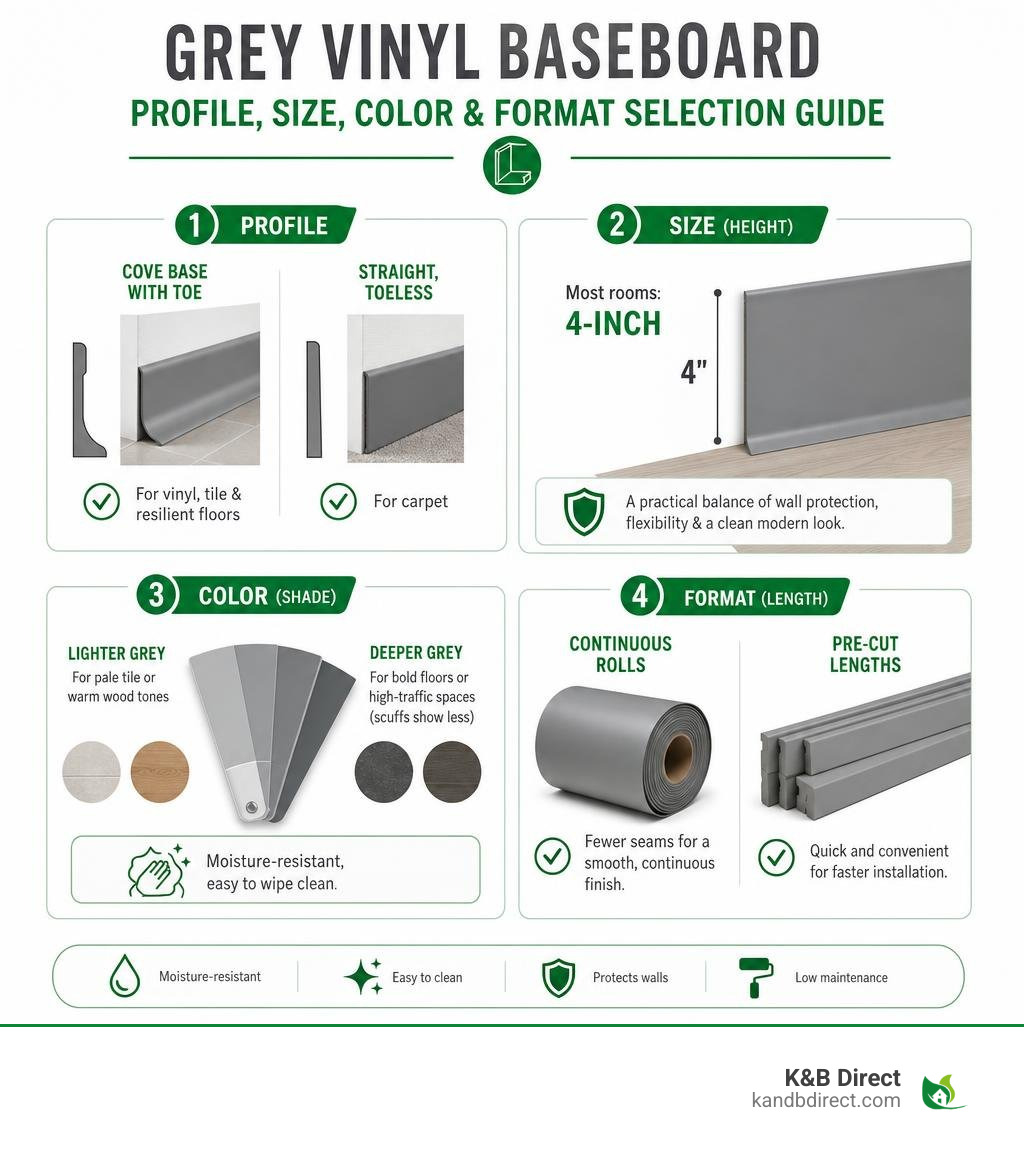
Choose cove base with a toe for vinyl, tile, and other resilient floors because its curved lower edge covers the gap where flooring meets the wall. Choose a straight, toeless profile for carpet, where a flush edge creates a neater finish.
For most rooms, a 4-inch Grey Vinyl Baseboard in either .080-inch or 1/8-inch gauge offers a practical balance of wall protection, flexibility, and a clean modern look. Select a lighter grey for pale tile or warm wood tones, and a deeper grey for bold floors or high-traffic spaces where scuffs may show less.
Grey vinyl wall base is moisture-resistant, easy to wipe clean, and available in continuous rolls or pre-cut lengths. That makes it a useful trim choice for kitchens, bathrooms, hallways, and other spaces where painted wood trim may need more upkeep.
I’m Eryk Piatkowski, owner of K&B Direct, and since 2011 I have helped homeowners choose finishes that balance style and everyday use, including Grey Vinyl Baseboard. This guide will help you match the right profile, size, shade, and material to your room.
Grey vinyl baseboard word roundup:
Key Profiles and Dimensions of Grey Vinyl Baseboard
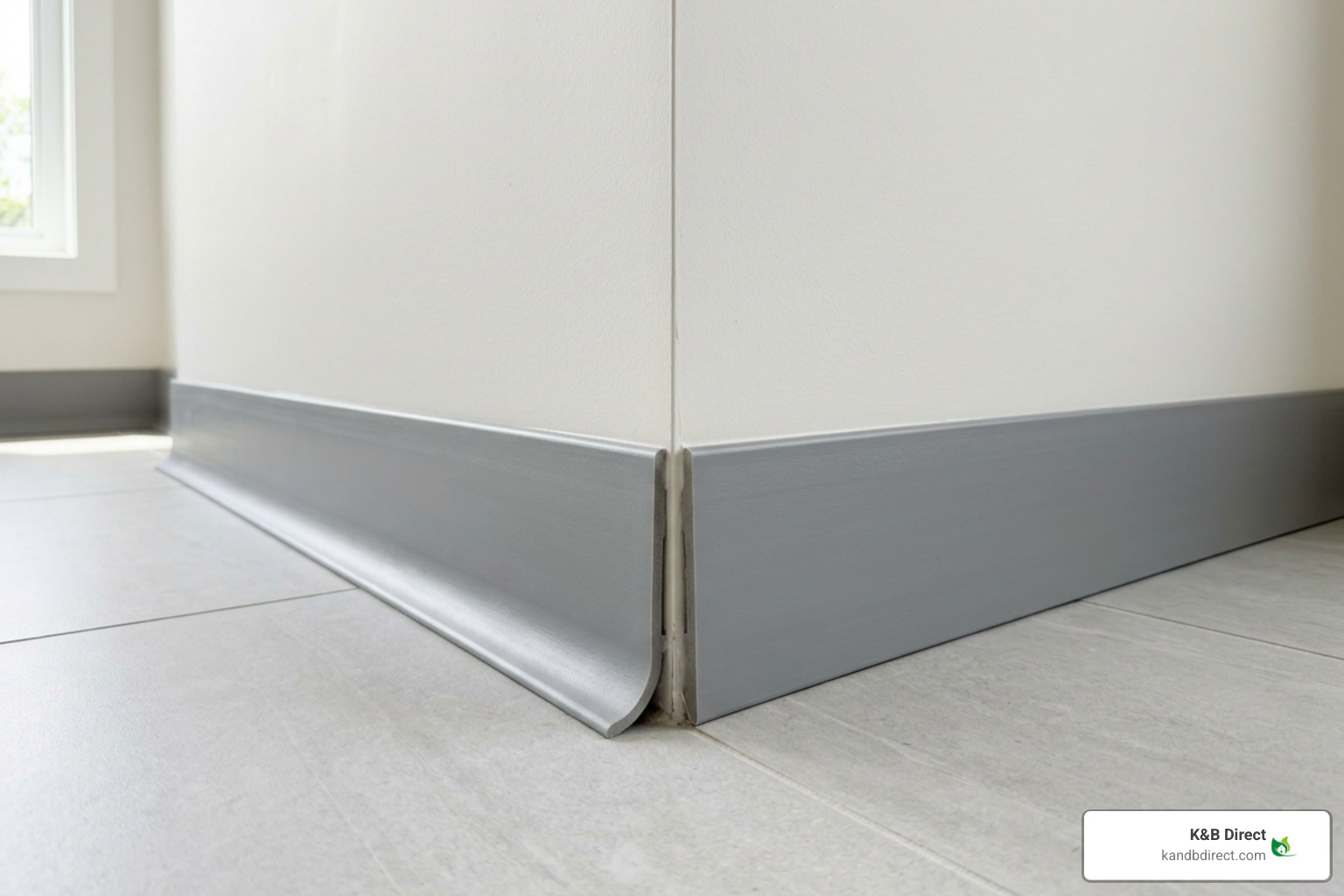
Selecting the right baseboard trim requires understanding profile geometry and dimensions when pairing trim with wall substrates and flooring materials. Vinyl wall base functions as a protective shield against vacuum strikes, pedestrian traffic, mop moisture, and everyday impacts while presenting a crisp border along room perimeters.
The two foundational profiles available in thermoplastic vinyl moulding are cove base (with toe) and straight base (toeless). While both provide identical perimeter protection against vertical wall scuffs, their bottom edges serve entirely different flooring transitions.
Selecting Profiles for Resilient Flooring vs Carpet
When working with hard surfaces such as luxury vinyl plank (LVP), sheet vinyl, porcelain tile, or sealed concrete, perimeter expansion gaps are mandatory. Flooring materials expand and shift with temperature changes. A cove profile features a curved bottom toe—typically projecting outward around 0.450 inches (11.43 mm)—that rests firmly over the edge of the flooring. This downward curvature conceals rough cuts, masks movement gaps, and prevents cleaning water from seeping beneath the floorboards.
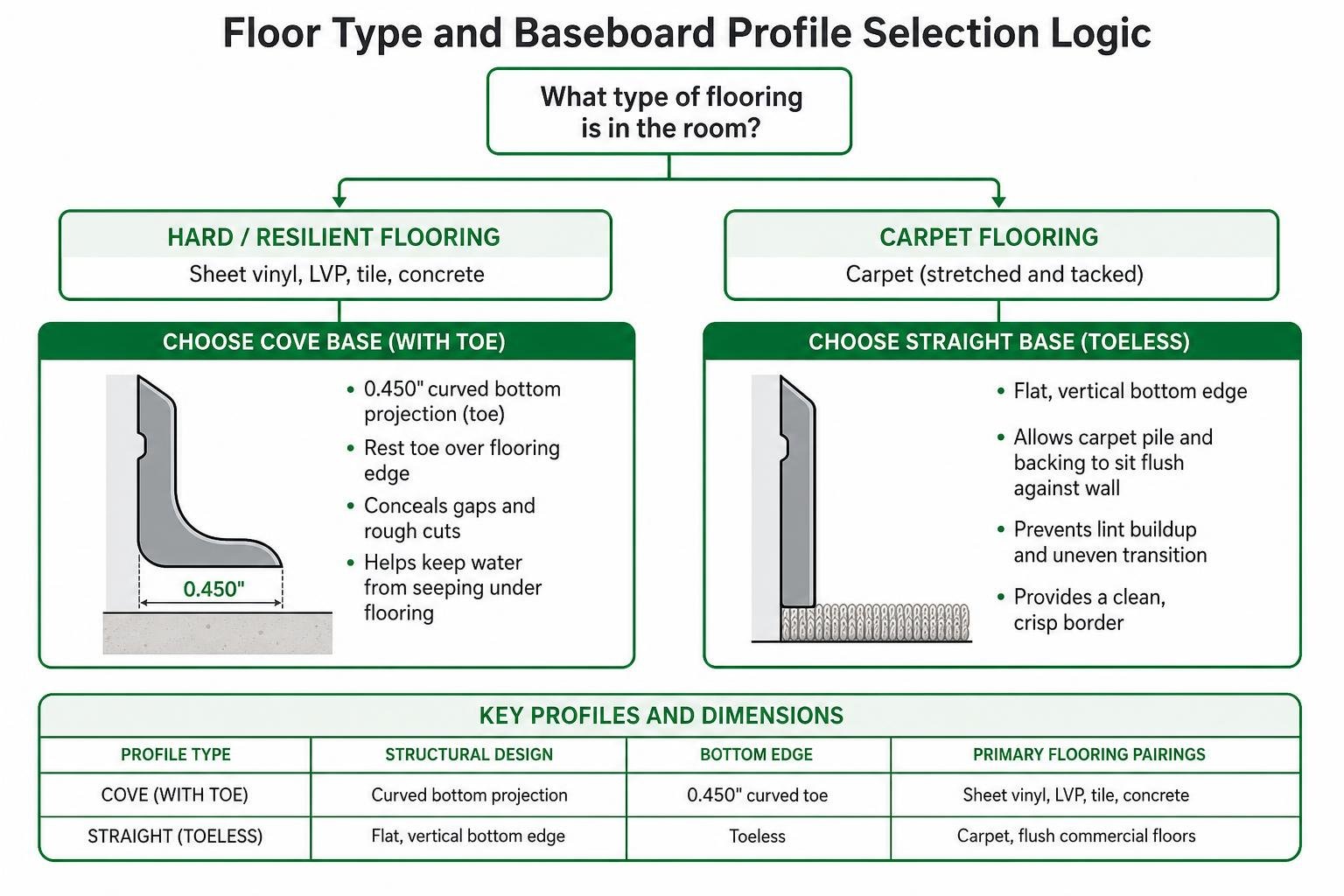
For carpeted rooms, a straight or toeless profile delivers a cleaner, flush aesthetic. When carpet is stretched and tacked along the perimeter, carpet installers tuck the backing and pile against the wall. A toe would protrude awkwardly over the carpet weave, collecting lint and creating an uneven transition. Straight vinyl profiles allow the carpet pile to sit naturally against the vertical plane of the trim, establishing a crisp architectural boundary.
Gauges and Sizing for Grey Vinyl Baseboard
Vinyl trim is engineered across specific heights and thicknesses to accommodate different architectural scales and protection requirements:
- 2.5-Inch Height: A compact, low-profile trim ideal for minimalist residential utility areas, small powder rooms, or commercial spaces where subtle edge protection is needed without drawing visual attention upward.
- 4-Inch Height: The industry standard for both residential spaces and commercial interiors. It provides balanced vertical coverage, shielding drywall from everyday walking traffic, cleaning equipment, and furniture marks.
- 6-Inch Commercial Height: A tall format engineered for expansive corridors, healthcare settings, high-traffic commercial facilities, and modern open-concept rooms. For spaces with elevated ceilings, going big with 6 inch vinyl baseboards establishes a bold visual presence while delivering enhanced impact resistance.
Regarding thickness, manufacturers supply two primary gauges:
- .080-Inch Gauge (approx. 2.0 mm): A slender, highly pliable gauge commonly utilized in residential utility areas and standard renovations. It conforms effortlessly to wavy drywall or irregular framing.
- 1/8-Inch Gauge (.125 inch / 3.2 mm): The heavy-duty commercial standard. This gauge offers superior impact deflection, hides underlying substrate imperfections, and provides enhanced dimensional stability over time. Review our baseboard moulding guide for deeper insights on structural profiles across residential and commercial applications.
Material Performance: Vinyl vs Rubber Wall Base
Understanding material performance helps determine which composition best suits your environmental demands. Thermoplastic vinyl (classified in ASTM International standards as Type TV) and vulcanized thermoset rubber (Type TS) represent the two primary flexible trim materials on the market.
| Performance Attribute | Type TV Thermoplastic Vinyl | Type TS Thermoset Rubber |
|---|---|---|
| Material Composition | Thermoplastic vinyl polymer resin | Vulcanized thermoset synthetic rubber |
| Pliability & Flexibility | Pliable when warm; slightly rigid at lower temperatures | Highly flexible across all indoor temperatures |
| Impact & Scuff Shielding | Resists scuffs, scratches, and everyday abrasions | Exceptional scuff resistance with shape recovery |
| Moisture Resistance | 100% waterproof; impervious to wash water | 100% waterproof; resists chemicals |
| Corner Formation | Scored and heat-folded on site | Wraps sharp corners without heating |
| Surface Finish | Matte, satin, or glossy textured surfaces | Matte, non-reflective smooth finish |
| Recyclability & Eco Profile | FloorScore certified; fully recyclable polymer | Long lifecycle; low indoor emissions |
Type TV thermoplastic vinyl serves as an economical, resilient alternative to traditional wood or rubber trims. Unlike wood that can swell or rot when exposed to mop water, vinyl maintains absolute moisture resistance. For additional comparisons with rigid synthetic trims, consult our article on types of moulding along with our guide to buying rot-proof PVC baseboard trim.
Commercial vs Residential Durability and Warranties
Commercial spaces experience heavy pedestrian traffic, luggage carts, mop buckets, and mechanical cleaning machinery. For these high-demand settings, 1/8-inch Type TV vinyl baseboard engineered with a tough matte finish hides substrate bumps while withstanding continuous contact. Leading commercial manufacturers back these heavy-duty profiles with 2-year to 5-year commercial warranties.
Residential applications, such as laundry rooms, basements, kitchens, and mudrooms, benefit from the moisture-tight perimeter seal that flexible vinyl creates. Furthermore, reputable vinyl baseboards carry FloorScore indoor air quality certifications, ensuring that volatile organic compound (VOC) emissions remain ultra-low for residential living spaces, classrooms, and medical facilities.
Popular Grey Colorways and Interior Design Coordination
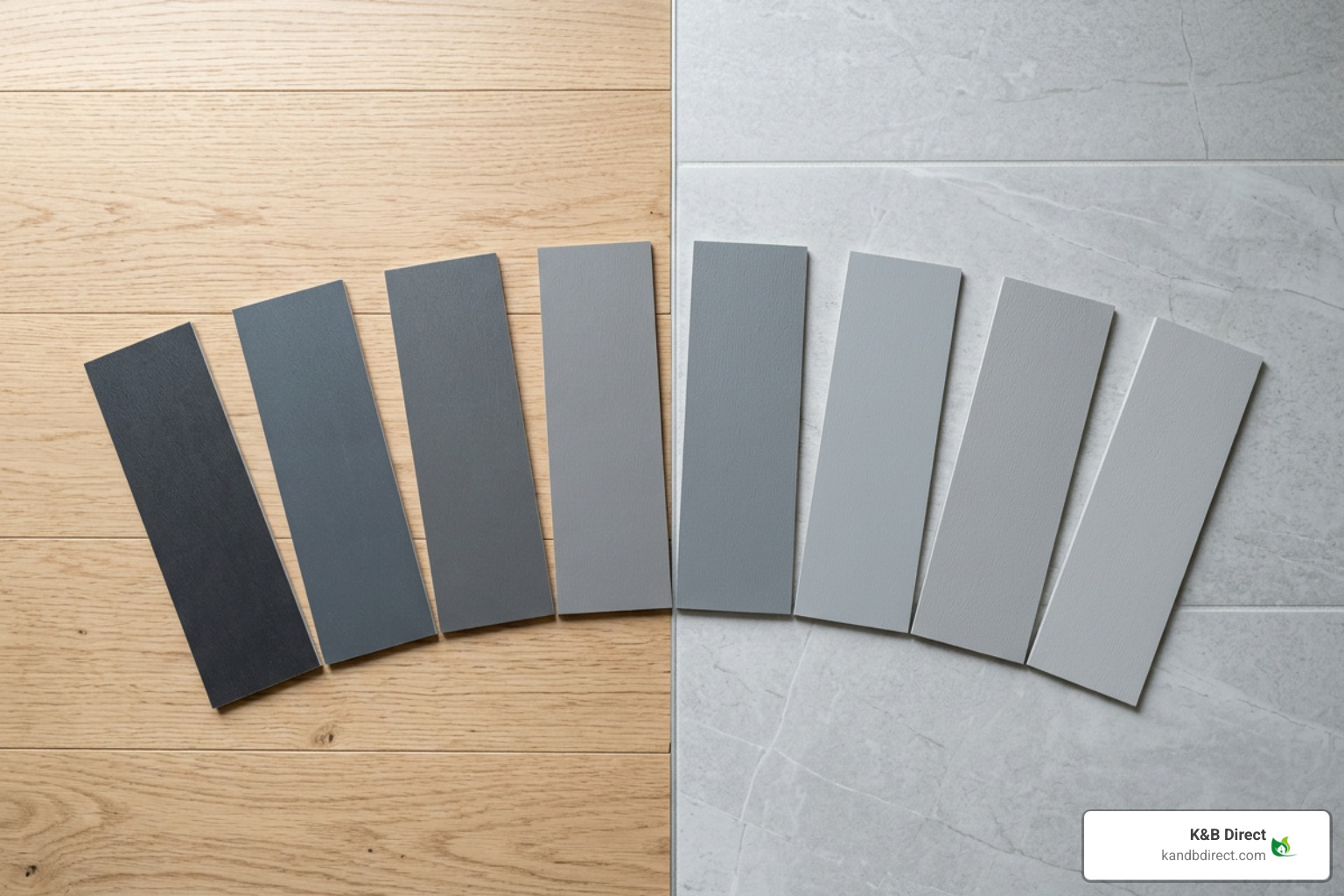
Grey has evolved from a purely functional utility hue into an essential design neutral. Modern thermoplastic formulations provide rich, color-through pigmentation that will not wear away or peel when abraded. While black vinyl baseboard trim offers dramatic contrast, grey provides understated transitional elegance across various flooring styles.
- Smokey Gray & Charcoal: Deep, grounding tones that hide dust and scuffs in high-traffic hallways, workshops, and utility areas.
- Medium Gray & Graystone: Balanced mid-tones featuring subtle warm undertones, pairing seamlessly with concrete-look luxury vinyl and greige palettes.
- Vapor Grey & Silver Grey: Soft, light neutrals that reflect ambient light, ideal for brightening compact powder rooms or modern residential basements.
- Titanium & Nickel: Sleek, cool-toned industrial greys that complement stainless steel appliances, brushed aluminum fixtures, and modern urban loft motifs.
Explore our comprehensive ultimate guide to molding and baseboards to see the way color selections harmonize with wall paint and casing elements.
Pairing Shades with Hardwood, LVP, and Tile
When coordinating grey baseboards with your flooring, examine the underlying undertones in both surfaces under natural and artificial light:
- Cool-Toned Surfaces: Pair slate tile, crisp white marble, or ash-toned LVP with cool grey trims like Vapor Grey or Titanium to maintain a cohesive palette.
- Warm-Toned Wood Looks: Complement honey oak, natural maple, or warm taupe flooring with softer, earthy greys like Graystone to prevent the trim from appearing sterile.
- Subway Tile and White Walls: Medium Gray creates a crisp accent line that frames pristine white walls without the visual weight of dark charcoal.
Always view physical color swatches against your actual flooring on site, as digital displays can distort subtle undertones.
Purchasing and Installation: Continuous Rolls vs Cut Sticks
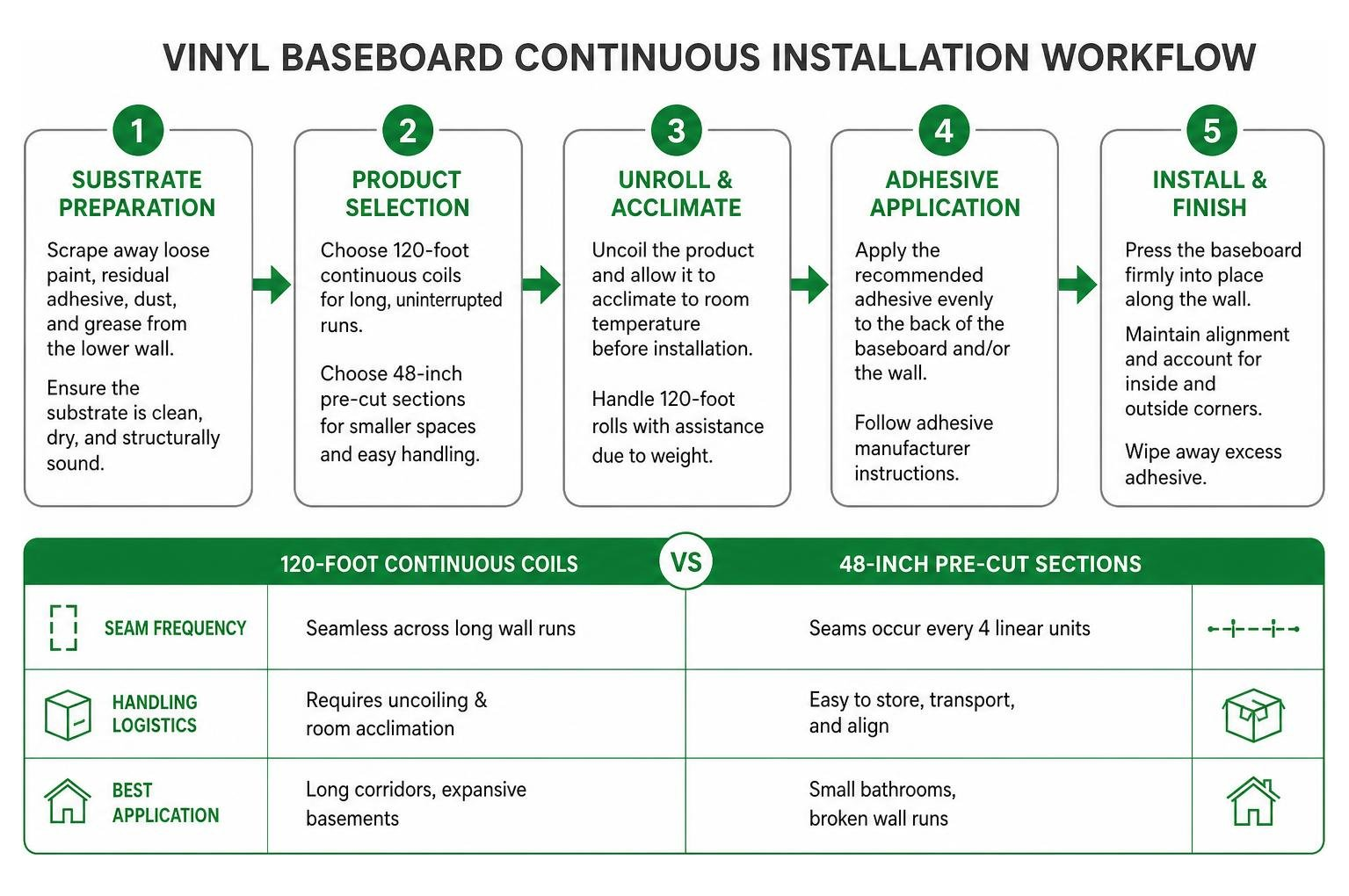
Vinyl baseboard is supplied in two primary packaging formats: 120-unit continuous coils (rolls) and 48-inch pre-cut sections (sticks). Choosing the right format depends on your room layout and project scale.
Continuous coils eliminate intermediate joints along lengthy walls, establishing a sleek, uninterrupted perimeter line. However, a large roll of 6-inch 1/8-inch vinyl can weigh nearly 70 pounds, requiring assistance to maneuver and unroll. Conversely, 48-inch sections ship packed in cartons of 25 to 30 pieces (covering 100 to 120 linear units) and are exceptionally easy to handle in tight residential corridors.
Step-by-Step Installation of Grey Vinyl Baseboard
Achieving a clean finish requires methodical wall preparation and proper adhesive application:
- Substrate Preparation: Scrape away loose paint, residual adhesive, dust, and grease from the lower wall. The substrate must be clean, dry, and structurally sound to ensure strong bonding.
- Material Acclimation: Unroll continuous coils and let them lay flat in the room for at least 24 hours prior to application so they adjust to room temperature.
- Adhesive Application: Use a specialized acrylic-based wall base adhesive or water-based contact cement. Apply the adhesive to the back of the baseboard using a notched spreader, keeping the glue roughly 1/4-inch away from the top edge to prevent adhesive squeeze-out.
- Positioning and Pressure: Press the baseboard firmly against the wall, seating the cove toe tightly against the floor. Run a hand roller across the entire face from one end to the other to eliminate air pockets and guarantee 100% adhesive contact.
- Inside Corners: For inside 90-degree corners, do not cut the baseboard entirely. Score the back side of the vinyl along the corner fold line (cutting halfway through the gauge), fold the material backward to open the score, and press the continuous strip tightly into the wall corner.
- Outside Corners: To wrap an outside corner seamlessly, measure the corner location, score a vertical channel on the reverse side of the strip, warm the face gently with a heat gun to increase pliability, and wrap the piece snugly around the corner without snapping.
Frequently Asked Questions About Vinyl Baseboards
What is the typical expenditure per linear unit for vinyl wall base?
The financial outlay for vinyl wall base generally ranges from $0.69 to $1.95 per linear unit, depending on gauge thickness, profile height, and order volume. Standard .080-inch residential coils in 4-inch heights typically fall at the lower end of the spectrum, while commercial-grade 6-inch profiles in 1/8-inch gauge with specialized cove toes represent the upper tier. Purchasing full 100-unit or 120-unit coils generally provides the highest value per linear unit compared to purchasing individual retail sticks.
Can vinyl baseboards be painted or stained?
Thermoplastic vinyl baseboards are engineered with factory-integrated, through-body pigmentation and a protective matte finish, meaning they never require painting or staining. While specialized acrylic bonding primers can adhere to vinyl, painting flexible baseboards is generally not advised; repeated impacts and natural flexing will cause topical paint layers to chip and flake over time. Choosing the correct grey shade from the start ensures a lifetime of lasting color without extra upkeep.
What are the best practices to clean and maintain flexible vinyl moulding?
Maintenance is straightforward. Clean the vinyl surface periodically using a soft microfiber cloth, sponge, or mop dampened with warm water and a neutral pH household detergent. For stubborn black heel scuffs or equipment marks, apply a small amount of isopropyl alcohol or a non-abrasive vinyl cleaning paste to a cloth and gently rub the mark away. Avoid harsh solvents, acetone, or abrasive scouring pads, as these can dull the factory matte finish.
Conclusion
Choosing the ideal grey vinyl wall base comes down to matching your flooring type with the appropriate profile, selecting the right vertical height and gauge for your traffic demands, and picking a shade that ties your interior palette together. From moisture-prone laundry spaces and busy kitchens to commercial corridors, vinyl trim provides a durable, waterproof boundary that stands up to daily wear while looking sharp.
At K&B Direct, we take pride in supplying top-tier home improvement products that combine enduring performance with outstanding aesthetics. Whether you are updating a single room or outfitting an entire building across the Chicago area, our team is here to guide you toward the perfect finishing touches. Explore our comprehensive collection of baseboard trim and moulding options to find the ideal match for your next project.