
Why Bifold Door Track Systems Matter for Your Home
Bifold door track systems are the hardware framework that lets folding doors glide, pivot, and stack neatly — turning awkward, space-eating swing doors into sleek, functional room features.
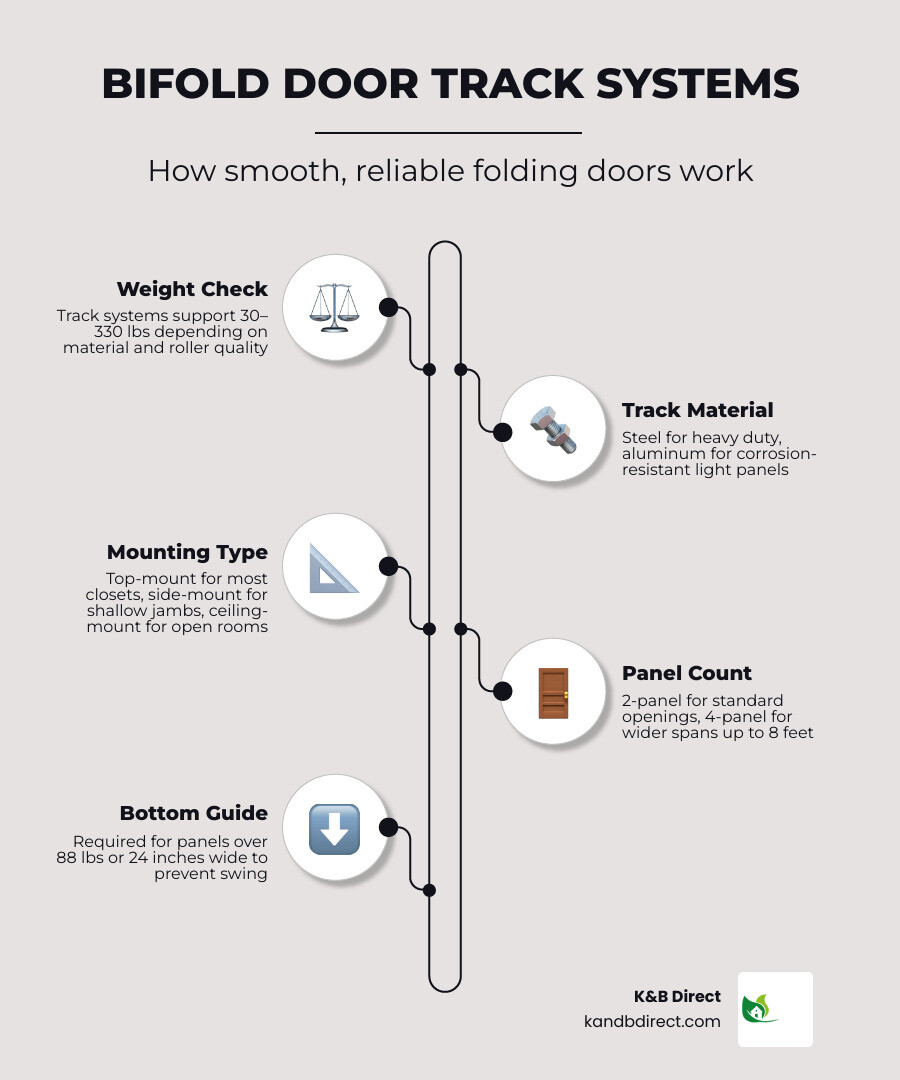
Here is a quick overview of what you need to know before choosing one:
| What to Consider | Why It Matters |
|---|---|
| Weight capacity | Ranges from 30 lbs (closet panels) to 330 lbs (heavy solid wood) |
| Track material | Steel vs. aluminum affects durability, weight, and corrosion resistance |
| Mounting type | Top-mount, side-mount, or ceiling-mount changes the system installation |
| Panel count | 2-panel and 4-panel configurations require different track lengths |
| Bottom guide | Optional on lighter doors, but recommended for panels over 88 lbs or wider than 24 inches |
Bifold doors fell out of favor in the late 1980s — largely because the hardware was unreliable. Doors slipped off tracks. Fingers got pinched. Adults got frustrated. But modern bifold door track systems have completely changed that story. Today’s systems use precision ball-bearing rollers, extruded aluminum box tracks, and adjustable pivot hardware that keep doors aligned, quiet, and smooth — even under heavy daily use.
Whether you are updating a bedroom closet, dividing a living space, or upgrading a pantry, choosing the right track system is the single most important decision in the project.
I’m Eryk Piatkowski, owner of K&B Direct, and I’ve spent over a decade helping homeowners and contractors select the right bifold door track systems for everything from lightweight closet builds to heavy solid-wood interior installations. In this guide, I’ll walk you through every key decision — materials, sizing, weight ratings, mounting options, and more — so you can move forward with confidence.
Handy bifold door track systems terms:
Key Differences in Bifold Door Track Systems
When you begin looking at bifold door track systems, the first major fork in the road is deciding between residential-grade and commercial-grade hardware. Choosing the wrong grade can lead to sagging headers, warped frames, or doors that constantly jump off their tracks.
Residential-Grade Hardware
Residential-grade systems are engineered for standard, lightweight interior doors. Think of hollow-core bedroom closets, pantry doors, and laundry room partitions.
- Weight Capacity: Typically supports panels weighing between 30 lbs and 50 lbs each.
- Door Thickness: Usually accommodates standard doors from 3/4 inch to 1-3/8 inches thick.
- Operation: Often utilizes 2-wheel plastic rollers or basic snugger systems. While highly economical, these are best kept in low-traffic areas.
Commercial-Grade Hardware
Commercial-grade systems are built for heavy-duty, high-traffic environments or large architectural partitions. If you are hanging solid oak, pine, or paneled doors, you need commercial-grade track systems.
- Weight Capacity: Designed to support panels from 75 lbs up to 125 lbs, and in heavy-duty barn-door style applications, up to 330 lbs per panel.
- Door Thickness: Built for thicker panels, typically ranging from 1-3/8 inches up to 1-3/4 inches or even 2-1/4 inches.
- Operation: Features heavy-duty extruded aluminum box tracks and 4-wheel ball-bearing rollers that enclose the wheels, preventing derailment.
Understanding these differences helps you choose the perfect space-saving interior doors for your space.
| Feature | Residential-Grade Systems | Commercial-Grade Systems |
|---|---|---|
| Max Panel Weight | 30 to 50 lbs | 75 to 125+ lbs (up to 330 lbs for specialty tracks) |
| Track Design | Open-sided steel or light aluminum | Box-style enclosed extruded aluminum or heavy carbon steel |
| Hanger Type | 2-wheel nylon glides or non-bearing rollers | 4-wheel ball-bearing rollers |
| Typical Use Case | Hollow-core closet doors, light pantries | Solid wood doors, room dividers, high-traffic commercial spaces |
Track Materials, Mounting Options, and Bottom Guides
The physical makeup of your track and its attachment method to your home’s framing dictates the longevity of silent door operation.
Steel vs. Aluminum Tracks
- Steel Tracks: Often found in economical, light-duty kits like the Knape & Vogt BIF-50S-2D-3 Steel Track Set. Steel is rigid and highly durable under static loads. However, if installed in high-humidity areas like bathrooms or laundry rooms in our local Chicago suburbs, standard steel can rust over time unless it is powder-coated.
- Aluminum Tracks: Premium systems utilize extruded aluminum box tracks. Aluminum is naturally corrosion-resistant, lightweight, and can be extruded with highly precise tolerances. High-end aluminum tracks feature convex interior rails that minimize wheel friction, creating a whisper-quiet glide.
Mounting Options
- Top-Mount: The track is fastened directly to the underside of the door header (the soffit). This is the most common residential configuration because it keeps the hardware hidden and the floor completely clear.
- Side-Mount: Ideal when there is no solid header frame to screw into. The track is mounted to the side wall using heavy-duty brackets.
- Ceiling-Mount: Used for full-height room dividers where the track is anchored directly into ceiling joists.
Bottom Guide vs. Trackless Systems
A common question when selecting an interior bifold door track kit is whether to include a bottom guide track.
- Trackless Systems (Top-Hung Only): These systems carry all the door weight on the top track. They are highly desirable because they leave your flooring uninterrupted — no metal channels to step over or collect dust. This is perfect for lightweight doors under 88 lbs (40 kg) and panel widths under 24 inches (600 mm).
- Bottom Guide Systems: For heavier solid-wood panels or wider spans, a bottom guide track is highly recommended. It prevents the doors from swinging back and forth, stabilizes the folding motion, and increases the weight rating of the overall system.
Sizing and Configuration for Your Opening
Before purchasing any bifold hardware, you must take precise measurements of your finished opening. Unlike standard swing doors, bifold doors have very little margin for error.
2-Panel vs. 4-Panel Configurations
- 2-Panel System: Consists of two panels hinged together that fold to one side (either left or right). This is perfect for standard closet openings up to 36 inches wide.
- 4-Panel System: Consists of two pairs of folding doors (four panels total) that open from the center and fold to both sides of the opening. This configuration is ideal for wide openings up to 72 inches or more.
Measuring Your Opening
- Measure the Width: Measure the finished opening width at the top, middle, and bottom. Use the smallest measurement to select your track length.
- Measure the Height: Measure the height from the finished floor to the underside of the header at three different points. Use the smallest height to ensure your door panels will clear the floor.
- Account for Clearances: Bifold doors require small gaps (typically 1/4 inch at the sides and 1/2 inch to 1-1/2 inches at the bottom depending on carpet thickness) to operate without binding.
For a complete breakdown of dimensions, check out our bifold door sizes guide and our comprehensive overview of standard bifold closet doors.
Essential Components of Bifold Door Track Systems
A complete bifold door hardware kit is a finely tuned collection of moving parts. If even one piece is low-quality or misaligned, the whole system suffers.
- Hangers: The rolling assemblies that slide inside the track, carrying the weight of the folding panels.
- Pivots: The stationary pins that sit at the top and bottom corners of the jamb-side door panel, anchoring the door while allowing it to rotate.
- Track Stops: Small adjustable metal or plastic blocks clamped inside the track to limit how far the doors can slide.
- Snuggers: Shock-absorbing spring-loaded devices positioned at the ends of the track to hold the doors firmly closed and prevent them from drifting open.
To learn more about the interaction of these parts, read our folding closet doors guide.
Core Hardware in Bifold Door Track Systems
The heart of any smooth-gliding folding door lies in its rollers, hinges, and structural brackets.
High-quality bi-fold door brackets ensure that the top and bottom pivots remain perfectly vertical. Over time, heavy door panels can put immense stress on these brackets, which is why choosing heavy-duty steel or solid brass components is crucial. If your doors have started to sag or slide poorly, it might be time to look into replacing bifold door rollers with modern ball-bearing upgrades.
Achieving Quiet Operation with Bifold Door Track Systems
No one likes the jarring, metallic screech of a closet door opening in the morning. Achieving silent, feather-touch operation comes down to two factors: wheel design and track geometry.
Standard kits often use basic plastic wheels riding on flat steel rails. For a truly quiet home, opt for heavy duty bifold hardware featuring machine-turned polymer or nylon wheels running on convex aluminum track rails. This minimizes friction by ensuring only a single point of contact between the wheel and the track. Periodically applying a dry silicone lubricant to the inside of the track will keep your doors gliding silently for decades.
Installation Best Practices and Common Mistakes
Installing bifold door track systems is a highly rewarding home improvement project, but it requires patience and precision.
Critical Steps for a Flawless Installation:
- Ensure the Header is Structurally Sound: Top-hung bifold doors transfer all their weight to the overhead header. If your header is sagging or made of soft drywall without solid wood backing, the track will bow, causing the doors to bind.
- Use a Level on Everything: The track must be perfectly level, and the side jambs must be perfectly plumb. Even a 1/8-inch deviation can cause the doors to slide open on their own or rub against the floor.
- Pre-Drill Your Screw Holes: Wood door panels can easily split if you attempt to drive pivot hinges or brackets directly into the wood without pre-drilling pilot holes.
Common Mistakes to Avoid:
- Cutting the Track Too Short: Always measure twice and use a fine-tooth hacksaw to cut metal tracks. A track cut too short will cause the rollers to bump or derail at the ends.
- Neglecting Wood Sealing: If you are using unfinished solid wood doors, you must seal or paint all six sides of the door (including the top and bottom edges) within two days of delivery. Failing to do this allows moisture to warp the wood, throwing your track alignment completely out of whack.
Frequently Asked Questions about Bifold Door Hardware
What is the maximum weight capacity for bifold door tracks?
Weight capacities vary wildly depending on the grade of the hardware. Light-duty residential steel tracks are rated for 30 lbs to 50 lbs per panel. Heavy-duty commercial-grade aluminum track kits can easily support 125 lbs per panel. Specialized carbon-steel barn-door style track kits can support massive architectural panels weighing up to 330 lbs. Always choose a track system rated higher than the actual weight of your door panels to guarantee long-term safety and smooth gliding.
Can bifold door tracks be cut to custom lengths?
Yes. Most aluminum and steel bifold door tracks are designed to be cut to size in the field. If you have an uncommon opening width, simply purchase the next standard track length up (such as a 72-inch track for a 66-inch opening) and trim it down using a hacksaw. Be sure to file down any rough metal burrs at the cut end to ensure the rollers do not get caught.
Is a bottom guide track necessary for all installations?
No, a bottom guide is not always necessary. For lightweight closet doors (under 88 lbs) and narrow panel widths, a top-hung trackless system is perfect and keeps your floors clean and uninterrupted. However, if you are hanging heavy solid wood doors, utilizing panels wider than 24 inches, or setting up a high-traffic room partition, a bottom guide track is essential to stabilize the doors and prevent them from wobbling.
Conclusion
Upgrading to premium bifold door track systems is one of the easiest ways to elevate the functionality and visual appeal of your home. By selecting the right track material, matching the weight capacity to your doors, and taking precise measurements, you can enjoy decades of quiet, effortless operation.
At K&B Direct, we are dedicated to helping homeowners across Schiller Park, Chicago, Park Ridge, Elmhurst, and surrounding suburbs find top-quality doors, cabinets, and hardware at the lowest possible rates. Our friendly team is always here to guide you toward the perfect fit for your home improvement goals.
Ready to transform your living spaces? Explore our premium bifold doors today or visit us to find the perfect track system for your next project!