
More Than Meets the Eye
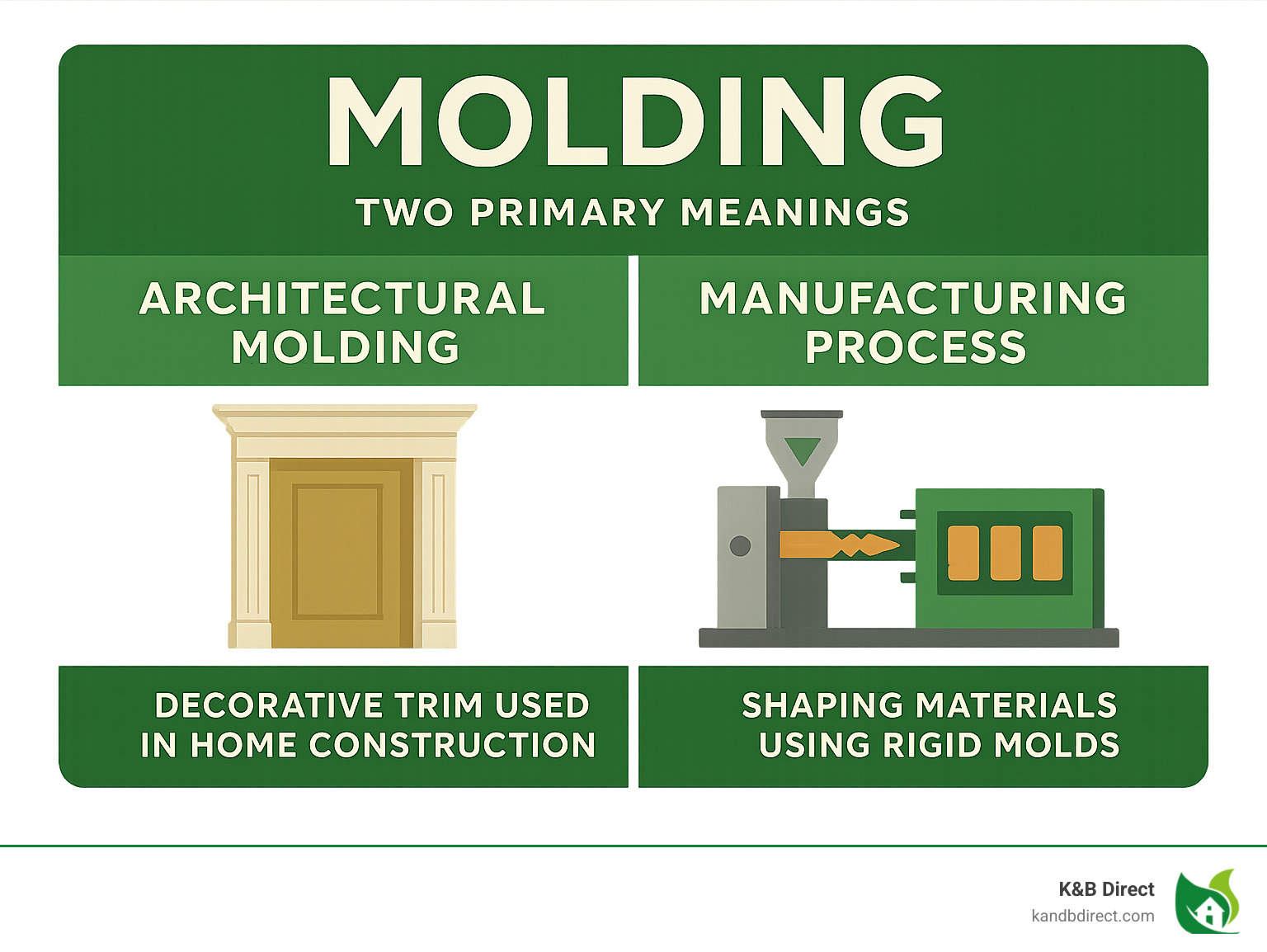
Molding refers to two distinct but related concepts: the industrial manufacturing process of shaping materials using molds, and the decorative architectural trim that adds finishing touches to interior spaces.
Quick Definition Guide:
- Architectural Molding: Decorative strips of wood, MDF, or synthetic materials used to frame doors, windows, walls, and ceilings
- Manufacturing Process: Industrial technique for shaping liquid or pliable materials (plastic, metal, glass) using rigid molds
- Common Types: Crown molding, baseboards, casing, chair rails, and quarter round
- Primary Purpose: Hide joints, add visual interest, and create smooth transitions between surfaces
The word “molding” has been in use since the 14th century, evolving from simple functional elements to sophisticated design features that define architectural styles. From ancient Egyptian cavetto moldings in temples to modern minimalist profiles in contemporary homes, these seemingly simple strips of material have the power to transform ordinary rooms into neat spaces.
Whether you’re planning a kitchen renovation or simply want to add character to your living room, understanding the different types of molding and their applications will help you make informed decisions. The interplay of light and shadow created by various molding profiles can add depth, definition, and visual interest to any interior.
I’m Eryk Piatkowski, Owner of K&B Direct, and over the past decade, I’ve helped countless homeowners select the right molding profiles to complement their cabinet installations and complete their dream spaces. My experience in home improvement has shown me that quality molding is often the difference between a basic renovation and a truly finished, professional-looking result.
Molding terms to know:
The Art of the Finish: A Guide to Architectural Molding
When we talk about the molding that transforms a house into a home, we’re often referring to architectural trim. These decorative elements are essential in interior design, combining both function and style to create polished, cohesive spaces. At K&B Direct, we understand that these finishing touches lift a good design to a great one.
The Different Types of Architectural Molding
Architectural molding comes in a vast array of types, each serving a specific purpose, whether it’s protecting walls, concealing gaps, or simply adding decorative flair.
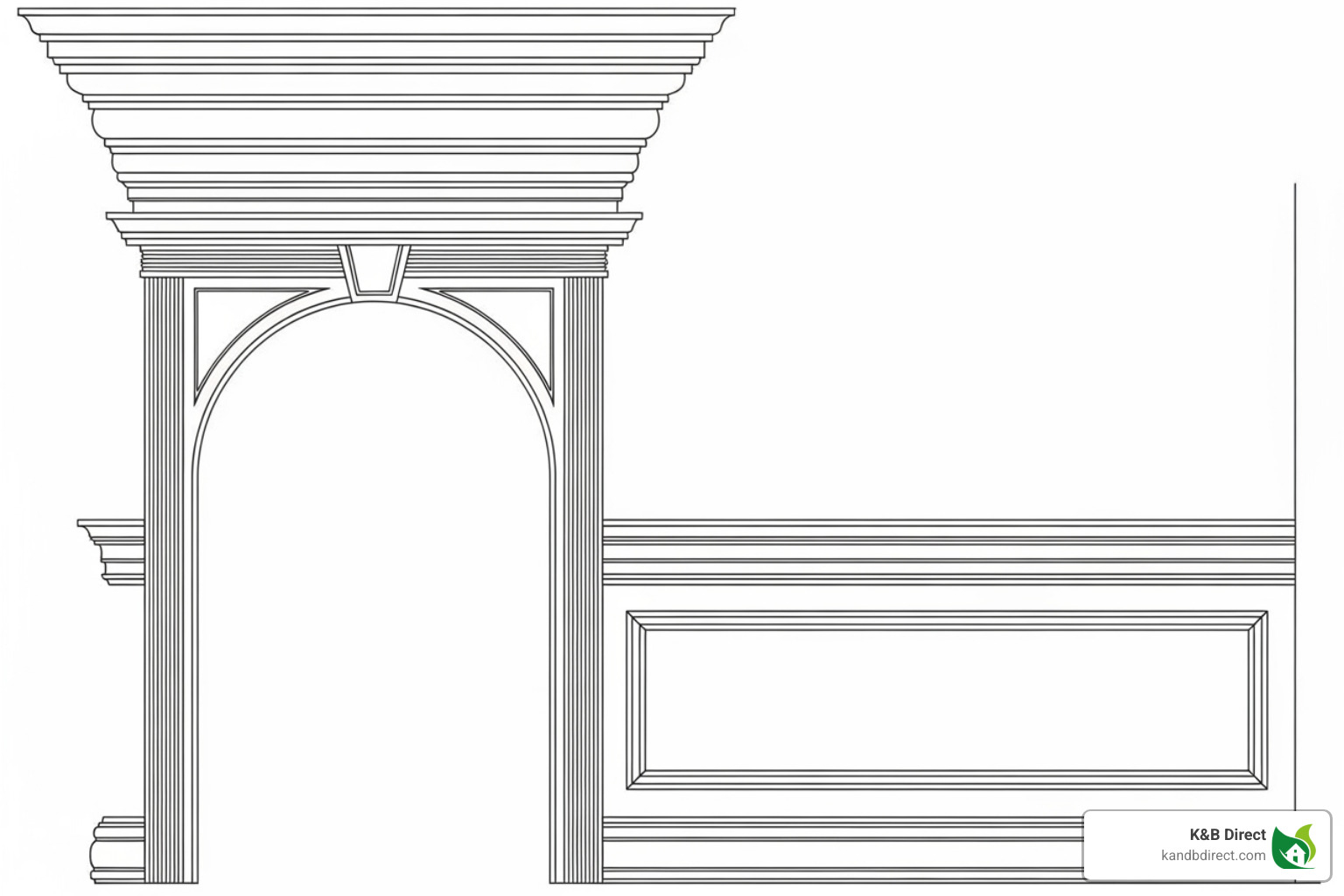
Crown Moulding: This neat molding is installed at the junction where walls meet the ceiling. Its primary purpose is decorative, creating a smooth, neat transition and adding a sense of grandeur to any room. We offer a wide range of Crown Moulding options, perfect for enhancing your living room, dining room, or even a Bedroom Crown Moulding installation for a touch of luxury. Crown molding can be used alone or combined with other trim pieces to create a more elaborate cornice. Factors like wall height, room size, and door type all play a role in selecting the ideal crown molding profile.
Baseboard: Installed along the bottom of walls, where they meet the floor, Baseboard Trim serves multiple functions. It protects the lower part of the wall from scuffs and damage, conceals any gaps between the flooring and the wall, and provides a finished, polished look to the room. Our selection of Baseboard Trim ensures that you can find the perfect style to complement your home’s aesthetic.
Casing: This type of molding frames doors and windows, providing a finished and refined look to these openings. Door Casing not only covers the raw edges of door and window frames but also adds architectural interest, defining these key features in a room.
Chair Rail: Typically installed horizontally around the perimeter of a room at about chair-back height (usually 32-36 inches from the floor), chair rail molding serves a protective purpose, preventing furniture from scuffing or damaging the walls. Beyond its functional role, it also adds a decorative break in the wall, often used to define different wall treatments above and below it.
Panel Mould: This versatile molding is used to create decorative panels on walls, ceilings, or even furniture. It can be applied in various patterns to simulate traditional wainscoting or add intricate designs, giving a room a custom, high-end feel. A Panel Cap Molding is often used to top off wainscoting, creating a clean, finished edge.
Shoe & Quarter Round: These smaller, often overlooked, molding profiles are installed at the very bottom of baseboards, where they meet the floor. They bridge any small gaps between the baseboard and uneven flooring, providing a neat, finished edge. Quarter round is a quarter of a circle in profile, while shoe molding has a slightly different, more elongated profile.
Choosing Your Material: Pros and Cons
The material we choose for our molding has significant implications for its appearance, durability, cost, and suitability for different environments. At K&B Direct, we offer premium options to ensure longevity and beauty.
| Material | Pros | Cons | Best Uses |
|---|---|---|---|
| Solid Wood | Naturally beautiful, durable, can be stained or painted, adds warmth, good for intricate profiles. | More expensive, susceptible to moisture and humidity changes (warping, cracking), requires careful finishing. | High-end homes, historical restorations, areas where natural wood grain is desired, decorative elements. |
| MDF | Cost-effective, very smooth finish (excellent for painting), stable, easy to work with. | Not as durable as solid wood, can swell if exposed to moisture, not suitable for staining. | Painted trim, budget-friendly projects, interior applications away from high humidity. |
| PVC/Polyurethane | Waterproof, rot-resistant, insect-proof, flexible, highly durable, low maintenance. | Can look less natural than wood, less impact resistance than wood, may require special adhesives or paints. | Bathrooms, basements, exterior applications, areas with high moisture or humidity, curved walls. |
Solid Wood: For those who appreciate natural beauty and durability, Wood Trim is an excellent choice. It can be stained to highlight its grain or painted to match any decor. Premium hardwood and softwood molding are trusted by architects, interior designers, and millwork professionals across the country. Our custom molding options allow you to choose your preferred species, length, width, and thickness, ensuring a perfect fit for your vision. While solid wood is more susceptible to moisture and can be pricier, its timeless appeal and ability to hold intricate profiles make it a top choice for many.
MDF (Medium-Density Fiberboard): A popular and cost-effective alternative to solid wood, MDF molding is made from wood fibers, resin, and wax. It offers a very smooth surface, making it ideal for painting. It’s stable and easy to work with, providing a uniform look. However, MDF can swell if exposed to excessive moisture, making it less suitable for high-humidity areas without proper sealing.
PVC/Polyurethane: For areas prone to moisture, such as bathrooms, basements, or even exterior applications, Pvc Floor Molding and similar synthetic options are incredibly practical. These materials are waterproof, rot-resistant, and insect-proof. Polyurethane molding can also be flexible, making it ideal for curved walls or unique architectural features. While they may not offer the natural warmth of wood, their durability and low maintenance are significant advantages.
A Journey Through Time: The Evolution of Molding Styles
Have you ever stopped to think about how the shapes and styles around us have changed over centuries? The story of molding is fascinating, stretching back as far as architecture itself. It’s a journey through time that reflects human creativity, changing tastes, and leaps in technology. From the grand temples of ancient civilizations to the cozy nooks in our modern homes, molding profiles have a rich history that defines architectural eras, shaping the spaces we inhabit.
Let’s take a little trip through history and see how molding has evolved:
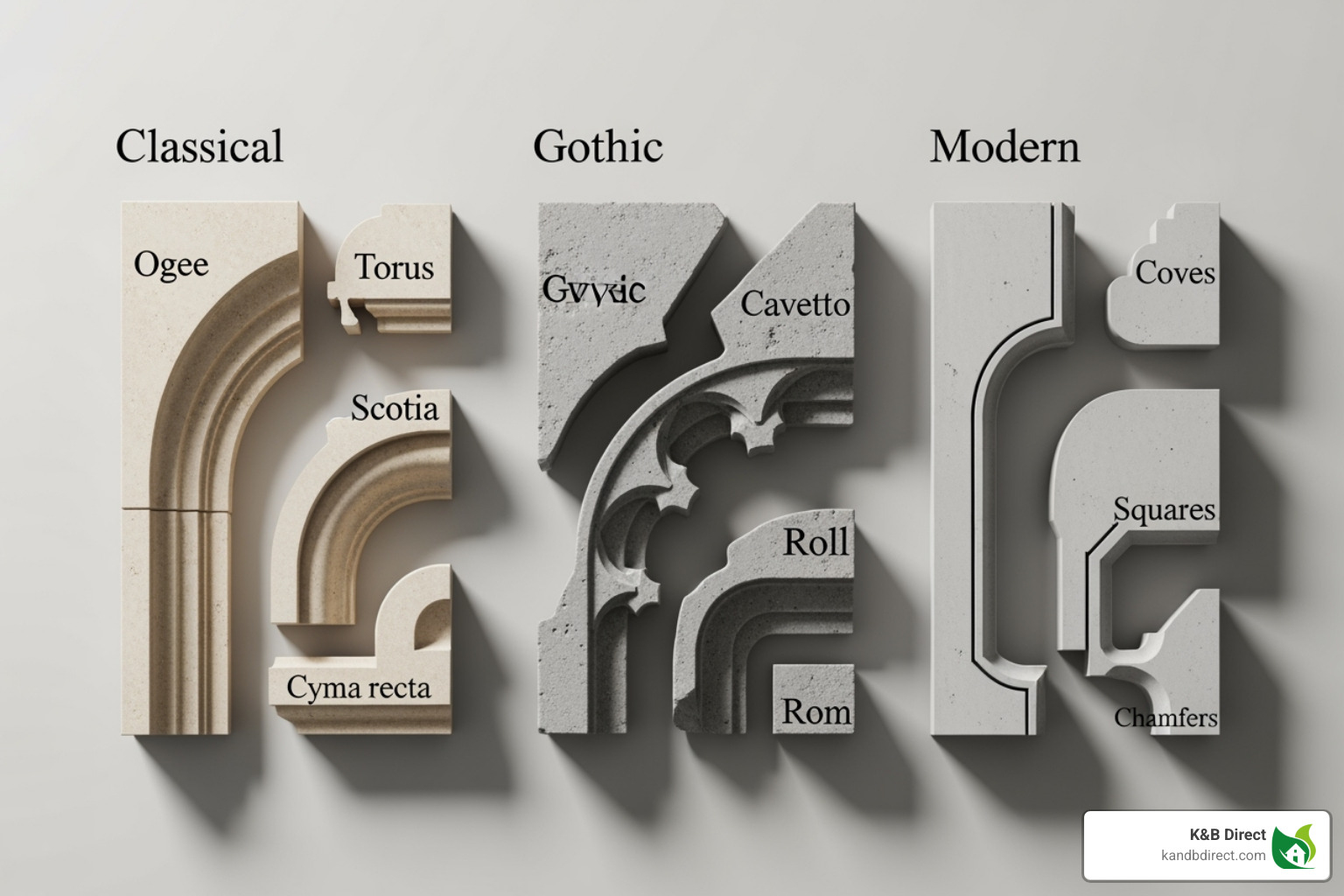
Classical (Greek & Roman): Our journey begins with the ancients! The very first decorative molding can be traced back to early civilizations like the Egyptians, who used simple concave (curved inward) profiles. But it was the Greeks and Romans who truly perfected these forms, creating a systematic “language” of molding that became central to their famous architectural styles. Think of classic shapes like the ogee, cavetto, torus, and ovolo – these weren’t just pretty details; they were carefully designed to bring harmony and order to buildings. They were even spread through famous architectural books, ensuring precision and consistency. If you’re curious to dive deeper, this Encyclopedia article about molding offers a wonderful historical overview.
Gothic Architecture: As we move into the medieval period, things got a bit more intricate! Gothic molding styles began to appear, often showcasing more complex, regional designs. Unlike the very standardized classical forms, Gothic molding evolved as skilled masons traveled and shared their craft, leading to a fantastic variety of creative profiles. While still outlining architectural features, Gothic molding often featured deeper cuts and more dramatic shadow lines, perfectly reflecting the era’s love for soaring heights and elaborate details.
Renaissance Styles: The Renaissance was all about looking back to the classics, and molding was no exception! Architects during this period eagerly studied ancient Roman ruins, bringing back and applying classical molding profiles with a fresh focus on perfect proportion, symmetry, and human-centered design. This era firmly cemented molding‘s role as a key element in defining architectural style and adding a touch of intellectual elegance to buildings.
Colonial American: When European architectural styles made their way to the New World, molding continued to be super important. Colonial American molding often reflected simpler versions of the grand Georgian and Federal styles from Europe. These designs were adapted to the materials and building techniques available at the time. While perhaps not as ornate as their European cousins, these molding designs still provided essential architectural detail, framing interiors with a quiet, understated elegance.
Modern & Minimalist: Fast forward to the 20th century, and we see a big shift! Modernist architecture, with its focus on clean lines, practicality, and unadorned surfaces, often moved away from traditional molding. The idea was that extra ornamentation was unnecessary, and spaces should be defined by their pure forms and materials. However, design trends are always evolving, and we’ve seen a comeback for molding in new classical and even contemporary spaces. Today, you’ll often find simpler, bolder molding profiles that beautifully complement sleek, modern designs. They still offer that traditional benefit of visual interest and a wonderfully finished aesthetic, proving that molding truly stands the test of time!
The Science of Shape: How Profiles Affect Light and Shadow
Have you ever walked into a room and felt it had a certain “something”—a subtle richness or elegance you couldn’t quite put your finger on? Often, that magic comes from the way architectural molding interacts with light. The unique curves and angles of a molding profile aren’t random. They’re thoughtfully designed to play with the light around them, creating a beautiful dance of brightness and shadow. This interplay adds depth, character, and visual interest to any space. It’s where the artistry of molding shines.
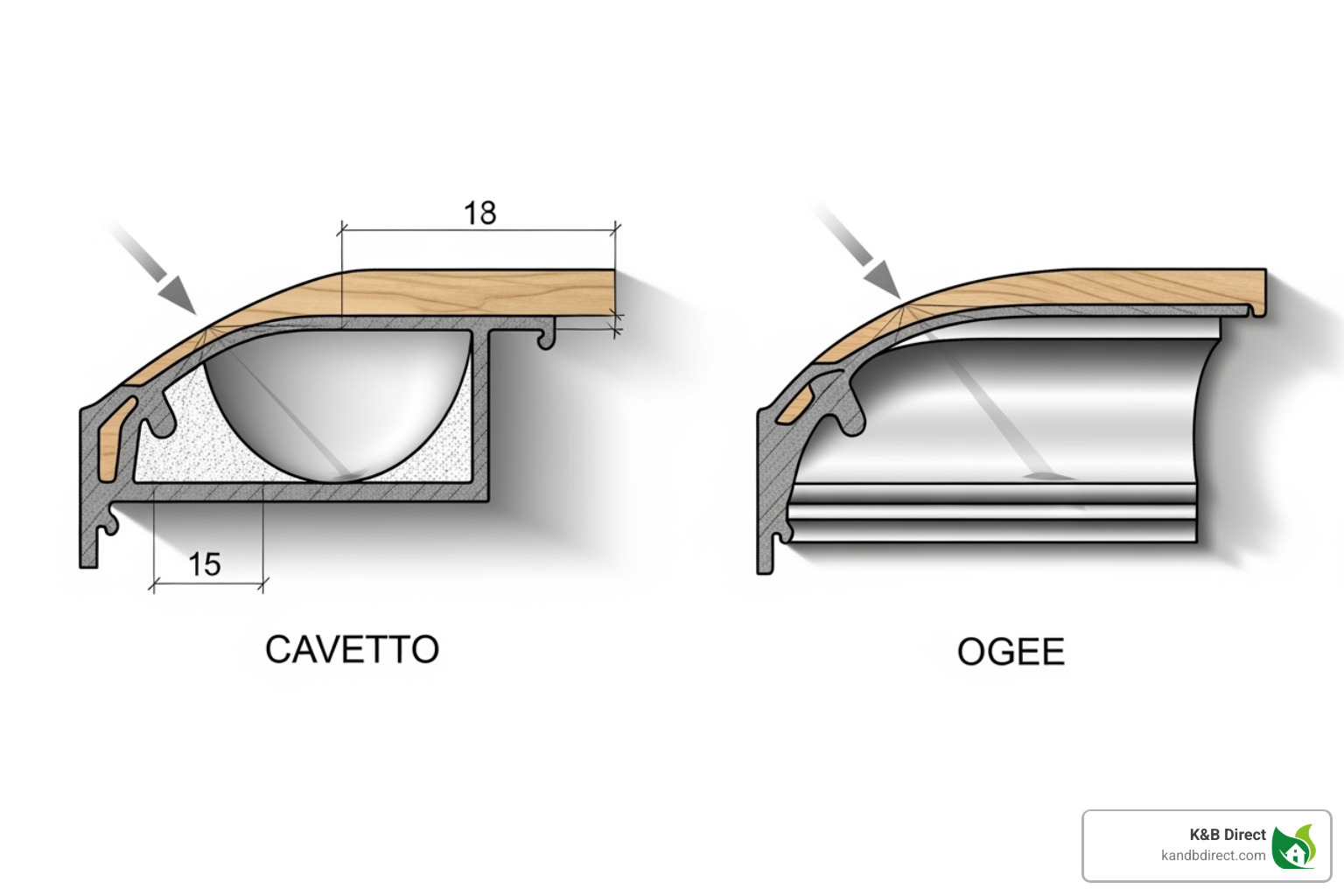
Think about concave profiles – these are the ones that curve inward, like a gentle scoop. Examples include the classic cavetto and the deeper scotia. These inward curves tend to absorb light, creating lovely, pronounced shadows. A cavetto molding, for instance, will often appear lighter at the top and gradually darken towards the bottom. This effect can make a space feel cozy or provide a clear visual break between surfaces. The scotia, being a bit deeper, casts even stronger shadows. These shadows make the molding seem to recede, adding a touch of mystery and complex layering to your walls.
Now, let’s look at convex profiles. These are the shapes that curve outward, designed to catch and reflect light. They create bright highlights and a sense of projection. The ogee is a fantastic example – it’s that neat S-shaped curve that combines both an inward and outward bend. One part of the ogee will beautifully catch the light, creating a highlight, while the other will gracefully fall into shadow. This makes for a truly dynamic and fluid look! Other common convex shapes include the bold torus, which is a large semi-circular curve, and the ovolo, a convex quarter-circle. These outward curves help to define edges and give your molding a strong, solid presence in the room.
The clever mix of these concave and convex elements within a single molding profile is what creates that intricate play of light and shadow. It gives your molding a true three-dimensional quality, adding significant visual depth to any room. This interplay isn’t just pretty; it gives your architecture definition, turning flat walls into dynamic, engaging elements. When we help our clients at K&B Direct choose their molding, we always consider how these profiles will interact with the natural and artificial light in their homes. We want to make sure the finished result isn’t just good, but absolutely stunning!
From Factory to Wall: The Two Sides of the Molding Process
Ever wondered why the word “molding” pops up in two different conversations—one about factory floors and another about home trim? To understand the term, it’s crucial to distinguish between the industrial manufacturing process that creates countless everyday objects and the craft of installing decorative trim in our homes. While both involve shaping, their scale, purpose, and techniques differ greatly.
The Manufacturing Process of Molding
Let’s peel back the curtain on the industrial side first. The industrial molding process is a fundamental manufacturing technique. It’s all about shaping liquid or pliable raw materials into desired forms using a rigid frame called a mold or matrix.
At its core, molding in manufacturing involves filling a hollowed-out block (the mold) with a material like plastic, metal, glass, or ceramic. The material then hardens or sets inside the mold, adopting its precise shape. This allows for the mass production of identical objects with incredible precision and efficiency. The talented person who designs and makes these specific molds is known as a moldmaker.
You might be surprised by how many ways materials are molded! Think of injection molding, a very common process where molten material (often plastic) is injected into a mold cavity, cooled, and then ejected. It’s used for everything from car parts to household goods. Then there’s compression molding, where material is placed into an open, heated mold, and then squished into shape under pressure. We even see blow molding for forming hollow plastic or glass parts, like bottles, where air is blown into a preform inside a mold. Casting involves pouring a liquid material into a mold and letting it solidify – ancient molds were used for casting spear tips and mass-producing clay figurines! For hollow plastic parts, rotational molding rotates the mold on two axes while heated, spreading the molten plastic evenly. And for continuous shapes, extrusion molding pushes material through a die, perfect for things like pipes, window frames, and even some types of continuous plastic molding itself.
This industrial magic is applied in countless industries. We see molded plastics in furniture, household goods, electronic cases, and structural materials. Historically, wooden molds were even used for jaggery and sweets, demonstrating the ancient roots of this versatile manufacturing method. You can find more sources on the “Molding” process by searching here.
The Installation Process for Decorative Molding
Now, let’s switch gears from the factory floor to your living room walls. Installing decorative molding is a different kind of art – one that transforms raw materials into beautiful, finished architectural details in our homes. This is where our expertise at K&B Direct truly comes into play, as we guide customers through the selection of the perfect trim and offer insights into successful installation.
Before you even pick up a saw, a little preparation goes a long way. Accurate measurements are your best friend; remember the old saying, “measure twice, cut once!” Make sure your walls are clean and dry, and have all your materials – your beautiful molding, nails, glue, and so on – ready to go.
Having the right essential tools makes all the difference for a professional finish. Here’s a list of what you’ll typically need:
- Miter saw (for precise angle cuts)
- Coping saw (for intricate inside corner cuts)
- Tape measure and pencil
- Stud finder
- Level
- Nail gun (pneumatic or cordless) and finish nails
- Wood glue or construction adhesive
- Caulk gun and paintable caulk
- Wood filler
- Sanding block
- Paint or stain
Now comes the precise part: measuring and cutting your molding. Getting these cuts just right is key to minimizing waste and achieving tight, seamless joints. For baseboards and crown molding, understanding how to cut baseboard corners, especially inside and outside corners, is vital. Don’t worry, we’ve got you covered with detailed guides like How to Cut Baseboard Corners and How to Cut Baseboard. For a truly polished look, even specific pieces like How to Install Base Cap Moulding require careful cuts.
Once your pieces are perfectly cut, it’s time to fasten them. Typically, a nail gun and finish nails do the trick, securing the molding to your wall studs. For extra hold and to prevent any unsightly gaps down the line, a little wood glue or construction adhesive on the back of the molding before you nail it up is a smart move.
The final step is where the real magic happens – finishing! This is what transforms a good job into a professional-looking one. Use paintable caulk to fill any tiny gaps between the molding and your walls or ceiling – it creates a smooth, seamless transition. Then, fill any nail holes with wood filler and sand them until they’re perfectly smooth. Finally, a fresh coat of paint or stain completes the look, blending your new molding beautifully with your room’s aesthetic. This attention to detail isn’t just about looks; it adds significant value and character to your home.
Frequently Asked Questions about Molding
At K&B Direct, we love talking molding with our customers! Over the years, we’ve noticed the same questions come up again and again. Let’s tackle the most common ones to clear up any confusion and help you make the best choices for your home.
What’s the difference between ‘molding’ and ‘moulding’?
Here’s a fun fact: there’s no difference between ‘molding’ and ‘moulding’ except where you learned to spell!
American English uses “molding” – this is what you’ll see in the Merriam-Webster dictionary and throughout the U.S. home improvement industry. British English and other Commonwealth countries prefer “moulding.” Both words describe exactly the same beautiful architectural elements that transform your space.
Since K&B Direct serves customers throughout Chicagoland and across America, we typically use the American spelling “molding” in our materials. But whether you call it molding or moulding, we’re talking about the same trim that adds character and finish to your home. The etymology traces back centuries, and both spellings have been used interchangeably in historical texts.
How do I choose the right size molding for my room?
Choosing the right size molding is like finding the perfect frame for a painting – it needs to complement, not compete with, your space. Here’s how to get it just right.
Ceiling height is your starting point. With standard 8-foot ceilings, crown molding between 3 to 5 inches creates beautiful proportion. Got 9 or 10-foot ceilings? You can go bolder with 5 to 7-inch profiles. For those lucky enough to have soaring ceilings over 10 feet, larger molding of 7 inches or more creates that grand, luxurious feel. The same logic applies to baseboards – taller rooms can handle taller trim.
Room proportions matter just as much. A spacious great room can showcase substantial molding without feeling cluttered, while a cozy bedroom might sing with more delicate profiles. Think of it as visual harmony – your molding should feel like it belongs, not like it’s trying too hard.
Your home’s architectural style also guides the decision. Traditional homes often call for multi-layered crown molding or classic ogee profiles, while modern spaces typically prefer clean, simple lines. A good rule of thumb for scale is keeping elements balanced – if you choose wide crown molding, consider proportionally sized baseboards to maintain visual equilibrium.
For specific applications like Bedroom Crown Moulding, we often recommend slightly smaller profiles that create elegance without overwhelming the intimate space. There’s no single “right” answer – it’s about what makes you smile when you walk into your room.
What is the difference between molding as a process and as a decorative element?
This question gets to the heart of why “molding” can be confusing! The word describes two completely different things that happen to share the same name.
Molding as a manufacturing process is all about shaping raw material using a rigid mold. Picture a factory where molten plastic gets injected into a mold to create identical parts – that’s the manufacturing process side. The goal is mass production of functional items like car parts, bottles, or even the raw lengths of decorative trim themselves. Here, the mold is the tool that creates the product.
Molding as an architectural element is the finished decorative trim you see in homes. These are the strips of wood, MDF, or synthetic materials that cover transitions between surfaces and add detail to your walls, ceilings, and floors. Think crown molding, baseboards, door casings – these ARE the finished products that get installed as part of your interior design.
The beautiful connection? The manufacturing process often creates the decorative trim we install in homes. So industrial molding makes the architectural molding that transforms your space. It’s like the difference between the bakery that makes the cake and the finished cake on your table – both essential, but serving very different purposes.
Understanding this distinction helps when you’re researching products or talking with contractors. When we discuss molding at K&B Direct, we’re focused on those beautiful architectural elements that will make your home shine, not the factory processes that created them.
Conclusion: Lift Your Home with the Perfect Finish
It’s amazing how much depth and character a simple element like molding can add to a space. It is that magical bridge where careful construction meets beautiful artistry. As we’ve explored, the term “molding” covers a lot of ground—from the clever industrial process that shapes everyday items to the decorative trim that transforms your home.
Understanding both sides of this word truly empowers you. It helps you make smart design choices, ensuring you pick the perfect profiles and materials to add incredible value, timeless elegance, and that unique personal touch to any room.
Here at K&B Direct, we wholeheartedly believe in providing you with top-notch products that help bring your dream home aesthetic to life. We’re passionate about supporting homeowners across Chicagoland, helping you turn your vision into a beautiful reality. You’ll find we offer only the best quality products, always at unbeatable, lowest possible prices, all backed by friendly, helpful service.
Whether you’re diving into a full home renovation or simply looking to add those crucial final touches, the right molding can dramatically boost your interior design value. It’s often the element that takes a space from good to absolutely stunning!
Ready to see the possibilities for your home? We invite you to Explore our full range of Mouldings & Millwork today. Let us help you find the perfect finish that will make your house truly feel like home.