
Why Your Baseboard Trim Style Sets the Tone for Every Room
Choosing the right baseboard trim style can be the difference between a room that feels polished and one that feels unfinished. Baseboards do two jobs at once: they protect your walls from scuffs and impacts, and they frame the space where your walls meet the floor — quietly shaping the character of every room.
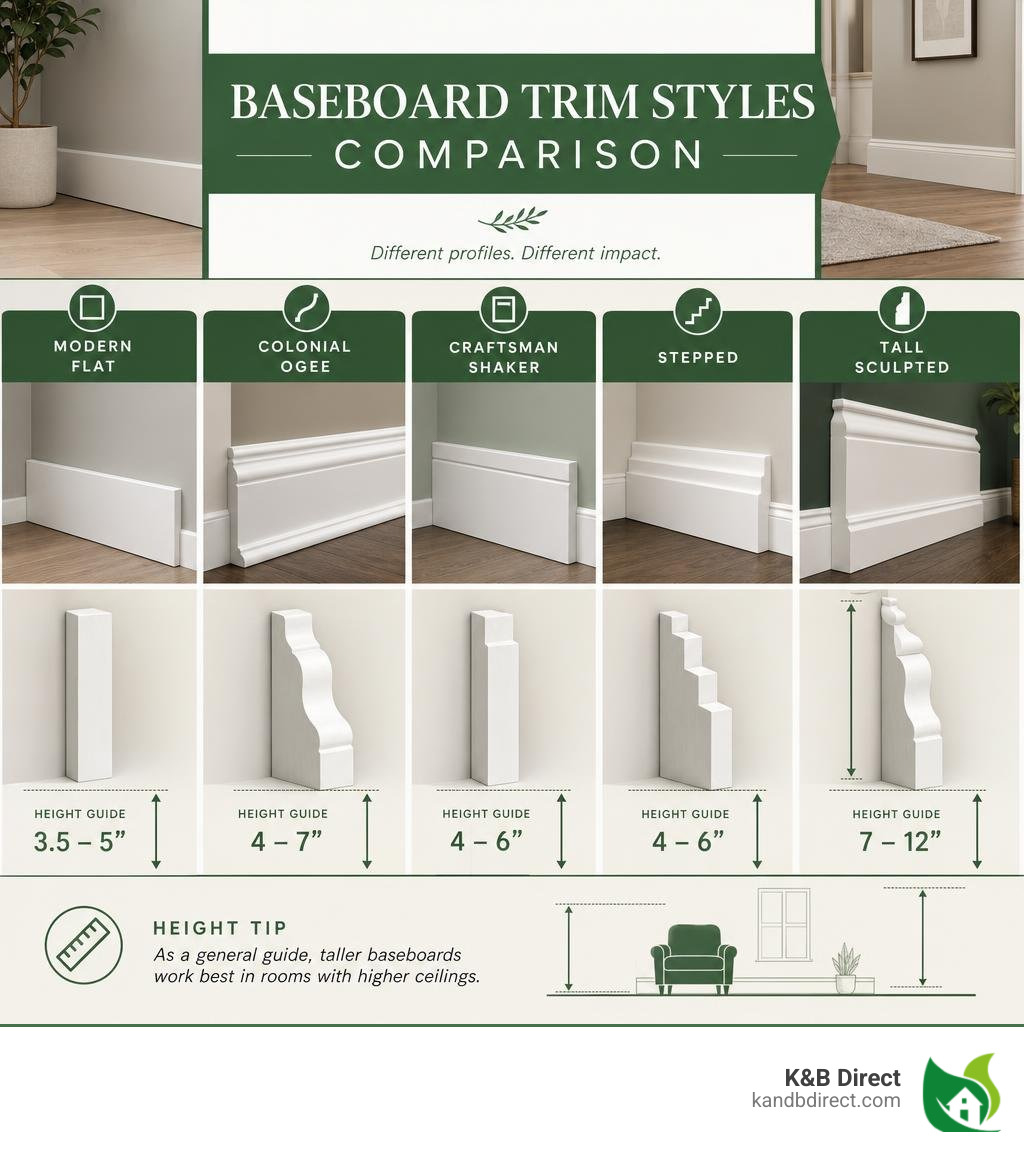
Here are the most common baseboard trim styles at a glance:
| Style | Best For | Typical Height | Key Feature |
|---|---|---|---|
| Modern / Flat Stock | Contemporary, minimalist homes | 3.5 – 5 inches | Clean, straight edges |
| Colonial / Ogee | Traditional, classic interiors | 4 – 7 inches | Curved, decorative profile |
| Craftsman / Shaker | Bungalows, farmhouse, Arts & Crafts | 4 – 6 inches | Flat top, simple reveal |
| Stepped | Transitional or layered looks | 4 – 6 inches | Multi-level profile |
| Tall / Sculpted | High-ceiling formal rooms | 7 – 12 inches | Bold visual presence |
Even subtle differences in profile, height, or material can make a room feel taller, warmer, or more formal — without touching the walls, floors, or furniture. Most homeowners don’t realize how much impact this one detail carries until they see it done right (or wrong).
I’m Eryk Piatkowski, owner of K&B Direct, and after more than a decade helping homeowners and renovation professionals select the right baseboard trim style for kitchens, bathrooms, and beyond, I’ve seen how the right profile ties an entire room together. In this guide, I’ll walk you through everything you need to choose with confidence.
Important baseboard trim style terms:
Selecting the Right Baseboard Trim Style
When we look at the way a room comes together, we must consider the architectural pedigree of the house. Selecting a profile is not just about grabbing whatever sits on the shelf at the local lumber yard in Schiller Park or Des Plaines. It is about matching the lines of your home to create a seamless visual flow.
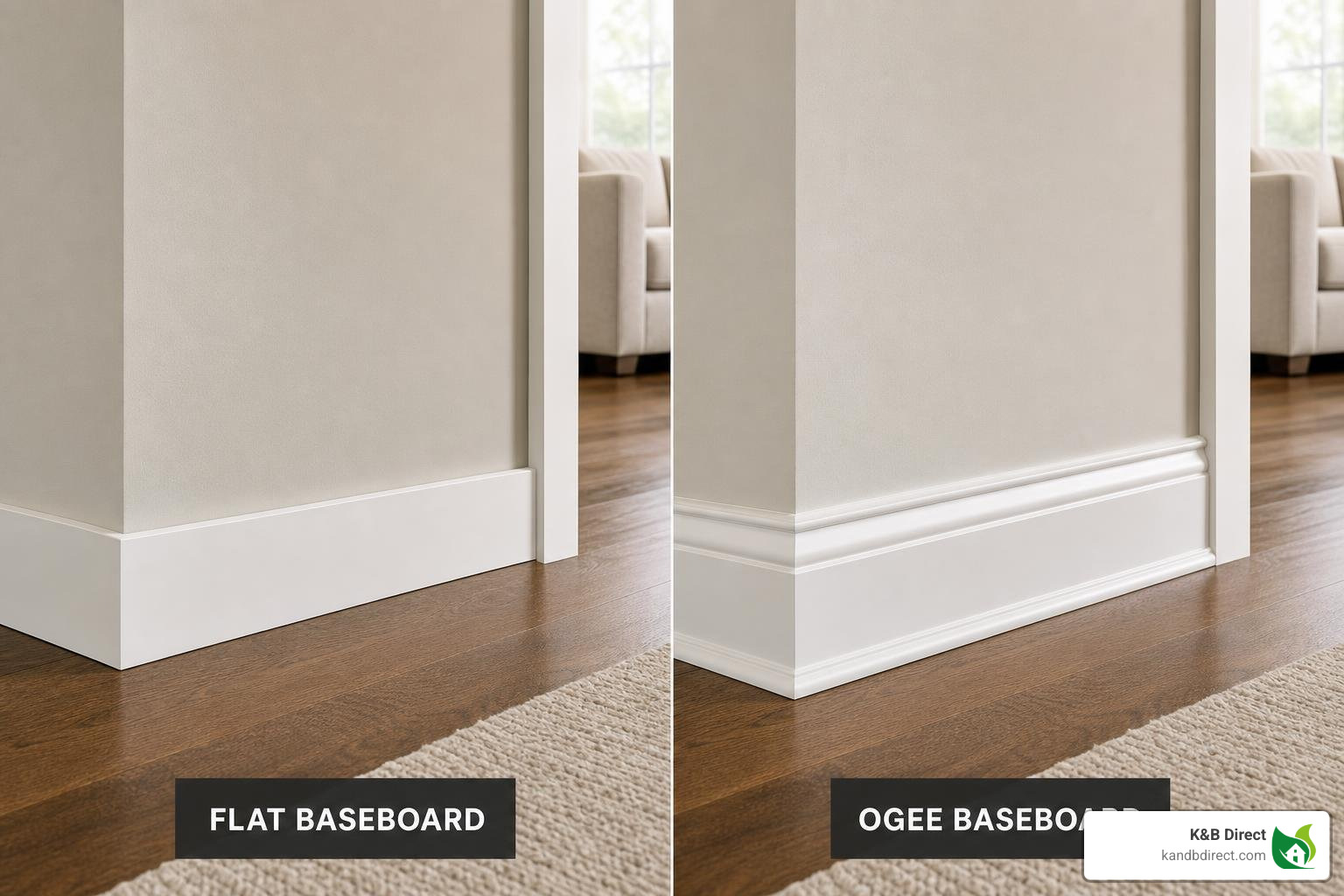
The right profile serves as the visual anchor of your room. If you install an ornate, highly sculpted trim in a sleek, contemporary high-rise condo in downtown Chicago, the visual conflict will feel jarring. Conversely, placing a thin, plain board in an elegant Victorian home in Oak Park will make the space look stripped of its soul.
To find the perfect fit, we look at three primary design categories: modern, traditional, and craftsman. You can Explore Baseboard Moulding Options to see these distinct shapes in detail and determine which direction suits your property.
Modern and Minimalist Baseboard Trim Style
For contemporary interiors, simplicity reigns supreme. The modern aesthetic relies on clean lines, shadow lines, and the absence of ornate detailing. In these spaces, we rely heavily on flat stock profiles.
A flat stock board features a completely flat face and a straight top edge, sometimes finished with a very slight radius known as an eased edge. This eased edge prevents the wood from splintering and allows paint to adhere beautifully without pooling. If you want to understand the understated power of these profiles, read about Why 4 Inch Flat Baseboards Are the Unsung Heroes of Modern Design.
Modern profiles are highly effective at making a room feel larger. When painted the exact same color as the walls, they create an unbroken vertical plane, drawing the eye upward and making standard eight-foot ceilings feel much loftier.
Traditional and Classic Baseboard Trim Style
If your home has roots in classic design — such as Colonial, Georgian, or Victorian architecture common in historic pockets of Evanston or Park Ridge — you will want to embrace traditional profiles. These styles are defined by their curves, steps, and decorative flourishes.
The most famous traditional profile is the Colonial or ogee shape. This style features a convex curve (an ovolo) that transitions smoothly into a concave curve, creating an elegant wave-like profile. These curves catch the light and cast soft shadows, adding depth and architectural interest to the perimeter of the room.
For traditional homes, a classic Baseboard Trim profile acts as a visual reset. When your walls feature bold paint colors, classic wallpaper, or picture frame molding, a detailed traditional baseboard grounds the design, providing a sense of permanence and luxury.
Craftsman and Shaker Profiles
Originating from the early twentieth-century Arts and Crafts movement, Craftsman and Shaker styles celebrate structural integrity, clean lines, and warm aesthetics. Unlike modern minimalism, which seeks to hide the trim as much as possible, Craftsman style puts the beauty of wood and joinery on proud display.
A typical Craftsman baseboard consists of a flat board topped with a simple, sharp-edged cap or a subtle bevel. There are no swooping curves or ogee shapes here; instead, you get a solid, grounded profile with a simple reveal.
These profiles look exceptional when milled from natural hardwoods or high-grade pine and finished with a rich stain rather than paint. Stained Wood Trim highlights the natural grain, bringing a sense of warmth, comfort, and craftsmanship into bungalows and farmhouse-style homes.
Comparing Baseboard Materials and Finishes
Once you select your profile, the next step is choosing the material. The material you select impacts the durability, moisture resistance, paint finish, and overall investment of your project.
| Material | Relative Investment | Moisture Resistance | Best Application | Finishing Options |
|---|---|---|---|---|
| MDF | Low | Poor (swells if wet) | Bedrooms, living areas | Paint only |
| Jointed Pine | Moderate | Moderate | Hallways, general living | Paint or light stain |
| Hardwood (Oak/Maple) | High | High | High-traffic areas, formal rooms | Stain or clear coat |
| Vinyl / PVC | Moderate | Excellent (waterproof) | Bathrooms, basements | Pre-finished or paint |
Medium-Density Fiberboard (MDF)
MDF is the most popular material for painted trim applications. Made from compressed wood fibers and resin, MDF contains no natural grain, knots, or warping tendencies. This engineered structure ensures that every single length of trim is perfectly straight and uniform.
The primary benefit of MDF is its ultra-smooth surface, which accepts paint beautifully. It comes factory-primed, meaning you only need a light sanding and a couple of topcoats to achieve a flawless, brushstroke-free finish. For a detailed breakdown of options, consult our 5 Inch MDF Baseboard Complete Guide.
However, MDF does have a notable weakness: it does not tolerate standing water. If water seeps into the raw edges of MDF, it swells like a sponge and loses its structural integrity. Therefore, we recommend avoiding it in damp environments. To make sure you select the perfect dimensions for your space, check out our guide: Don’t Get Board Choosing Your Next MDF Trim Size.
Solid Wood Options
For many homeowners and custom builders in the Chicago area, solid wood remains the gold standard. Wood offers unmatched structural strength, crisper milled details, and the ability to accept stains.
- Finger-Jointed Pine: This material consists of short pieces of clear pine joined together with interlocking joints. It is highly stable, less prone to warping than solid clear pine, and comes pre-primed for paint. Read more about this excellent option in Primed for Perfection Everything You Need to Know About 1×12 Pine.
- Poplar: A favorite among professional painters, poplar is a dense hardwood with a tight grain. It resists denting much better than pine and paints up like absolute glass.
- Oak and Maple: These premium hardwoods are reserved for stain-grade installations. Oak offers a bold, classic grain pattern, while maple provides a smooth, contemporary look. Both are exceptionally durable and easily withstand the impacts of vacuum cleaners, toys, and shoes. You can view our premium Wood Trim options to find the perfect species for your home.
Moisture-Resistant Vinyl and PVC
In areas prone to high humidity, dampness, or frequent spills — such as basements, laundry rooms, and bathrooms — traditional wood and MDF can fail over time. This is where synthetic materials like PVC and vinyl shine.
These materials are completely waterproof, termite-resistant, and will never rot, warp, or split. Vinyl options often come in flexible rolls that are installed using specialized adhesives, making them excellent for commercial spaces or curved walls. If you are looking to make a bold statement in a moisture-prone area, consider Going Big with 6 Inch Vinyl Baseboards to protect your walls while maintaining an upscale look.
Sizing, Proportions, and Trim Coordination
A beautiful profile can easily look out of place if the proportions are wrong. Choosing the height of your trim requires analyzing the entire three-dimensional volume of your room, including ceiling height, door casing widths, and even the thickness of your flooring.

Determining the Ideal Height
To keep your rooms looking balanced, we recommend using the ceiling height as your primary anchor. A classic design guideline is the “rule of thirds,” which suggests that the lower third of the wall should contain your visual grounding elements, with the baseboard occupying a proportional sliver of that space.
- 8-Foot Ceilings: Stick to baseboards measuring between 3.25 and 5.25 inches. Anything taller will make the walls feel compressed, while anything shorter than 3 inches can look skimpy and “builder-grade.”
- 9-Foot Ceilings: This standard height is highly versatile, comfortably accepting baseboards between 5.25 and 7.25 inches.
- 10-Foot Ceilings and Above: To prevent the trim from getting lost in the vast vertical space, look at profiles measuring 7.25 to 12 inches.
If you are considering a substantial, mid-range profile, you will find excellent inspiration and technical advice in our guide, Everything You Need to Know About 5 1/4 Inch Flat Baseboards. For a complete overview of how these dimensions interact with your walls, check out The Ultimate Guide to Molding and Baseboards.
Coordinating with Casing and Crown Moulding
Your baseboards should never be selected in isolation; they must coordinate with your door and window casings to create a cohesive trim package.
A fundamental rule of millwork proportion is that the baseboard must be thicker than the casing where they meet. If your door casing is 3/4-inch thick, your baseboard should ideally be 5/8-inch thick or meet a plinth block to prevent an awkward, exposed edge.
Furthermore, the styles must speak the same design language. Putting a highly detailed Victorian baseboard under a flat, modern door casing creates a visual conflict that feels unsettled. Keep the level of detail consistent across all trim elements, from the floor to the crown moulding.
Layering with Shoe Moulding and Base Caps
If you want a truly custom, high-end look without the heavy investment of solid, wide custom millwork, you can create a built-up assembly using multiple pieces of trim.
- Base Cap Moulding: This is a small, decorative profile that sits directly on top of a flat baseboard. It adds a touch of elegance and allows you to customize the height and detail of your trim. To see how these profiles can elevate your design, explore the Base Cap Moulding Profiles Complete Guide.
- Base Shoe / Quarter Round: This small profile (usually 3/4 by 3/4 inches) runs along the very bottom of the baseboard where it meets the floor. It is designed to cover the expansion gaps left between wood flooring and the wall.
- Two-Piece Assemblies: By combining a flat board with a decorative cap, you can create a gorgeous 2 Piece Base Molding that looks like a single, expensive custom run of trim.
Frequently Asked Questions About Baseboards
Can I match new baseboards to existing trim in older homes?
Yes, this is a common challenge during renovations in historic Chicago neighborhoods like Elmhurst or Niles. When exact matches are no longer available on the shelf, you have two excellent paths:
First, you can take a small sample of your existing trim to a specialized millwork provider to have a custom cutter made. This allows them to run exact duplicates of your historic profile.
Second, you can often modify stock profiles. By taking a standard stock profile and running it through a table saw to adjust the height, or by combining it with a specific base cap, we can closely replicate the proportions of the original trim. Our team at K&B Direct frequently helps homeowners find creative ways to match their existing Baseboard Trim during historic restorations.
Should baseboards match door casing and flooring colors?
They do not have to match exactly, but they must look intentional. You have three main color design paths:
- Classic Contrast: Paint your baseboards and casings a crisp, clean white or cream while keeping your walls colored. This frames the room beautifully and highlights the architectural lines of the trim.
- Tone-on-Tone: Paint your baseboards, casings, and walls the exact same color. Use a matte finish on the walls and a satin or semi-gloss finish on the trim. This creates a highly sophisticated, seamless look that makes rooms feel larger.
- Stained Wood Harmony: If you have high-quality hardwood floors, matching the species and stain of your baseboards to your flooring creates a warm, grounded envelope.
For visual inspiration on how different design professionals coordinate these elements, you can check out various Baseboards and Trim Ideas on Pinterest.
What are the best installation and finishing tips for a professional look?
Achieving a seamless, professional finish requires attention to detail during the cutting and joining stages:
- Coped Joints for Inside Corners: Never miter your inside corners at 45 degrees. Walls are rarely perfectly square, and seasonal wood movement will cause mitered inside corners to pull apart. Instead, use a coped joint, where one board runs flat into the corner and the second board is profiled to fit perfectly over the face of the first.
- Miter Outside Corners: Cut outside corners at 45 degrees, and always test the angle with scrap pieces first. Use a high-quality wood glue and pin the joint together with a pin nailer to keep it tight.
- Caulk the Top Edge: Run a neat bead of paintable acrylic caulk along the top edge where the baseboard meets the drywall. This fills any slight gaps caused by wavy walls and creates a perfectly seamless transition.
- Secure with the Right Adhesive: In addition to finishing nails, using a high-quality adhesive prevents the trim from pulling away from the studs over time. To avoid common mistakes, read about managing A Sticky Situation for Your Baseboard Glue.
Conclusion
At K&B Direct, we believe that every detail of your home should contribute to your dream aesthetic. Whether you are updating a cozy bungalow in Bensenville or remodeling a classic home in Arlington Heights, selecting the perfect baseboard trim style is a simple yet powerful way to elevate your interior design.
We offer an exceptional selection of high-quality mouldings, doors, and cabinets at the lowest possible prices, ensuring you never have to compromise on quality to achieve a beautiful finish. If you are ready to transform your space, Explore Baseboard Moulding Options or visit us to find the perfect profile for your next home improvement project.