
Why Getting Your MDF Trim Size Right Matters
2 inch MDF trim is one of the most popular choices for interior trim work — and for good reason. It fits a wide range of spaces without overpowering them, from door casings to baseboards to chair rails.
Quick answer: What is 2 inch MDF trim?
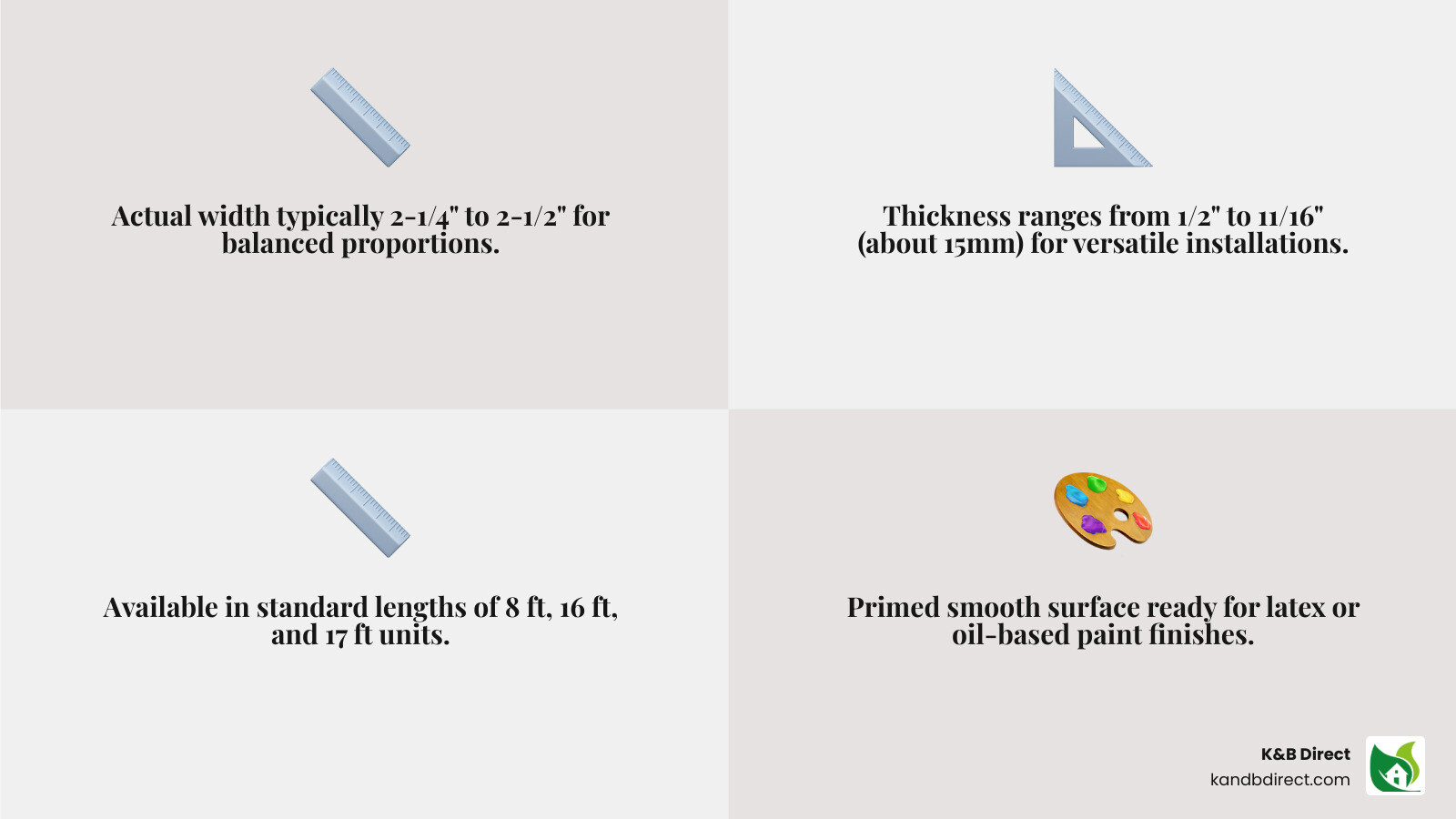
| Feature | Details |
|---|---|
| Actual width | Typically 2-1/4″ to 2-1/2″ |
| Thickness | Ranges from 1/2″ to 11/16″ (about 15mm) |
| Common lengths | 8′, 16′, and 17′ |
| Surface | Smooth, primed, and ready for paint |
| Best uses | Door casings, window frames, baseboards, chair rails |
Choosing the wrong trim size is a surprisingly easy mistake to make. Go too narrow and the trim looks thin and unfinished. Go too wide and it can crowd smaller rooms or clash with your cabinetry style.
That’s exactly why understanding your options before you buy matters so much.
The good news? 2 inch wide MDF trim hits a sweet spot. It works in modern, craftsman, and traditional interiors alike — and MDF’s smooth, knot-free surface makes it far easier to paint than solid wood.
This guide walks you through everything: profiles, dimensions, applications, finishing tips, and the way to pick the right trim for your space.
I’m Eryk Piatkowski, owner of K&B Direct, and after more than a decade helping homeowners and renovation professionals select the right 2 inch MDF trim for kitchens, bathrooms, doors, and windows, I know the way the right trim size can transform a room. Let’s make sure you get it right the first time.
2 inch mdf trim terms you need:
Understanding the Versatility of 2 inch MDF Trim
When we talk about Mouldings Millwork, the “2-inch” designation is often a category rather than a single exact measurement. In Types of Moulding, you will find that actual dimensions vary slightly depending on the profile. For example, a standard 2 inch mdf trim casing often measures 2-1/4 inches or 2-1/2 inches in width.
These variations are intentional. A 2-1/4 inch width is a classic standard for door surrounds, while a slightly wider 2-1/2 inch board provides a more substantial feel for baseboards in smaller rooms or for creating detailed wall accents. Thickness also plays a major role in the final look. You will frequently encounter 15mm profiles (roughly 0.59 inches), which offer a sturdy depth that creates beautiful shadow lines against your walls.
Common Profiles for 2 inch MDF trim
The “profile” refers to the shape or design of the trim’s face. Because MDF is an engineered material, it can be machined into crisp, consistent shapes.
- Primed S4S Boards: These are simple, flat boards with “Flat Four Sides” (often with slightly eased edges). They are the backbone of the “Craftsman” or “Modern Farmhouse” look.
- Colonial Styles: These feature traditional curves and beads, perfect for classic Chicago-area homes. A common example is an Empire 356-style casing profile, which provides a timeless teardrop shape.
- Craftsman Bases: These often use a flat profile with a very slight radius on the top edge, offering a clean, architectural finish that does not collect dust as easily as more complex shapes.
Standard Lengths and Thicknesses
We provide 2 inch mdf trim in several standard lengths to reduce waste during your project.
- 8′ units: Great for vertical door casings and easier transportation in a standard vehicle.
- 16′ and 17′ units: Ideal for long runs of baseboard or horizontal banding. Using longer pieces can reduce the number of visible joints in a room.
Thicknesses typically range from 1/2 inch to 11/16 inch. A thicker 11/16 inch board is excellent for Door Casing because it allows the trim to sit proud of the baseboard, creating a clean transition where the two meet.
Advantages of Fiberboard Over Traditional Wood
When deciding between Wood Trim and fiberboard, it helps to look at the way they perform in a real home environment. While Wood Moulding is beautiful for staining, MDF (Medium Density Fiberboard) is the undisputed king of painted finishes.
| Feature | MDF (Fiberboard) | Solid Wood (Pine/Poplar) |
|---|---|---|
| Surface | Ultra-smooth; no grain | Grain patterns may show |
| Stability | Highly resistant to warping | Can twist or cup with humidity |
| Knots | 100% knot-free | Knots can bleed through paint |
| Consistency | Uniform density throughout | Density varies by growth ring |
| Splitting | Very resistant to splitting | Can split near ends or knots |
The primary advantage of 2 inch mdf trim is its dimensional stability. Because it is made of compressed wood fibers and resin, it doesn’t have a grain direction. This means it won’t shrink, expand, or warp as much as natural wood when the Chicago humidity shifts between summer and winter. Furthermore, the lack of knots means you won’t have to deal with yellow sap spots ruining your white paint job a year later.
Primary Applications for Interior Projects
The beauty of the 2-inch width is that it is incredibly versatile. It is large enough to be noticed but slim enough to be used in multiple ways throughout a single room.
- Door Casing: This is perhaps the most common use. It frames the door and hides the gap between the door jamb and the drywall.
- Window Trim: Using the same 2 inch mdf trim on windows as you do on doors creates a cohesive, professional look.
- Baseboard Trim: In smaller rooms like bathrooms or laundry rooms, a 2-1/2 inch MDF baseboard provides a clean finish without making the walls feel “short.”
- Cabinetry Trim and Accents: We often see customers use these narrow boards to add architectural interest to the ends of kitchen islands or as decorative linear banding around a room.
- Chair Rails: A 2-1/4 inch profile installed at waist height can protect walls from furniture and allow for two-tone paint schemes.
Enhancing Interiors with 2 inch MDF trim
Using 2 inch mdf trim isn’t just about covering gaps; it’s about playing with light and shadow. When you choose a profile with “stepped” layers or an ogee curve, you create visual complexity. As light hits these different levels, it creates highlights and shadows that add depth to your walls.
According to our Baseboard Moulding Guide, pairing a simple Modern Base Moulding with a matching casing can significantly elevate the luxury of a room. Even a small 2-inch trim can make a space feel more “finished” and intentional.
Finishing and Installation Best Practices

One of the reasons professionals love MDF is the way it beautifully takes a finish. Most 2 inch mdf trim comes factory-primed, which saves you significant time.
Painting Tips
- Paint Choice: You can use high-quality latex or oil-based paints. Since the surface is non-porous and smooth, the paint flows out evenly, often hiding brush marks better than on wood.
- Sanding: If you need to sand a joint, use a fine-grit sandpaper (220 grit or higher). Be careful not to sand through the primer layer into the raw MDF, as the raw fibers will absorb paint differently.
- Sealing Edges: If you make a cut, the “end grain” of the MDF is more porous. We recommend a quick dab of primer on these cut ends before installation to ensure a uniform finish.
Installation Tools
To get the best results with Molding and Wall Trim, we recommend the following:
- Miter Saw: Essential for those crisp 45-degree corner angles.
- Pneumatic Finish Nailer: 18-gauge brad nails are perfect for 2 inch mdf trim. They hold securely but leave a very small hole that is easy to fill.
- Adhesive: For scarf joints (where two pieces meet on a long wall), a small amount of wood glue or specialized miter adhesive helps prevent the joint from opening over time.
Guide for Cutting Baseboard
Precision is key when you Cut Baseboard. Because MDF is so consistent, it cuts very cleanly without splintering. When you Cut Baseboard Corners, always “dry fit” your pieces first. If your walls are not perfectly 90 degrees (and in many Illinois homes, they are not), you might need to adjust your miter saw by half a degree to close the gap perfectly.
Selecting the Right Profile for Your Home
Choosing a profile is where you can truly express your style. Whether you are looking at our Base Cap Moulding Profiles Complete Guide or the Base Cap Molding Profiles Guide, there are three main directions you can take:
- Eased Edge (S4S): This is the “less is more” approach. It features flat surfaces and slightly softened corners. It’s the go-to for modern and minimalist designs.
- Ogee and Traditional Profiles: These feature an “S” curve. They are excellent for adding a touch of elegance to traditional dining rooms or entries.
- Backbands and Crown Backers: If you want your 2 inch mdf trim to look even more substantial, you can add a “backband.” This is a smaller piece of trim that fits over the outer edge of your casing, adding thickness and a “stepped” look.
If you are looking for a homeowner-friendly upgrade, Installing Base Cap Moulding on top of a simple 2-inch flat board can create the illusion of a much more expensive, custom-built baseboard.
Frequently Asked Questions about Fiberboard Trim
Why choose primed fiberboard?
Primed fiberboard is all about efficiency and finish quality. It arrives at your door with a smooth, white surface that is ready for paint. This eliminates the need for multiple coats of primer and heavy sanding. Because the material is consistent, you don’t have to worry about grain raising or “telegraphing” through your final topcoat.
Where is this trim most effective?
2 inch mdf trim shines in “high-visibility” areas like door surrounds and window frames. It’s also the perfect size for “picture frame” wall moulding (wainscoting). But we generally recommend avoiding MDF in areas with constant direct water contact, such as the immediate perimeter of a shower or as an exterior trim, as it is designed specifically for interior use.
What tools are required for installation?
You don’t need a massive workshop to install this trim. A miter saw (manual or power), a finish nailer (or hammer and nail set), a level to ensure your horizontal runs are straight, and a reliable measuring tape are the basics. For finishing, you’ll want a high-quality wood filler for nail holes and a tube of paintable caulk to seal the gap between the trim and the wall.
Conclusion
At K&B Direct, we believe that the details make the home. Whether you are in Chicago, Glen Ellyn, or any of our surrounding Illinois communities, choosing the right 2 inch mdf trim is a step toward achieving that polished, professional look you’ve always wanted.
MDF offers an unbeatable combination of smoothness, stability, and ease of use. It allows you to focus on the design and the finish rather than fighting with warped boards or bleeding knots. From simple modern casings to elegant colonial profiles, we are here to help you find the perfect match for your project.
Ready to transform your space? Explore our full range of Wood Trim and MDF options to find the high-quality, high-value solutions that fit your vision and your budget. Let’s build something beautiful together.