
Why Getting Your 1/2 Inch Trim Moulding Right Makes All the Difference
1/2 inch trim moulding is one of the smallest — and most underestimated — details in any room. But get it right, and it pulls your entire space together. Get it wrong, and gaps, mismatched profiles, and unfinished edges become impossible to ignore.
Here’s what you need to know at a glance:
| Use Case | Best Profile | Common Material |
|---|---|---|
| Floor-to-baseboard transition | Shoe moulding | Poplar, Red Oak |
| Hiding expansion gaps | Quarter round | Hardwood or polyurethane |
| Cabinet and wall panel detail | Small wood moulding | Poplar, Cherry, Maple |
| Curved or radius surfaces | Flex trim shoe moulding | Paint-grade flex material |
| Exterior trim accents | Flat stock trim | High-density polyurethane |
Small mouldings — including 1/2 inch profiles — start at roughly $0.60 to $0.81 per linear foot, making them one of the most budget-friendly ways to add real architectural character to a room.
They don’t just look good, either. They work hard. They cover expansion gaps, hide imperfections between flooring and walls, and give plain baseboards a more finished, layered look — all without a major renovation.
I’m Eryk Piatkowski, owner of K&B Direct, and over more than a decade of helping homeowners renovate kitchens and bathrooms, I’ve seen how the right 1/2 inch trim moulding choice transforms a space from forgettable to polished. In this guide, I’ll walk you through everything you need to pick the right profile for your project.
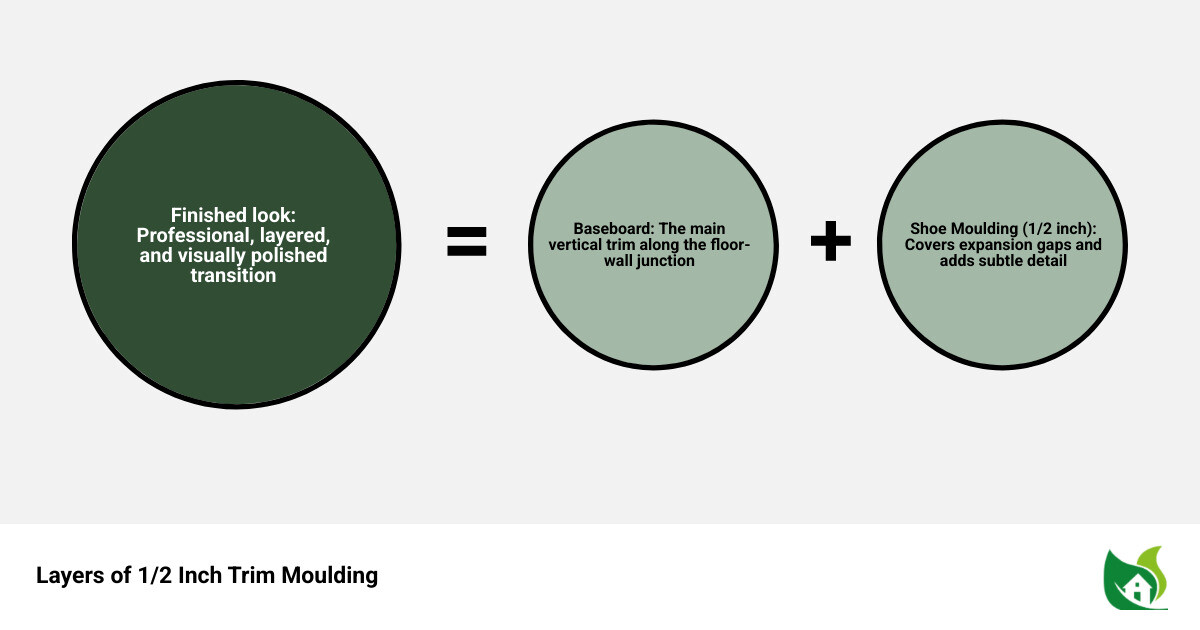
Common 1 2 inch trim moulding vocab:
Defining 1 2 Inch Trim Moulding and Its Versatility
When we talk about 1 2 inch trim moulding, we are referring to a category of millwork defined by its compact profile. These small accents are the “crowning jewels” of interior design. While larger casings and baseboards provide the structural frame of a room’s aesthetic, these smaller pieces add the depth and character that make a house feel like a custom home.

The versatility of these profiles is unmatched. You might find a 1/2″ x 3/4″ shoe moulding used to finish a hardwood floor installation, or a 1/2″ x 1-1/2″ traditional profile used as a decorative stop on a door frame. Because they are smaller, they are easier to handle and can be applied to almost any surface to create a sense of intentionality.
At K&B Direct, we often see these used in combination with other Molding styles to create “built-up” looks. Whether you are browsing Mouldings Millwork for a full renovation or just looking for Types of Moulding to refresh a single room, understanding the specific roles of these small profiles is key.
Enhancing Aesthetics with 1/2 Inch Trim Moulding
The primary aesthetic goal of 1 2 inch trim moulding is to provide subtle elegance. In modern design, we often use Modern Base Moulding which features clean lines. However, adding a small 1/2 inch cap or shoe can soften those lines or add a shadow line that makes the trim pop.
These small pieces are also masters of disguise. No wall is perfectly straight, and no floor is perfectly level. When you install Baseboard Trim, you might notice tiny gaps where the wood meets the floor. A 1/2 inch shoe moulding or quarter round follows the contours of the floor, effectively concealing those imperfections and creating a seamless transition.
Functional Benefits of 1/2 Inch Trim Moulding
Beyond looks, there are practical reasons to use these profiles. Hardwood and laminate floors require “expansion gaps” near the walls to allow the material to expand and contract with the Chicagoland humidity. Without 1 2 inch trim moulding, these gaps would be unsightly dirt traps.
By using these small profiles, we ensure that Molding and Baseboards work together to protect the perimeter of your room. They also act as a sacrificial barrier; it is much easier to replace a piece of 1/2 inch shoe moulding that has been scuffed by a vacuum cleaner than it is to replace an entire section of expensive baseboard.
Material Selection for Small Profiles
Choosing the right material for your 1 2 inch trim moulding depends on whether you plan to paint or stain, and where the moulding will be located.
- Hardwood Species: For those who love the look of natural grain, solid hardwoods are the gold standard. You can find 1/2 inch profiles in Cherry, Maple, Red Oak, Sapele, and Mahogany. These are ideal for staining to match furniture or cabinetry.
- Poplar: This is our favorite “utility” wood. It is a hardwood, but it is relatively affordable and takes paint beautifully. Unlike pine, it doesn’t have knots that bleed through the finish.
- Polyurethane: For areas prone to moisture or for exterior accents, high-density polyurethane (HDP) is a fantastic alternative. It won’t rot, warp, or crack, and it’s impervious to insects.
- MDF: Medium-density fiberboard is a popular choice for interior paint-grade projects. It is consistent, easy to cut, and comes pre-primed.
If you are looking for a vast selection of materials, Newmouldings | The Wood Moldings and Trim Super Store offers a variety of species. For specialized needs, we often point clients toward a PVC Base Cap Moulding Guide or general Wood Moulding resources to compare durability.
Working with Flexible 1/2 Inch Trim Moulding
A challenge in home design is dealing with curves. Whether it’s a curved staircase, a rounded wall, or an arched doorway, rigid wood simply won’t bend. This is where “Flex Trim” comes in.
Paint-grade flex trim, such as a 1/2″ x 3/4″ traditional shoe moulding, is made from a resin-based material that can follow a tight radius without snapping. While it may be more of an investment — for example, a 12-foot length of flex trim can be around $42.00 — it is the only way to achieve a professional finish on curved surfaces. For more on how to integrate these into your home, check out our Wood Cap Moulding Complete Guide.
Strategic Applications for Visual Impact
The magic of 1 2 inch trim moulding happens when you think outside the “floor level” box. While shoe moulding is the most common use, these small profiles can be used all over the home.

- Cabinetry Detailing: You can add 1/2 inch panel moulding to flat-panel cabinet doors to create a “shaker” or “traditional” look. It’s an excellent way to update a kitchen without replacing the boxes.
- Wall Panels: “Picture frame” moulding on walls is a classic high-end look. Using a Panel Cap Molding or a small 1/2 inch profile allows you to create these frames with precision.
- Door Casings: Adding a small bead or 1/2 inch backband to the outside of a door casing can make a standard door look much more substantial.
For those looking for specific profiles to use as accents, our Base Cap Moulding Profiles Complete Guide is a great place to start.
Building Up Profiles
In the millwork industry, we use the term “building up” to describe layering multiple moulding pieces to create one large, ornate profile. If you have a simple 3-inch crown moulding and you want it to look like a 5-inch custom piece, you can install a 1 2 inch trim moulding an inch below it and paint the space between the same color. This creates the illusion of a single, massive piece of Crown Moulding.
This technique also works for baseboards. By adding a Base Cap Molding Profiles Guide to the top of a standard S4S (surfaced on four sides) board, you create a custom look that adds significant value to your home.
Installation and Finishing Techniques
Installing 1 2 inch trim moulding requires a delicate touch. Because the pieces are small, they can split if you use nails that are too large.
- Preparation: Ensure your surfaces are clean. If you are installing over new flooring, make sure the expansion gap is consistent.
- Adhesive Selection: For polyurethane or particularly stubborn wood pieces, we recommend using a high-quality adhesive like PL Premium. This provides a permanent bond that supplements your fasteners.
- Fastening: Use a brad nailer with 18-gauge or 23-gauge pins. This minimizes the size of the hole you’ll need to fill later.
- Miter Cuts: For corners, always use a miter saw set to 45 degrees. For a tighter fit on inside corners, many professionals prefer “coping” the joint.
For more detailed steps, see our Base Cap Installation Guide. If you are using specialized HDP products, refer to technical specs like those found for the MD1220 Spectis Molding Half Round Trim – Spectis Moulders.
Finishing for a Professional Look
The finish is what separates a DIY-looking job from a professional one.
- Sanding: Even “ready-to-finish” wood should be lightly sanded with 220-grit sandpaper to remove any “milling marks” from the factory.
- Painting: If you are painting, use a high-quality latex paint. Most polyurethane and MDF mouldings come factory-primed, which saves a lot of time.
- Staining: If you are using hardwoods like Oak or Cherry, apply a wood conditioner first to ensure the stain absorbs evenly.
If you are looking to create your own custom profiles, you might even look into a Base Cap Molding Router Bit to mill your own small trim from scrap hardwood.
Frequently Asked Questions about Small Trim
Best applications for 1/2 inch trim?
Aside from floor transitions, 1 2 inch trim moulding is perfect for creating wall frames, detailing the edges of bookshelves, and finishing the “returns” on window stools. It’s also excellent for covering the joint where a backsplash meets a countertop. For a more traditional look, check out our Vintage Base Cap Moulding Guide.
Exterior use for small profiles?
Yes, but material choice is critical. We recommend high-density polyurethane for exterior use in the Chicago area. It handles our freeze-thaw cycles much better than wood. It is often used for decorative roof brackets or as a small accent on window shutters. Our PVC Base Cap Moulding Guide offers more insights into moisture-resistant options.
Necessary tools for installation?
You will need a miter saw for clean angles, a measuring tape, a brad nailer (pneumatic or cordless), and a high-quality adhesive. For larger profiles that might be paired with 1/2 inch trim, you can find more info in the 1 3/4 Base Cap Moulding Guide.
Conclusion
Choosing the right 1 2 inch trim moulding is about more than just filling a gap; it’s about adding that final layer of polish that makes your home feel complete. From the classic utility of poplar shoe moulding to the ornate possibilities of carved resin for curved walls, these small profiles offer endless design potential.
At K&B Direct, we are dedicated to helping our neighbors in Schiller Park, Des Plaines, Schaumburg, and across the Chicago area realize their dream home aesthetics. We believe that top-quality millwork should be accessible, which is why we offer a wide range of Wood Trim at the lowest possible prices.
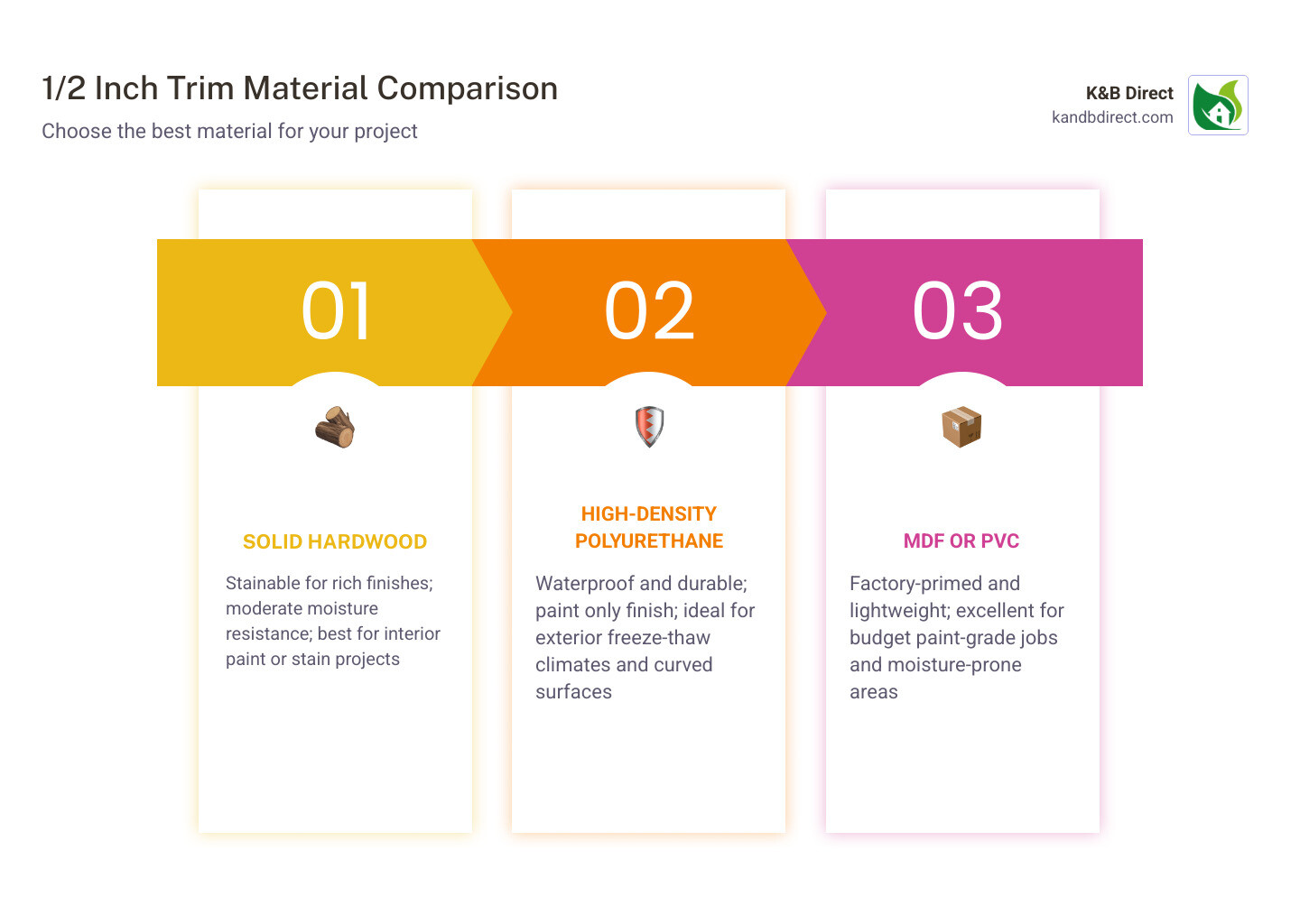
| Feature | Solid Hardwood | High-Density Polyurethane |
|---|---|---|
| Best Finish | Stain or Paint | Paint Only |
| Moisture Resistance | Low to Moderate | High (Waterproof) |
| Installation | Nails/Glue | Adhesive + Nails |
| Durability | High (Impact Resistant) | Moderate (Rot Resistant) |
| Customization | Can be sanded/routed | Molded shapes only |
Whether you are finishing a basement in Arlington Heights or updating a kitchen in Oak Brook, the right trim matters. Stop by and see us to explore our full collection of profiles and let us help you find the perfect fit for your next project.