
What Carpet to Floorboards Trim Does at a Doorway
Carpet to floorboards trim is the finishing strip that bridges the gap where your carpet ends and your hard floor begins — and choosing the right one makes a real difference to both safety and the look of your home.
Quick answer — the most common carpet-to-floorboards trim types:
| Trim Type | Best For | Fixing Method |
|---|---|---|
| PVC self-adhesive strip | Small gaps, up to 5 mm height difference | Peel-and-stick |
| Aluminum reducer | Uneven floors, high-traffic areas | Screw or adhesive |
| Wood/oak trim | Classic interiors, stainable to match boards | Screw-fixed |
| Solid brass bar | Traditional or premium finish, uneven floors | Screw-fixed |
Every doorway where carpet meets floorboards has an exposed edge. Without trim, that edge is a trip hazard, the carpet frays, and the floorboard chips. The right transition strip covers that joint cleanly, protects both flooring surfaces, and gives the room a finished, professional look.
It is one of those details that most people only notice when it is missing — or when they stub a toe on a sharp metal edge in the dark.
I’m Eryk Piatkowski, owner of K&B Direct, and with over a decade of helping homeowners and renovators source quality mouldings and trims, I’ve guided countless projects that needed the right carpet to floorboards trim to pull a room together. Let’s walk through everything you need to choose and fit the right one for your space.
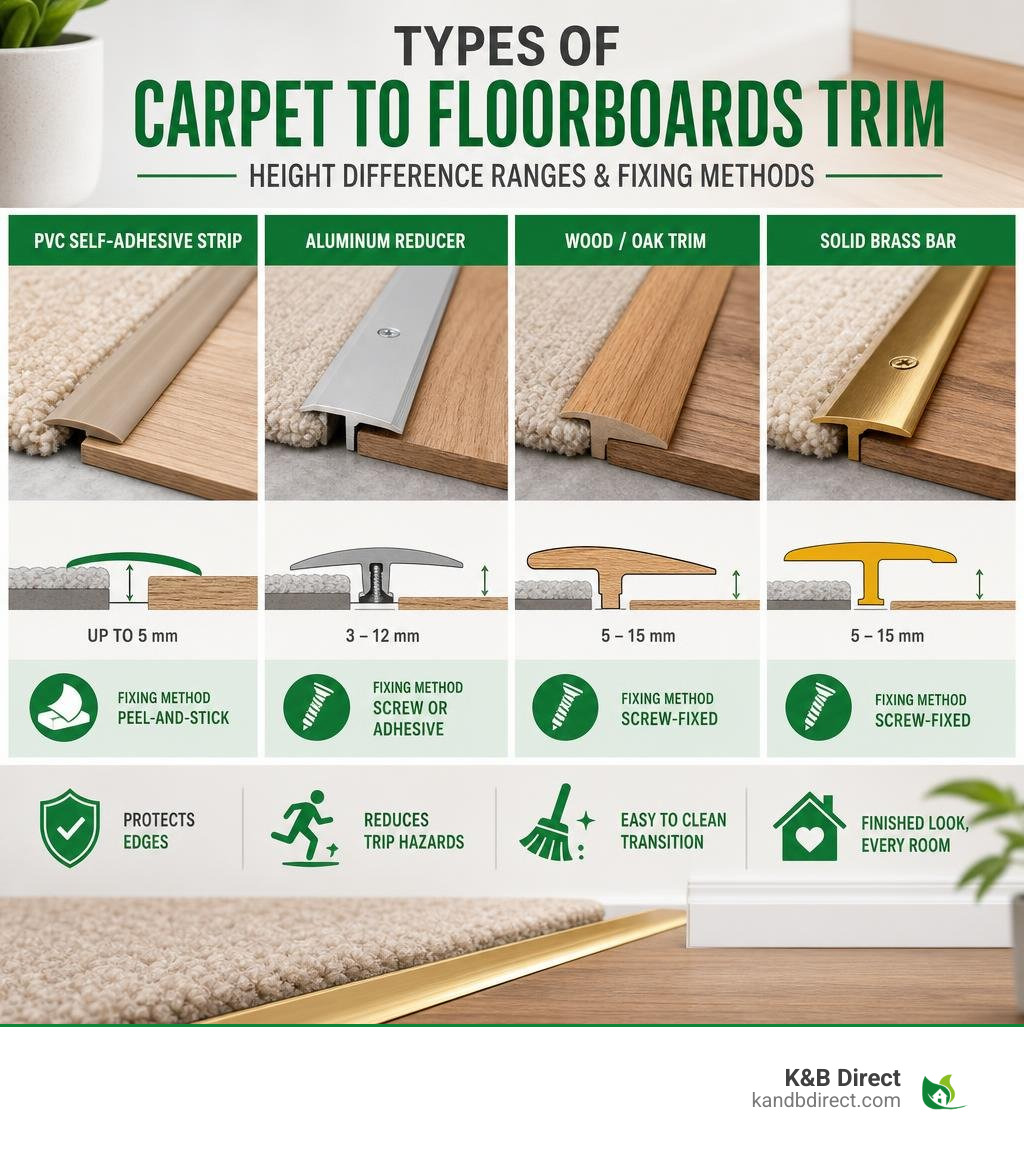
Handy carpet to floorboards trim terms:
When we look at a doorway, we see more than just a passage from one room to another; we see a meeting point of different materials. This intersection requires a specialized transition strip or threshold cover to protect the vulnerable edges of both materials.
A quality transition strip bridges the expansion gap required by wood floorboards while clamping down the carpet edge. Without this neat division, daily foot traffic quickly leads to carpet fraying and unsightly floorboard chipping. A well-chosen trim ensures a finished doorway and creates a much safer walking path throughout your home. In fact, matching these thresholds with your Floorboards Trim creates a continuous, high-end look.
Carpet to floorboards trim for equal floor levels
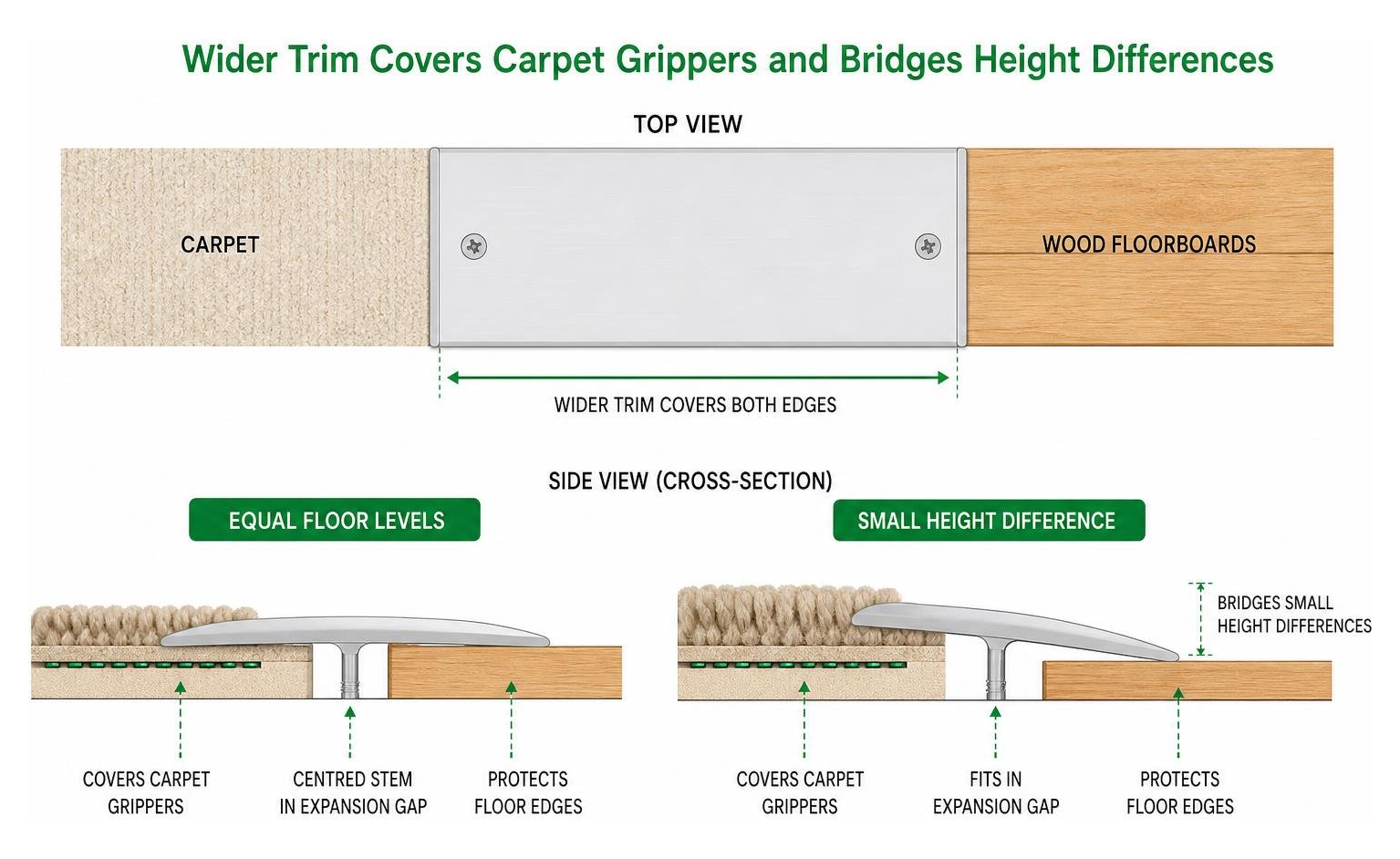
When the carpeted room and the adjacent wooden floorboards sit at the exact same height, we use a flat profile cover strip or T-moulding. This style of trim is designed with a centered downward stem that sits directly in the gap between the two floors, while the flat top caps both sides.
This centered placement allows both materials to undergo natural expansion movement without buckling. A flat profile keeps the transition low to the ground, ensuring excellent door clearance so your doors swing open and shut without catching.
Carpet to floorboards trim for small height changes
If your carpet pile is particularly thick or sits on a plush underlay, it will likely rest higher than the adjacent wood planks. For these uneven floors, a ramped profile or reducer strip is the ideal solution.
These transition pieces gently slope downward to bridge the height difference, preventing stubbed toes. While self-adhesive options are convenient, they are generally limited to height variances of 5 mm or less. For larger drops, a wider metal or wood trim with a more pronounced slope is necessary to create a safe, gradual ramp.
Primary purpose: protection, safety, and visual continuity
The primary job of any threshold trim is to deliver edge protection, prevent carpet fraying, and stop floorboards from chipping. Beyond protecting your investment in flooring, these strips play a critical role in home safety.
A flush, secure transition eliminates the raised edges that cause trips, which is a major factor in child safety and elderly safety. Instead of a jarring break between rooms, a smooth threshold provides visual continuity, transforming a potential hazard into a clean, attractive design element.
Comparing PVC, Aluminum, Wood, and Brass Transition Strips
To select the best transition strip, we must look at the physical properties of the materials available. Each material offers distinct advantages depending on daily traffic, moisture exposure, and the style of your home.
| Material | Durability | Flexibility | Safety Profile | Finish Options |
|---|---|---|---|---|
| PVC | Moderate | High | Excellent (Soft & flexible) | Woodgrain, solid colors |
| Aluminum | High | Low | Good (Low profile) | Silver, brass, pewter, mocha |
| Wood | High | Low | Good (Beveled edges) | Stainable oak, pre-finished |
| Brass | Exceptional | Low | Good (Heavy-duty) | Satin brass, polished, antique |
PVC transition strips: flexible and softer underfoot
Soft PVC transition strips have become incredibly popular for quick, self-adhesive installations. This flexible trim is highly forgiving on slightly uneven subfloors and features excellent anti-dust and smudge-resistant finishes that keep the walkway looking clean.
Because PVC is inherently softer than metal or hardwood, it significantly reduces the risk of painful toe stubs, making it a highly child-friendly and elderly-friendly option. It can even bend slightly to accommodate gently curved edges. For a deeper look at synthetic options, check out our guide on Vinyl Trim That Wins The Floor War.
Aluminum transition strips: durable and low-profile
For heavy-use areas, aluminum transition strips offer exceptional durability. These metal profiles are available in a variety of anodized or powder-coated finishes, including classic silver, warm brass tones, pewter, and rich mocha. Many feature a fluted grip surface to provide slip resistance.
Unlike self-adhesive options, aluminum strips typically require a secure drill-fixing method. If you are sourcing these for a large project, you can explore specialized aluminum carpet trim specifications to find the perfect profile. Just be sure to file down any sharp cut edges during installation to keep the threshold safe.
Wood and brass transition strips: warm, traditional, and substantial
If your home features classic interiors, nothing matches the substantial feel of wood or solid brass. An unfinished oak trim can be stained and sealed to match your existing hardwood planks perfectly, offering a seamless look. You can find excellent options like this hardwood transition trim reference, which is designed to handle uneven surfaces beautifully.
For a premium, traditional touch, solid brass bars—such as the Premier Posh Satin Brass Carpet to Floor Trim from Stair Heaven—provide unmatched elegance. Solid, unlacquered brass will naturally oxidize and develop a beautiful patina over time. These substantial trims require pre-drilling and screw-fixing to the subfloor, ensuring they remain rock-solid for decades.
Choosing the Right Carpet to Floorboards Trim Size, Profile, and Color
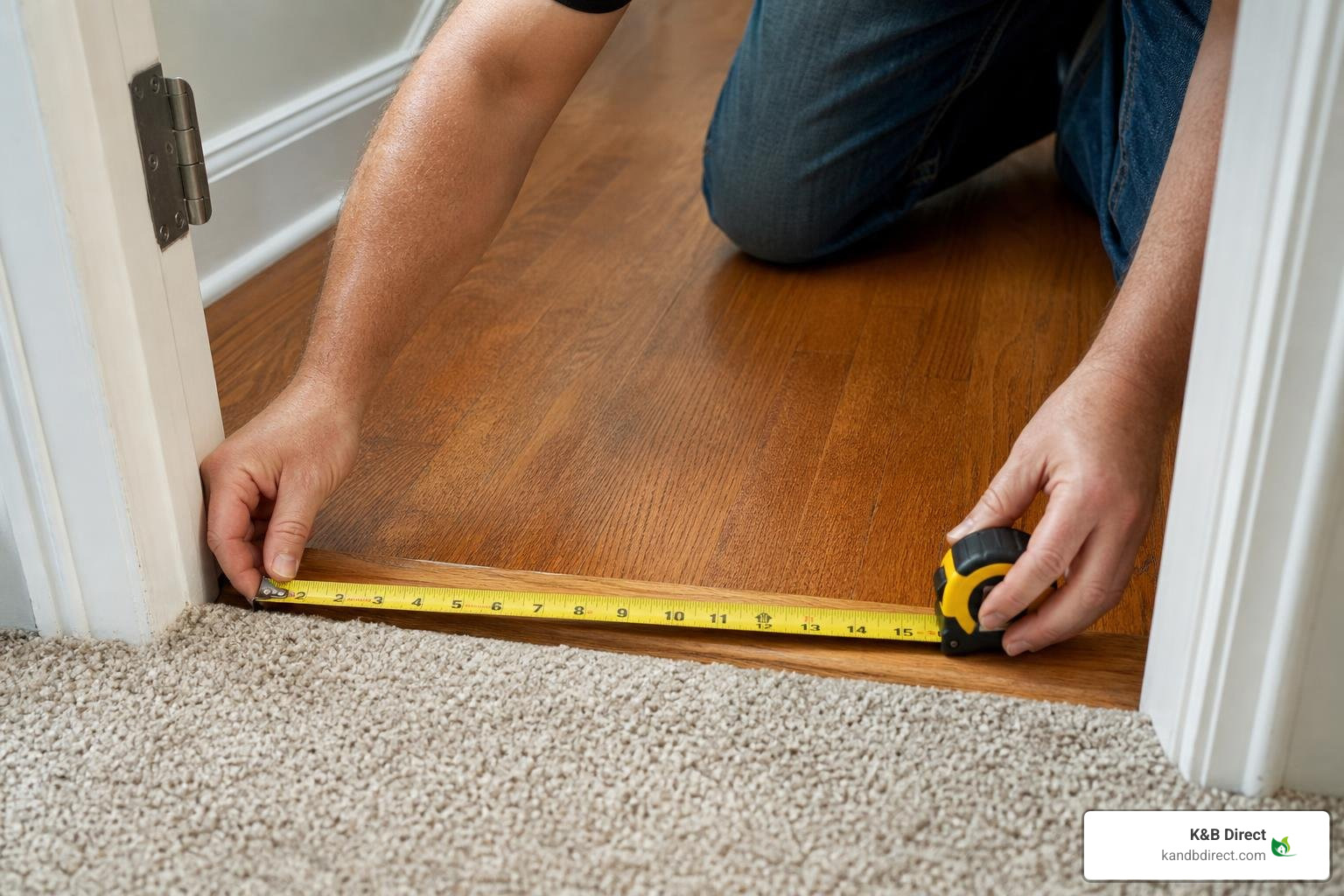
Before purchasing any trim, accurate measurements are essential. You must account for the doorway width, the height difference between the two floors, and the overall color scheme of the space to ensure a perfect match. For a broader understanding of how these elements coordinate, our Baseboard Moulding Guide offers valuable design principles.
Carpet to floorboards trim length selection
To determine the correct length, measure the clear distance of your doorway threshold at three different points and use the smallest measurement. Use a straight tape measure to ensure precision.
Standard transition strips are widely available in 36-inch, 72-inch, and 144-inch lengths, while flexible PVC often comes in long coils. Always leave a tiny bit of trimming allowance to ensure a tight, custom fit. A quick dry fit before final installation will confirm that your door clears the top of the trim.
Width selection for carpet grippers and uneven floors
The width of your transition strip is just as important as its length. Standard widths include 30 mm, 38 mm, and 55 mm profiles. If you are transitioning from a standard fitted carpet, the trim must be wide enough to completely cover the carpet gripper teeth and the underlay.
- 30 mm Width: Best for low-profile, stick-down carpets or vinyl where no carpet gripper is present. It handles height changes up to 4 mm.
- 38 mm Width: The standard choice for fitted carpets, easily covering the gripper strip and managing height differences up to 6 mm.
- 55 mm Width: Ideal for bridging larger height changes (up to 8 mm or 11 mm) or covering worn, fraying carpet edges.
If the height gap is exceptionally large, you can install a sloped shim or ramp under a wider cover plate to create a gentle, invisible incline.
Color and finish matching for carpet, floorboards, and room trim
For a cohesive look, coordinate the color of your transition strip with your existing flooring and wall trim. If you have dark floorboards and a neutral gray carpet, a matte black finish or a satin brass bar—like the Premier Cover Carpet Bar in Black from Stair Heaven—can create a stunning, modern focal point.
Alternatively, if you prefer a traditional look, matching an unfinished oak strip to the wood tones of your floorboards keeps the transition subtle. For those who want to tie the floor elements directly into the walls, matching your transition colors with your Molding And Baseboards creates a beautifully framed room.
Installing Self-Adhesive Floor Transition Trim for a Strong Bond
Self-adhesive transition strips are a fantastic, renter-friendly choice because they require no drilling into the subfloor. However, the longevity of a peel-and-stick strip depends entirely on proper surface preparation and adhesive activation. To avoid a loose, lifting edge, follow these steps to secure a permanent bond.
Surface preparation before placement
The secret to a strong adhesive bond is a pristine substrate. Any dust, loose carpet fibers, or moisture under the strip will cause the glue to fail.
- Clear the area thoroughly using a vacuum to remove all dust and debris from the edge of the carpet and the floorboards.
- Wipe down the hard floorboards, tile, or laminate surface with a dry microfiber cloth and a mild degreasing cleaner to remove any oils.
- Ensure the entire threshold is completely dry before proceeding.
- Trim away any loose, fraying carpet threads so they do not get caught under the adhesive backing.
For more insights on adhesive performance on different trims, check out our guide on A Sticky Situation For Your Baseboard Glue.
Cutting the strip to exact doorway length
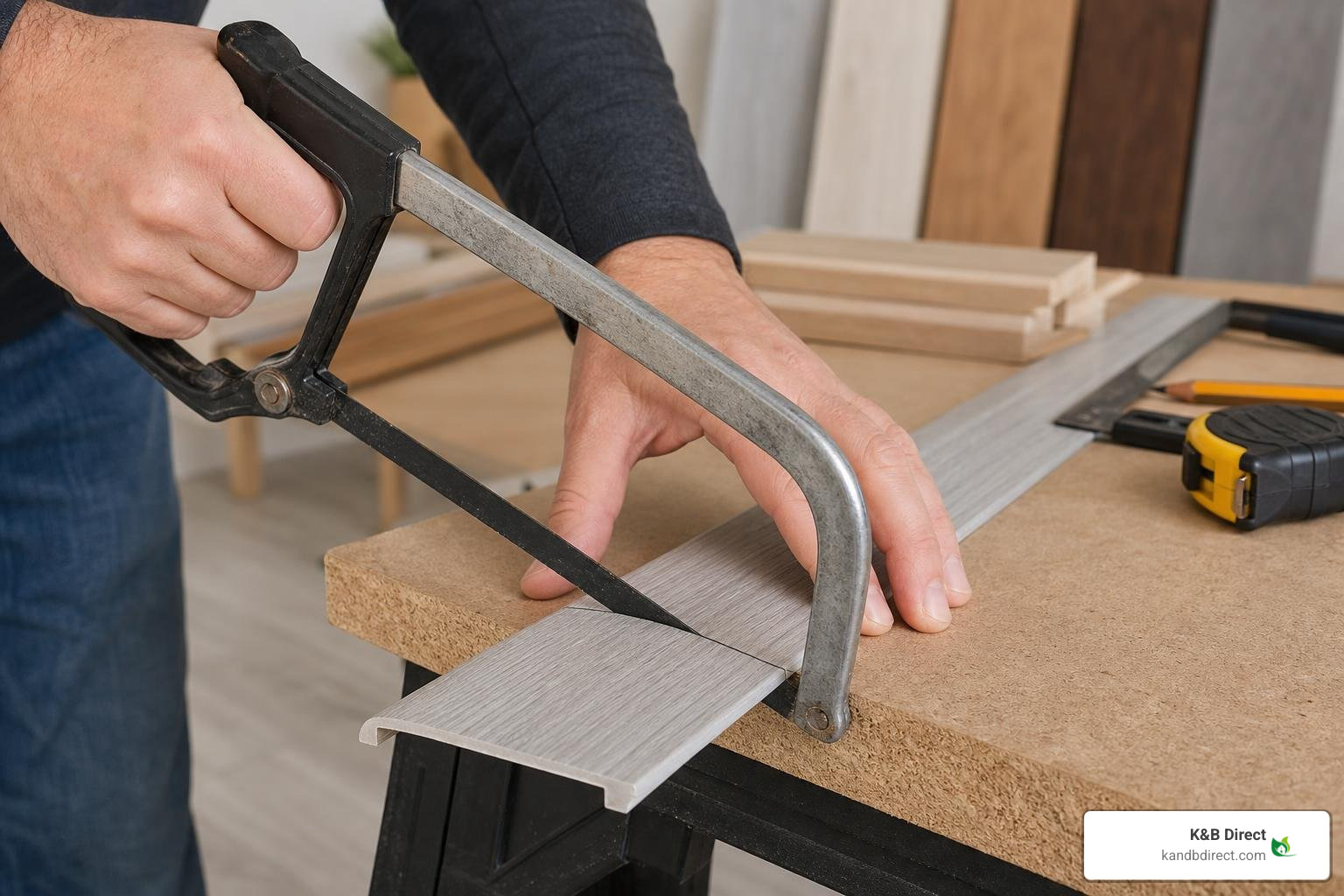
Achieving a clean, professional cut prevents gaps at either end of your doorway.
- Measure the doorway width twice to be absolutely certain of the length.
- Mark a straight line on the transition strip. For metal or wood trims, placing a piece of masking tape over the area before marking helps prevent the blade from slipping and protects the finish.
- Use the correct tool for the job:
- For PVC, a utility knife or heavy-duty shears will make a clean cut.
- For wood, use a fine-tooth saw and a miter box to keep the cut perfectly square. You can learn more about managing trim angles in our guide on cutting baseboard.
- For aluminum or brass, use a hacksaw.
- If cutting metal, use a metal file to smooth down any sharp burrs left after cutting.
Adhesion tips that improve longevity
To ensure your self-adhesive strip stays firmly in place under heavy foot traffic, follow these professional installation tips:
- Apply Heat: Before peeling off the backing tape, use a hair dryer to gently warm the adhesive on the underside of the strip. Warming the adhesive softens it and significantly increases its initial bonding strength.
- Press Firmly: Position the strip carefully, peel away the backing, and press down firmly across the entire length. Use your body weight or a hand roller to ensure full-contact bonding.
- Let it Cure: Avoid walking over the new transition strip for at least 24 hours. Placing a few heavy books on top of the strip while it cures will help lock the bond in place.
Limits, Surface Compatibility, Reviews, and Common Problems
While self-adhesive PVC and light metal strips are incredibly convenient, they are not a universal solution for every flooring scenario. Understanding their limitations will help you avoid installation failures.
Maximum height difference for self-adhesive strips
Most thin, self-adhesive PVC transition strips are designed for threshold height differences of less than 5 mm. Because these profiles are relatively flat and thin, attempting to force them over a taller lip will leave one side of the adhesive suspended in the air.
This lack of contact causes the strip to lift, creating a major trip risk. If you are dealing with a significant drop between rooms, you must use a dedicated reducer ramp or a screw-fixed threshold plate supported by a subfloor shim.
Compatible surfaces beyond carpet and floorboards
These versatile transition strips can be used on a variety of hard surfaces, making them excellent for connecting:
- Carpet to tile transitions
- Hardwood floorboards to laminate
- Vinyl planking to marble-look thresholds
However, always check the manufacturer’s guidelines regarding surface compatibility. For instance, while these strips work beautifully on sealed wood and painted surfaces, they should never be used near high-heat areas like stovetops unless specifically rated for heat exposure.
Self-adhesive strips versus screw-in and glue-down thresholds
While peel-and-stick options are incredibly easy to install, traditional screw-in or glue-down thresholds offer superior longevity in high-traffic commercial environments or busy family homes.
- Self-Adhesive Limits: Over time, consistent foot traffic, moisture from mopping, and seasonal temperature shifts can cause the adhesive to dry out and lift.
- Floating Floor Concerns: Floating laminate or engineered wood floors must be allowed to expand and contract. Pinning them down with a heavy glued or screwed transition can cause buckling.
- Underfloor Heating Caution: If your home has underfloor heating pipes or cables running through the doorway, drilling screws into the floor is highly risky. In these cases, a self-adhesive strip or a specialized adhesive track is the safest choice.
Ratings and reviews as real-world performance signals
When shopping for transition strips, customer reviews provide invaluable real-world performance signals. For example, a popular self-adhesive PVC strip on the market currently holds a 3.9 out of 5 stars rating from 756 reviews, ranking in the top 20 of the threshold category.
Analyzing these reviews reveals that while over 100 units are bought monthly due to their ease of installation and excellent safety profile for children, some users experience lifting over time. This feedback highlights the importance of thorough surface preparation and heating the adhesive during installation to get the best possible lifespan out of the product.
Frequently Asked Questions about Carpet to Floorboards Trim
What is the main purpose of a carpet-to-floorboards transition strip?
The primary job of a transition strip is to bridge the gap between different flooring materials, protecting the exposed carpet edge from fraying and the floorboard edge from chipping. It also eliminates trip hazards, providing a smooth, safe, and visually appealing threshold between rooms.
Can self-adhesive trim replace a screw-fixed threshold?
Yes, but only for low-profile transitions with height differences under 5 mm and in areas with light-to-moderate foot traffic. For heavy-traffic zones, significant height drops, or thick fitted carpets that require a carpet gripper, a screw-fixed metal or wood threshold—like a classic black carpet bar—is much more durable.
What cutting tool is right for each material?
- PVC: A utility knife or sharp heavy-duty scissors.
- Wood: A fine-tooth hand saw or miter saw.
- Aluminum & Brass: A hacksaw with a fine-tooth metal blade.
Always secure your trim with clamps before cutting, and use a metal file to smooth any rough edges. For complex wall joints nearby, you can read our guide on cutting baseboard corners.
Conclusion
Creating a seamless transition between your cozy carpet and elegant floorboards is all about choosing the right profile, width, and material. Whether you opt for a soft, child-friendly PVC strip for a quick update, or a substantial, stainable oak trim to match your classic hardwood, the right transition keeps your home safe and your flooring protected.
At K&B Direct, we are dedicated to helping homeowners across the Chicago area—from Schiller Park and Park Ridge to Norridge, Des Plaines, and Elmhurst—find the perfect finishing touches for their spaces. We offer top-quality mouldings, doors, and trims at unbeatable, lowest possible prices, backed by our friendly, expert service.
Ready to complete your flooring project with a professional finish? Explore baseboard and trim options at K&B Direct today, or visit our showroom to find the perfect match for your home!