
What Is Ranch Style Baseboard Trim — and Is It Right for Your Home?
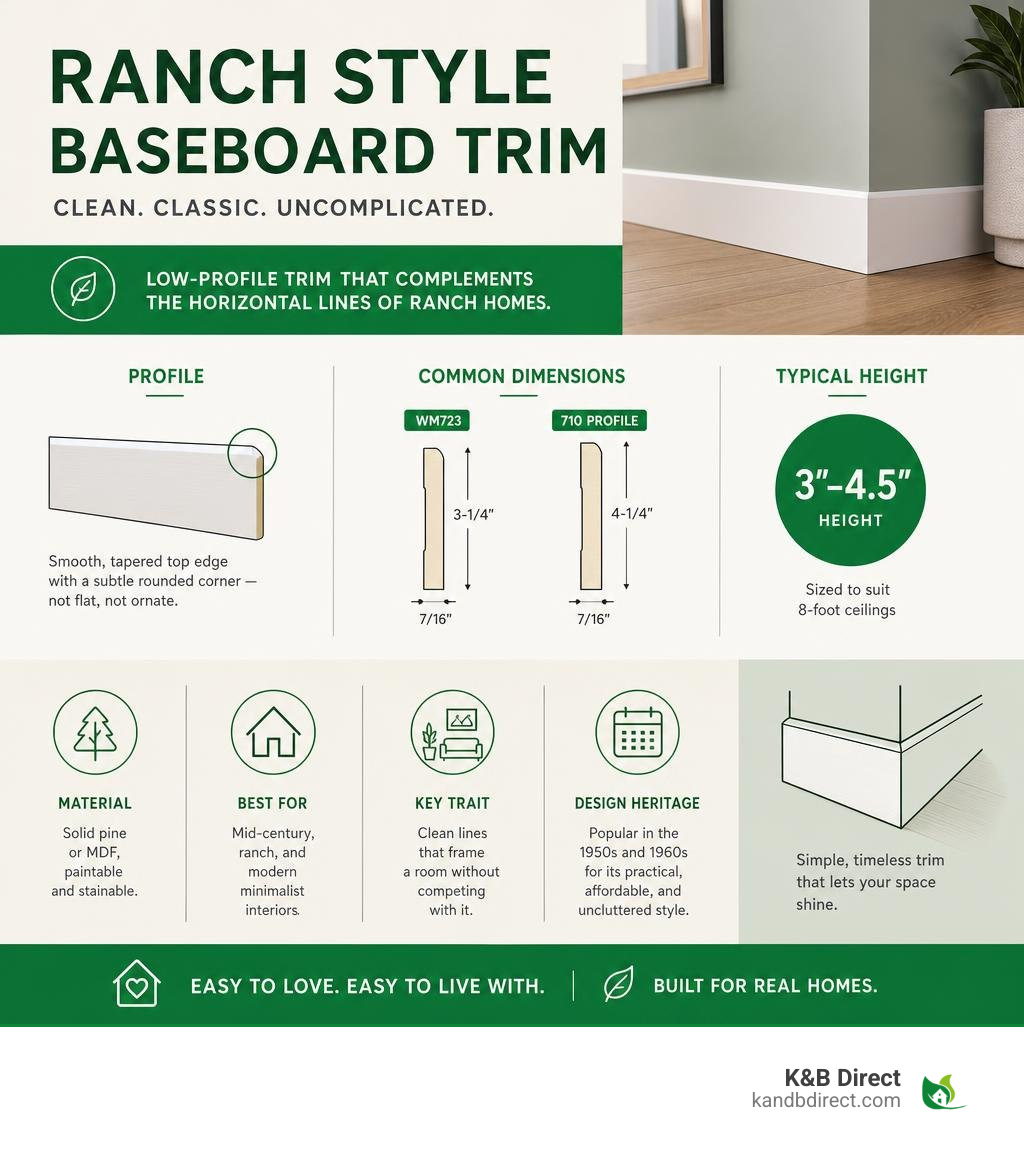
Ranch style baseboard trim is a simple, low-profile molding with a slightly tapered top edge and a clean, unfussy silhouette — designed to complement the horizontal lines and modest ceiling heights of mid-century ranch homes.
Here’s a quick overview of what defines it:
- Profile: Smooth, tapered top edge with a subtle rounded corner — not flat, not ornate
- Common dimensions: 7/16″ thick × 3-1/4″ wide (WM723) or 7/16″ thick × 4-1/4″ wide (710 profile)
- Typical height: 3 to 4.5 inches, sized to suit 96-inch ceilings
- Material: Solid pine or MDF, both paintable and stainable
- Best for: Mid-century, ranch, and modern minimalist interiors
- Key trait: Clean lines that frame a room without competing with it
Ranch trim became popular in the 1950s and 1960s because it matched the era’s design values — practical, affordable, and uncluttered. The original millwork in a 1957 ranch home is often exactly what people picture when they hear the term today.
It’s not flashy. That’s the whole point.
I’m Eryk Piatkowski, owner of K&B Direct, where I’ve spent over a decade helping homeowners select the right trim, cabinets, and finishing details — including ranch style baseboard trim — to pull their spaces together with confidence. In the sections below, I’ll walk you through everything you need to know to choose, style, and upgrade ranch baseboards the right way.
Quick look at ranch style baseboard trim:
Defining Ranch Style Baseboard Trim: Key Characteristics and Profiles
To understand the enduring appeal of this specific molding, we must look at the architectural shift of the mid-20th century. When ranch homes began popping up across Chicago suburbs like Park Ridge, Elmhurst, and Schaumburg in the 1950s, they brought a completely new layout. Gone were the formal, vertically oriented rooms of Victorian and Colonial designs. Instead, families embraced sprawling, horizontal, open-concept living spaces.
The interior millwork had to adapt to this horizontal landscape. Heavy, multi-tiered Victorian moldings felt completely out of place under the typical 96-inch ceilings of these new homes. The solution was a streamlined, low-profile trim that protected the plasterboard while maintaining clean visual lines.
This design is defined by a highly specific shape: a flat back that sits flush against the wall, transitioning into a smooth, tapered front face that thins out toward the top. The top edge is finished with a soft, rounded corner rather than a sharp angle or a complex decorative bead. This subtle curve prevents dust accumulation and creates a soft shadow line along the wall.
When exploring molding and baseboards for a mid-century or contemporary home, this profile stands out for its lack of pretense. It does not try to be the focal point of the room. Instead, it serves as a quiet frame, grounding the walls and allowing your furniture, flooring, and views to take center stage.
Comparing Ranch Style Trim to Other Popular Profiles
Selecting the ideal trim requires understanding the visual language of different profiles. The way a baseboard is shaped dictates the entire mood of a room. Let’s compare the classic ranch profile with three other dominant interior styles.

Craftsman Style
Craftsman trim is defined by straight lines and sharp, 90-degree edges. Typically constructed from S4S (Surfaced 4 Sides) flat stock, Craftsman baseboards are rectangular and substantial, often measuring 4.5 to 5.5 inches in height. While ranch trim gently tapers away to blend into the wall, Craftsman trim stands proud, casting a distinct, bold shadow. It emphasizes honest joinery and structural presence, making it a wonderful match for bungalows, but sometimes too heavy for low-ceilinged ranch layouts.
Colonial Curves
Colonial trim is steeped in traditional architecture. It features a series of elegant, sweeping curves, beads, and ogee profiles. These moldings are designed to mimic classical plasterwork and are highly ornate. While gorgeous in a traditional two-story home in Glenview or Oak Park, these busy profiles often clash with the relaxed, horizontal nature of a mid-century ranch.
Modern Minimalist
Modern trim takes simplicity to the absolute extreme. It often consists of thin, completely flat boards with absolutely no curves or tapers, or even recessed shadow-line reveals built directly into the drywall. While ranch trim shares a minimalist spirit, its soft, tapered upper edge makes it feel warmer and more inviting than the clinical, sharp lines of ultra-modern designs.
| Trim Style | Top Edge Profile | Visual Weight | Architectural Vibe | Best Ceiling Heights |
|---|---|---|---|---|
| Ranch | Smooth, tapered curve | Light to Medium | Mid-Century Modern, Relaxed | 96 inches |
| Craftsman | Flat, rectangular profile | Heavy | Mission, Bungalow, Arts & Crafts | 96 to 108 inches |
| Colonial | Multi-curved ogee | Medium to Heavy | Traditional, Formal, Historic | 108 inches and Taller |
| Modern | Sharp 90-degree or recessed | Minimal | Contemporary, Industrial | Any Height |
For a deeper dive into these differences, you can check out our best trim for house styles a comprehensive comparison guide to find the exact match for your home’s architectural era.
Selecting the Right Dimensions and Materials for Your Home
Achieving a balanced look is entirely about scale and material performance. If your baseboards are too short, they look like an afterthought; if they are too tall, they can make your ceilings feel low and oppressive.

To find the perfect balance for your space, explore our selection of baseboard trim.
Standard Dimensions of Ranch Style Baseboard Trim
The classic ranch baseboard is available in two highly standardized industry profiles:
- The WM723 Profile: This is the most common historic size. It measures exactly 7/16 inches in thickness by 3-1/4 inches in height. It offers a very low-profile, subtle border that is perfect for smaller bedrooms and halls.
- The 710 Profile: For those who want a slightly more substantial presence without losing the classic shape, this profile measures 7/16 inches thick by 4-1/4 inches in height.
A fantastic guideline for choosing your trim height is the one-tenth rule. This rule suggests that your baseboard height should represent roughly one-tenth of your overall ceiling height. For standard 96-inch ceilings, a baseboard between 4 and 5 inches is mathematically ideal. Choosing a 4.5-inch ranch profile fits this ratio beautifully, grounding the room without making the walls feel short.
For more details on balancing these proportions, read about choosing the right wall trim and baseboard style to ensure your millwork complements your room’s volume.
Best Materials for Ranch Style Baseboard Trim in Humid Climates
The climate of the Chicago area varies wildly, from dry, freezing winters to incredibly humid summers. In communities near the lake like Evanston or in damp basement family rooms in Arlington Heights, selecting a stable material is critical to prevent warping, twisting, and joint separation.
- Solid Pine: Solid wood, particularly clear white pine, is a traditional choice. It is incredibly durable, holds nails beautifully, and can be stained to show off the natural grain. If you love the look of natural wood doors and want matching stained trim, solid pine is the way to go. However, natural wood expands and contracts as humidity levels shift.
- Medium-Density Fiberboard (MDF): For painted trim, MDF is an absolute champion of stability. Because it is an engineered material, it does not have a natural grain direction, meaning it will not warp, cup, or split when the summer humidity rolls in. It provides a flawlessly smooth surface for paint, ensuring your tapered ranch profile looks crisp and seamless.
For high-moisture zones like bathrooms, kitchens, and entryways, we highly recommend checking out our guide on moisture proofing your floors the ultimate guide to waterproof trim to ensure your investment stands the test of time.
Styling and Finishing Ranch Style Baseboard Trim
The way you finish your baseboards can completely transform the atmosphere of your home. Ranch trim is incredibly versatile, lending itself to both historically accurate mid-century restorations and fresh, contemporary designs.
To explore the full spectrum of options, browse our collection of wall trim.
Paint Colors and Finishes for Mid-Century Aesthetics
While bright white semi-gloss is the standard choice for modern builder homes, ranch architecture invites a bit more creativity.
If you are restoring a mid-century home, consider skipping the stark white paint. Instead, look to warm neutrals. Soft taupes, rich beiges, and warm cream tones create a gentle, sophisticated contrast against warm white walls. This technique, often called contrast trim, highlights the clean lines of the ranch profile without creating a harsh visual break.
For a bold, contemporary statement, some homeowners are painting their ranch trim in deep charcoal or satin black. This looks incredibly striking when paired with light oak or natural maple flooring, drawing a clean, graphic frame around the base of the room.
If you are working with solid wood, a warm amber or honey-toned stain can beautifully celebrate the organic mid-century modern aesthetic. To see a gorgeous real-world example of this design philosophy in action, read about selecting millwork in a mid-century red house to see the way subtle contrast trim can elevate a space.
Regardless of the color you choose, we recommend a satin or semi-gloss finish. These sheens are highly durable, easy to wipe clean from vacuum scuffs, and reflect just enough light to accentuate the soft, tapered curve of the ranch profile.
Coordinating Door Casing and Window Trim
A cohesive home relies on all trim elements speaking the same design language. If you install ranch baseboards, your door and window casings should match.
Ranch-style door casings are typically slim, measuring around 2 to 2-1/4 inches in width. They feature the exact same tapered profile as the baseboards, thinning out as they approach the door frame. This slim profile is particularly beneficial around windows because it maximizes the window area, letting in abundant natural light and keeping the focus on your outdoor landscaping.
To ensure your doors and windows align perfectly with your new baseboards, explore our options for door casing.
Upgrading and Installing Ranch Baseboards
Installing new baseboards is one of the most satisfying ways to refresh a home. It instantly cleans up the bottom of your walls, hides messy flooring edges, and protects your plasterboard from daily wear and tear.
To learn more about selecting the right pieces for your installation, check out our guide on floorboards trim.
The Taller Baseboard Hack for Existing Trim
If you currently have short, 3-inch builder-grade baseboards but do not want to go through the messy, time-consuming process of ripping them out, there is a brilliant way to add visual height.
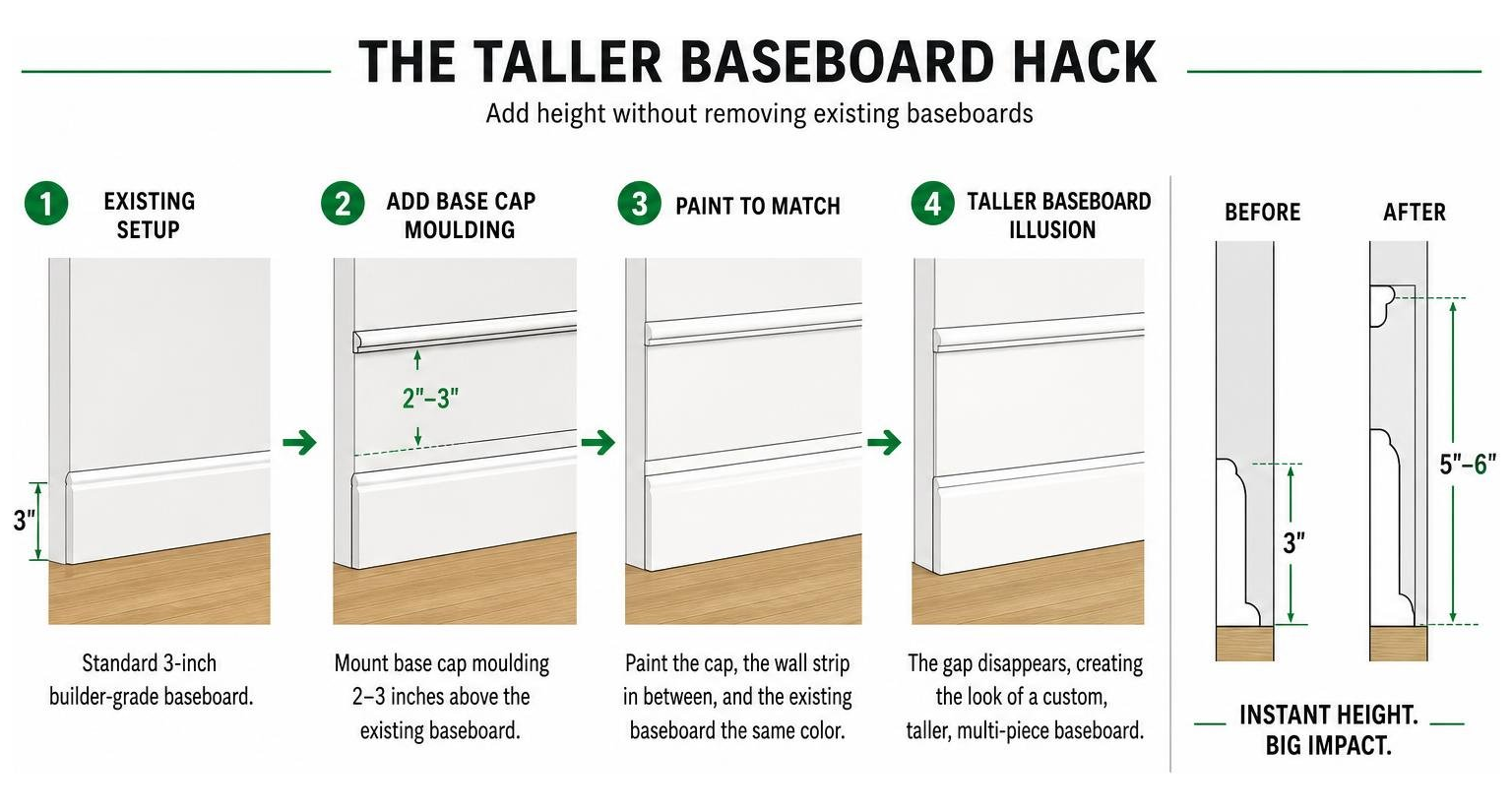
This method involves mounting a thin piece of base cap moulding roughly two to three inches above your existing baseboard. Once the cap is secured to the wall studs, you simply paint the original baseboard, the exposed strip of drywall in between, and the new top molding in the exact same trim paint.
To the naked eye, the drywall gap completely disappears, creating the illusion of a massive, custom, multi-piece baseboard. This is an exceptional way to add architectural weight to a formal dining room or entryway without a full demolition.
Managing Floor Gaps and Shoe Molding
A common dilemma when installing baseboards is deciding whether to add shoe molding or quarter round along the bottom edge.
If you are laying brand new, perfectly level hardwood floors, you can often rest the baseboards flush against the flooring for an incredibly clean, modern look. However, older homes in neighborhoods like Maywood or Niles often have slightly uneven floors.
Additionally, floating floors require a small expansion gap around the perimeter of the room to allow the wood to expand and contract with the seasons. To cover these gaps and hide any uneven dips in the floor, installing a matching 2 piece base molding system using a low-profile shoe mold is the perfect solution.
Frequently Asked Questions About Ranch Style Baseboard Trim
Can you skip shoe molding with ranch baseboards?
Yes, you can absolutely skip shoe molding if your subfloor is perfectly level and your flooring material does not require a large perimeter expansion gap. This results in a cleaner, more contemporary aesthetic that highlights the simple lines of the ranch profile. However, if you have older, uneven hardwood floors or are installing a floating laminate floor, adding a slim, matching shoe molding is highly recommended to cover gaps and ensure a polished finish.
What is the difference between ranch and Craftsman baseboards?
The primary difference lies in the profile shape and visual weight. Ranch style baseboard trim features a smooth, tapered front face that thins out toward the top with a soft, rounded corner. It is designed to blend gently into the wall. Craftsman baseboards, on the other hand, are completely flat with sharp, 90-degree edges. They are typically thicker and taller, standing proud of the wall to make a bold, structural statement.
What ceiling heights work best with ranch trim?
Ranch trim was specifically designed for standard 96-inch ceilings. Because of its low-profile, tapered design, it grounds the room beautifully without cutting into the vertical height of the walls. However, it also works wonderfully in modern homes with 108-inch ceilings when you choose the slightly taller 4-1/4″ (710) profile. For ceilings taller than 120 inches, we generally recommend moving to a more substantial, multi-piece trim system to maintain proper proportions.
For more expert advice on selecting the perfect trim for your home, explore the ultimate guide to molding and baseboards.
Conclusion
Ranch style baseboard trim remains a beloved choice for homeowners who appreciate clean, classic, and uncomplicated design. Whether you are lovingly restoring a mid-century home in Schaumburg, updating a cozy ranch in Bensenville, or building a modern minimalist space in Oak Brook, this profile offers a timeless frame that lets your home’s personality shine.
At K&B Direct, we are dedicated to helping you realize your dream home aesthetics. We offer a wide selection of high-quality mouldings, doors, windows, and cabinets at unbeatable, lowest possible values with friendly, local service.
Ready to find the perfect trim for your next project? Explore our full range of options in our baseboard category or visit us to speak with our team today!