
Understanding Flat MDF Baseboard and Its Profiles
Flat MDF baseboard is a smooth, factory-primed trim piece installed along the base of interior walls. It has a completely flat front face — no curves or carved details — and is made from medium density fiberboard (MDF), an engineered wood product.
Quick answer: Is flat MDF baseboard a good choice?
- Paint-ready — factory primer means it’s ready for your topcoat right away
- Stable and consistent — no knots, grain, or resin bleed under paint
- Versatile style — works in modern, minimalist, and transitional interiors
- Lightweight — easier to handle and install than solid wood
- Avoid in wet areas — not suitable for bathrooms or high-humidity spaces
It covers the gap between your flooring and wall, protects the lower wall from scuffs and furniture, and gives any room a clean, finished look. Because it accepts paint so well and comes at a lower material investment than solid hardwood, it’s become one of the most popular trim choices in residential renovations and new builds alike.
But is it the right choice for your project? That depends on your room, your style, and how you plan to finish it.
I’m Eryk Piatkowski, owner of K&B Direct, and after more than a decade helping homeowners select quality products for their renovations — including flat MDF baseboard for kitchens, hallways, and living spaces — I know exactly where this material shines and where it falls short. Let’s walk through everything you need to know to make the right call.
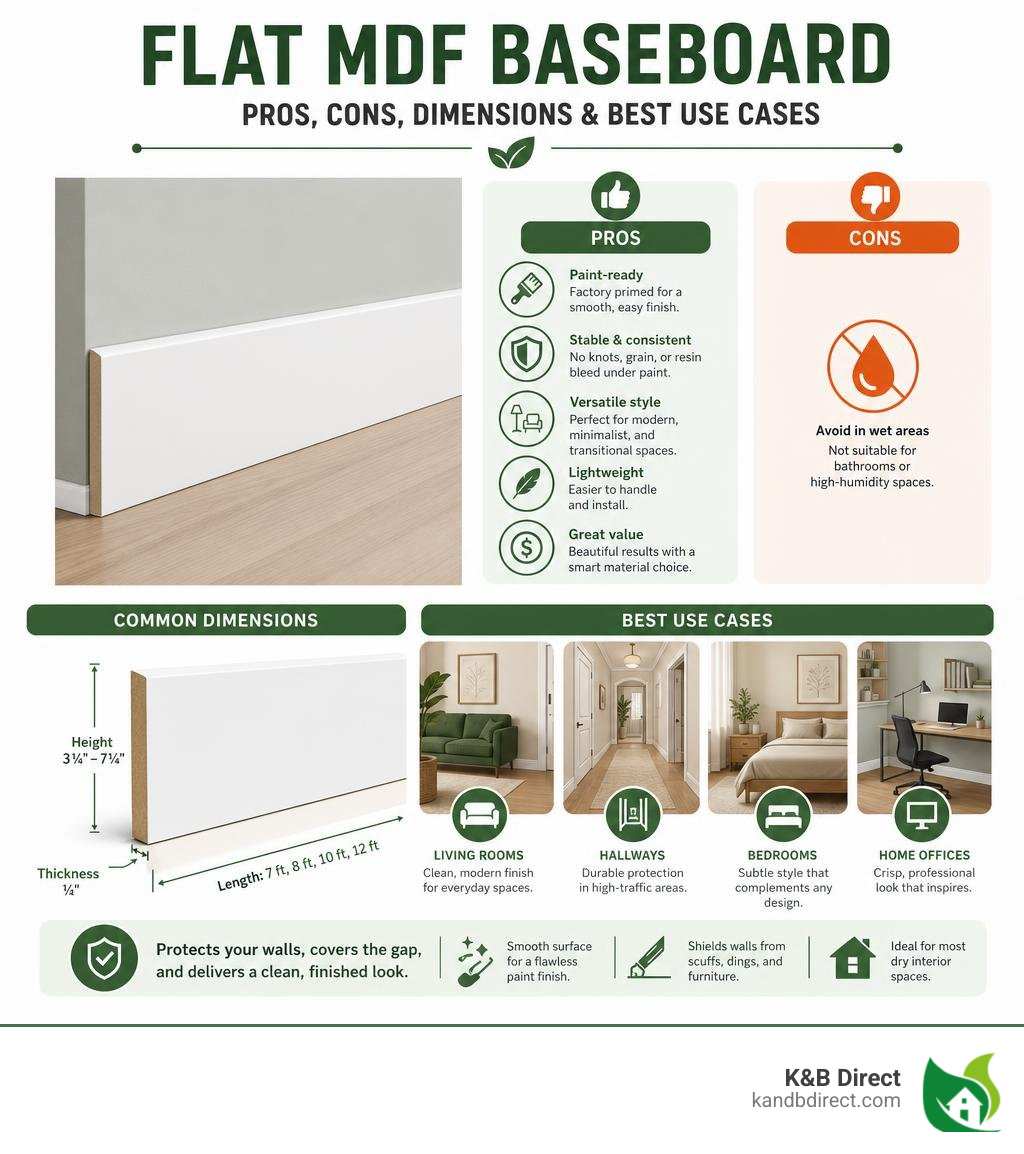
Flat mdf baseboard terminology:

When planning an interior renovation in the Chicago metropolitan area — whether updating a classic bungalow in Park Ridge or finishing a sleek modern condo in Schaumburg — selecting the correct trim profile is essential. The trim acts as the visual anchor for every room, establishing the architectural tone.
What is a Flat MDF Baseboard?
A flat MDF baseboard is characterized by its simple, rectangular cross-section. Unlike traditional mouldings that feature ornate curves, this profile offers a clean, unembellished surface. It typically features a slightly eased top edge — meaning the very top corner is gently rounded or chamfered rather than being a sharp 90-degree angle — which prevents splintering and allows paint to cling more effectively.
On the reverse side, high-quality flat MDF profiles often incorporate a grooved back. These shallow channels running along the backside of the board relieve tension within the material, permitting slight flexibility so the trim can conform to minor irregularities in your drywall. To gain a deeper understanding of this specific configuration, you can read Everything You Need to Know About 5 1/4 Inch Flat Baseboards.
Comparing Flat Profiles to Traditional Moulding
Traditional profiles, such as the classic ogee or the stepped Coronado profile, rely on shadow lines and intricate contours to draw the eye. While those designs excel in Victorian or highly formal colonial estates, they can clutter a contemporary space.
Flat profiles shift the focus to clean lines and structural simplicity. For example, if you compare a traditional profile like the 1866 9/16 in. x 5 1/4 in. x 96 in. Primed MDF Baseboard Moulding (1 … to a completely flat profile, the flat option offers a much more streamlined transition from wall to floor. If you want to explore different design aesthetics, you can Explore K&B Direct’s Baseboard Selection to find the perfect match for your home.
Key Advantages of Choosing Flat MDF Trim

Engineered wood products have revolutionized the building industry. For homeowners in Elmhurst, Glenview, and Oak Park, choosing MDF over solid lumber offers several distinct performance advantages.
Aesthetic Versatility in Modern Design
The minimalist movement has made the flat MDF baseboard a staple of modern design. Its lack of ornamentation allows it to blend seamlessly into the background, making rooms feel larger and less cluttered. It provides excellent wall protection against vacuum cleaners and stray toys without dominating the visual landscape. To see why this profile has captured the attention of top designers, take a look at Why 4 Inch Flat Baseboards Are the Unsung Heroes of Modern Design.
Material Stability and Performance
Solid wood trim is beautiful, but it is subject to the whims of nature. It contains knots, sap pockets, and natural grain patterns that can expand, contract, or bleed through a finished paint coat over time.
MDF is manufactured by combining fine wood fibers with synthetic resins under intense heat and pressure. This process yields a material with uniform density and no grain structure. It is highly resistant to splitting when nailed and will not warp or twist like solid lumber. For a comprehensive look at how these material characteristics impact your entire home, check out The Ultimate Guide to Molding and Baseboards.
Standard Dimensions and Sizing Options
Selecting the proper size of your flat MDF baseboard is critical to achieving a balanced look. The thickness and height of your trim must complement your room’s overall scale.
| Ceiling Height | Recommended Baseboard Height | Common Thickness Options |
|---|---|---|
| 8 feet (96 inches) | 3-1/2 inches to 4-1/2 inches | 1/2 inch, 9/16 inch |
| 9 feet (108 inches) | 4-1/2 inches to 5-1/2 inches | 1/2 inch, 9/16 inch, 5/8 inch |
| 10+ feet (120+ inches) | 5-1/2 inches to 7-1/4+ inches | 5/8 inch, 11/16 inch |
Selecting the Right Height for Your Ceilings
A common design mistake is installing trim that is either too short or too tall for the room. In homes with standard eight-foot ceilings, a 3-1/2 inch to 4-1/2 inch profile keeps the room feeling open. For grander spaces with ten-foot ceilings, such as those found in historic homes in Evanston or newer builds in Arlington Heights, a taller profile of 7-1/4 inches or more establishes a grounded, upscale presence.
To explore how thickness and height interact to create visual depth, read through Don’t Get Board: Choosing Your Next MDF Trim Size and Size Matters When Picking Your 1/2 Inch Trim.
Common Lengths of Flat MDF Baseboard
MDF baseboards are typically available in lengths ranging from 8 feet (96 inches) up to 16 feet (192 inches). Opting for longer 16-length pieces is highly advantageous because it significantly reduces the number of joints along a single wall, creating a smooth, unbroken appearance.
You can find excellent examples of these long-form options by looking at MDF Baseboard 1/2″ x 3-1/2″ x 16′ | Licari Tile & Home or exploring the options outlined in The Ultimate Roundup: 10, 12 and 16 Foot Baseboard Moulding Options.
Installation and Finishing Best Practices
Achieving a flawless finish with flat MDF baseboard requires careful attention to detail during both the cutting and fastening stages.
Proper Nailing and Joint Techniques
Because MDF lacks a natural grain, it behaves differently than solid wood when cut. We recommend using a high-tooth-count miter saw blade to prevent fuzzy edges.
When securing the boards to your walls:
- Locate the studs using a reliable finder.
- Drive 2-inch finish nails through the trim and drywall directly into the studs, spacing your fasteners approximately 16 inches apart.
- For inside corners, execute a coped joint rather than a basic miter. Coped joints fit together tightly and resist opening up during seasonal humidity shifts — a common issue in Chicago-area homes during our cold winters and humid summers.
- For outside corners, use a standard miter joint reinforced with quality wood glue.
For a detailed walkthrough of these joint techniques, consult Everything You Need to Know About 5 1/4 Inch Flat Baseboards.
Painting and Sealing MDF
MDF is incredibly receptive to paint, but it must be handled correctly. Most MDF trim comes factory-primed, which saves a tremendous amount of preparation time. However, any freshly cut edges will expose the porous inner core of the board.
Before painting, seal all raw cut edges with a quality primer. Once the trim is installed and the nail holes are filled with paintable wood filler and sanded smooth, apply two coats of premium interior latex paint. A semi-gloss or satin finish is ideal for trim because it stands up to frequent cleaning and highlights the clean, modern lines of the flat profile. For more tips on finishing flat profiles, see Why 4 Inch Flat Baseboards Are the Unsung Heroes of Modern Design.
Frequently Asked Questions About Flat MDF Trim
Can MDF Baseboards Be Used in Bathrooms?
We strongly advise against installing standard MDF baseboards in bathrooms, powder rooms, or any area prone to standing water and high humidity. While MDF is moisture-resistant to a degree, direct contact with water will cause the wood fibers to swell irreversibly. For bathrooms, it is far better to utilize alternative materials like solid wood (such as cedar or hemlock) or synthetic PVC and vinyl options that are entirely waterproof.
What Are the Best Alternatives to MDF Trim?
If you desire a different material or look, several excellent alternatives exist:
- Finger-Jointed Pine: Offers the feel of real wood but is pre-assembled from smaller pieces to minimize warping.
- Hardwoods (Oak, Maple, Poplar): Outstanding durability and the only choice if you plan to stain your trim rather than paint it.
- PVC/Vinyl: Completely impervious to water, making them perfect for basements and laundry rooms.
To learn more about solid wood alternatives, read Primed for Perfection: Everything You Need to Know About 1×12 Pine.
What Tools Are Needed for Installing MDF Moulding?
To complete your trim installation successfully, gather the following tools:
- A miter saw with a fine-tooth blade
- A pneumatic or battery-powered finish nailer
- 2-inch finish nails
- Quality wood glue and paintable wood filler
- Fine-grit sandpaper (220-grit works best)
- High-quality paintbrushes and painter’s tape
Conclusion
Selecting the right trim is a small decision that makes a massive impact on your home’s finished look. A flat MDF baseboard delivers a clean, modern aesthetic, exceptional stability, and an excellent surface for painting.
At K&B Direct, we are dedicated to helping our neighbors in Schiller Park, Franklin Park, Bensenville, and across the entire Chicago area find top-quality mouldings, doors, and cabinets to bring their dream homes to life. When you are ready to select the perfect trim for your next project, Explore K&B Direct’s Baseboard Selection or stop by to speak with our friendly team. We are always here to help you achieve beautiful results.